
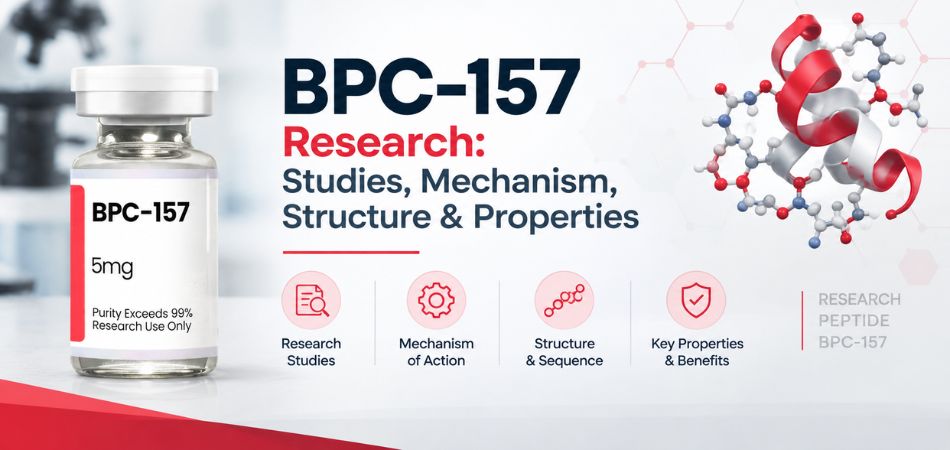
BPC-157 research examines a synthetic 15-amino-acid peptide in models of tissue response, vascular signaling, and gastrointestinal biology. Scientific interest comes from reported effects on cell migration, survival under stress, angiogenesis-related processes, and repair-associated outcomes in experimental systems.
The useful question is not simply whether BPC-157 is described as a “healing peptide.” It is what was studied, which response changed, and how closely that experiment relates to the conclusion being drawn.
This guide provides a broad overview of BPC-157 identity, investigated pathways, gastrointestinal research, and relevant Hotspan research materials. For study-by-study evidence and human-research limitations, use our BPC-157 studies guide. Laboratory materials remain separate from clinical-study formulations and personal treatment claims.
What Is BPC-157?
BPC-157 is a synthetic pentadecapeptide, meaning it contains 15 amino acid residues. The name is commonly expanded as Body Protection Compound-157, and much of its research history is associated with gastric cytoprotection and experimental tissue responses.
The synthesized research material should be evaluated through its actual molecular identity and specifications. A familiar compound name does not, by itself, establish the peptide’s sequence, chemical form, purity, or suitability for a particular assay.
It is also helpful to distinguish the compound from a biological outcome. BPC-157 is a molecule, while “recovery,” “repair,” and “gut health” describe broad subjects containing many possible endpoints. Researchers may measure cell movement, tissue morphology, biochemical markers, mechanical strength, or symptoms. Those are different observations.
Understanding the chemical identity provides the starting point. For sequence notation and the associated reference specifications, see Hotspan’s BPC-157 molecular structure guide. Structural information helps identify the material; experimental studies are needed to investigate what it does.
Which Mechanisms Are Being Investigated?
Tendon Fibroblast Migration and Survival
A 2011 study by Chang and colleagues investigated rat Achilles tendon explants and cultured tendon fibroblasts. Researchers reported enhanced explant outgrowth, increased cell migration and spreading, and improved cell survival under an oxidative-stress challenge. They also examined FAK and paxillin signaling.
An important detail is that the 2011 tendon study did not find a direct increase in basal proliferation of the cultured tendon fibroblasts. The results therefore support a specific description of migration, outgrowth, and stress survival—not a blanket statement that every repair-related cell grows faster.
These are useful cellular and tissue-explant findings. They help researchers investigate processes relevant to tendon biology, but the endpoints are not the same as a measured recovery time for an injured person.
Endothelial and Vascular Signaling
Endothelial research has examined angiogenesis-related responses, including an FBXO22–BACH1 interaction reported in a 2026 experimental study. These findings concern specific cell and preclinical injury models; they do not establish one universal BPC-157 mechanism or a clinical outcome. For the pathway evidence and its limitations, see our BPC-157 mechanism of action guide.
How Should the Research Evidence Be Interpreted?
BPC-157 research includes cell experiments, animal models, ex vivo human-tissue experiments, and small uncontrolled human reports. These are different forms of evidence and should not be treated as equivalent.
The largest body of literature remains preclinical. Systematic reviews can organize experimental findings, but they do not overcome the shortage of controlled human research. Likewise, small pilot reports cannot establish long-term safety or clinical effectiveness.
For detailed study summaries, including orthopedic research, human pilot reports, pharmacokinetics, and safety, see our BPC-157 studies guide. When evaluating a new report, check its model or population, control group, exact study material, measured endpoint, follow-up, and whether the conclusion matches the design.
How Does BPC-157 Gut Research Fit In?
Gastrointestinal research examines gastric cytoprotection, mucosal integrity, epithelial responses, blood-vessel function, and experimentally induced injury models. These endpoints should not be combined into a general claim of “gut healing” or assigned to every human gastrointestinal condition.
For the review evidence and model-specific limitations, see our BPC-157 gut and intestinal-barrier research guide.
Which Relevant Research Products Does Hotspan Offer?
Hotspan lists a standalone BPC-157 product and a BPC-157 + TB-500 blend. These are two directly relevant catalog examples, but they represent different experimental materials.
| Catalog product | Research-selection question |
|---|---|
| BPC-157, listed in 5 mg and 10 mg vial formats | Does the project require BPC-157 as the single named peptide? |
| BPC-157 + TB-500 blend | Does the design require a defined combination and appropriate individual-component controls? |
Research-use distinction: Hotspan supplies these materials strictly for in vitro laboratory research, not for human or animal administration. A catalog name, product image, or published clinical report does not establish equivalence between the supplied material and a clinical-study formulation.
Standalone BPC-157
A single-compound material can be relevant when researchers need to attribute an observed response to BPC-157 rather than to several ingredients. It can also serve as an individual-component comparison in a carefully designed mixture experiment.
Hotspan’s BPC-157 research product is listed in two vial-amount options. These are declared catalog formats, not personal-dose recommendations. The appropriate amount for procurement follows the laboratory’s experimental requirements and the material’s documented specifications.
BPC-157 With an Additional Research Peptide
A mixture addresses a different question: does adding another defined component change the response compared with each material studied alone? Useful experiments may therefore include vehicle controls, individual components, and the combination, with predefined outcomes and an appropriate analysis.
The existence of different proposed pathways does not, on its own, establish synergy. It is also important to confirm the additional component’s exact molecular identity rather than assume that every product using a familiar peptide label matches every publication associated with that name.
Hotspan’s BPC-157 + TB-500 research blend is an option to evaluate for such combination questions. Findings from a standalone BPC-157 paper should not be described as direct validation of the complete blend or as a promise of human recovery results.
What Should Researchers Check in the Product Documentation?
Identity and batch characterization are separate from biological evidence. The product pages above list purity and endotoxin report references, which provide a starting point for reviewing the actual laboratory documents.
A practical review should confirm:
- The exact compound or components named in the report.
- The batch identifier and whether it matches the material being evaluated.
- The testing date and analytical methods.
- What the reported purity result measures.
- The evidence supporting molecular identity.
- Which additional attributes were tested, and which were not.
A purity measurement is not automatically a sterility test, an endotoxin result, a long-term stability study, or a clinical safety assessment. Similarly, an observed response in a published experiment does not verify the identity or condition of a separately purchased vial.
For a compound-specific explanation, use Hotspan’s BPC-157 COA guide. The strongest research evaluation considers the literature, the material’s specifications, and the experimental controls together instead of asking one document to answer every question.
Frequently Asked Questions
What is BPC-157 research mainly concerned with?
Selected research examines cellular and tissue responses, tendon-related biology, vascular signaling, gastrointestinal models, and preliminary human observations. The evidence types and measured outcomes differ between these areas.
Does BPC-157 have one fully established mechanism?
Researchers have reported several pathways and a specific FBXO22–BACH1 interaction in a 2026 experimental study. A reported molecular mechanism should not be treated as a universal explanation for every tissue model or a demonstrated human treatment effect.
Have human BPC-157 studies been published?
Yes, but the published human evidence is limited to small, uncontrolled reports. These do not establish clinical effectiveness or long-term safety. For the current evidence summary, see our BPC-157 studies guide.
What BPC-157 products does Hotspan offer for this topic?
The examples discussed here are standalone BPC-157 and a BPC-157 + TB-500 blend. The choice depends on whether the experiment concerns one compound or a defined mixture, not a universal ranking of which is better.
Does a single-compound study establish that a blend works?
No. A study of BPC-157 alone does not test every mixture containing it. The composition, component identity, controls, and measured combination response need their own evaluation.
Are Hotspan’s BPC-157 products intended for personal use?
No. These research materials are not intended for human or animal administration. Educational discussion of clinical publications does not provide a personal-use protocol or turn a laboratory product into a treatment.
Final Thoughts
BPC-157 research provides a substantial set of experimental questions, from tendon-cell behavior to endothelial signaling and gastrointestinal tissue responses. The most useful findings are those connected clearly to their model, controls, and measured endpoint.
Recent molecular work adds detail, while systematic reviews and small human reports help show where the evidence is more developed and where stronger studies are still needed. Neither promising biology nor limited clinical data should be flattened into an all-or-nothing judgment.
For laboratory researchers, Hotspan’s relevant catalog products are materials to evaluate alongside that evidence. Start with a precise question, select the appropriate compound or defined combination, and keep the literature and batch documentation in their proper roles.