
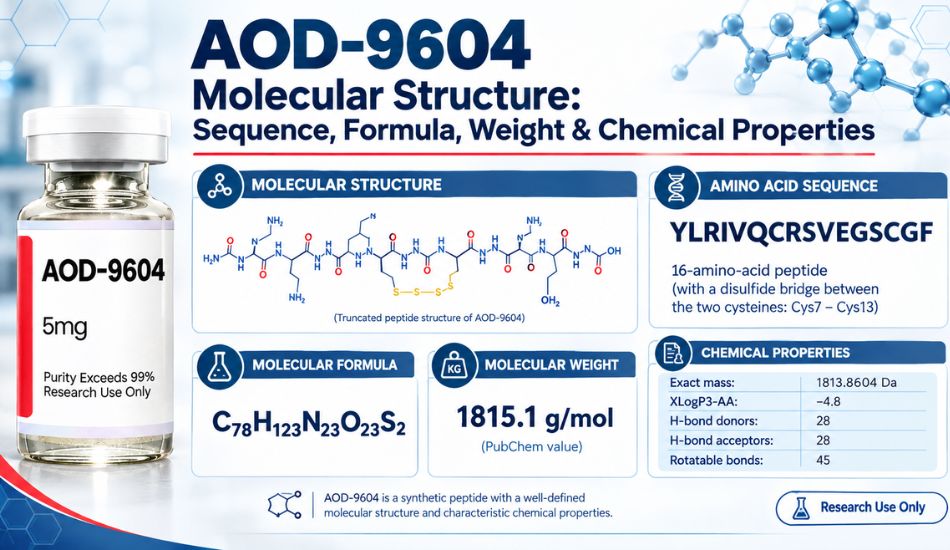
AOD-9604 is a synthetic peptide that has been studied primarily in relation to lipid metabolism and adipose-tissue research. Understanding its molecular structure helps explain how researchers identify, characterize, and study the compound.
AOD-9604 is associated with a specific region of human growth hormone, but it is not the same molecule as full-length human growth hormone. It has a substantially smaller peptide structure and a distinct molecular identity.
This article focuses specifically on the AOD-9604 molecular structure, including its amino acid sequence, molecular formula, molecular weight, disulfide bond, and analytical characterization.
For the broader scientific background, see AOD-9604 Research: Studies, Mechanism, Structure & Properties.
What Is the Molecular Structure of AOD-9604?
AOD-9604 is a short synthetic peptide consisting of 16 amino acids.
Its reported amino acid sequence is:
YLRIVQCRSVEGSCGF
The sequence provides the basic structural identity of the peptide and is important when researchers evaluate molecular composition and analytical results.
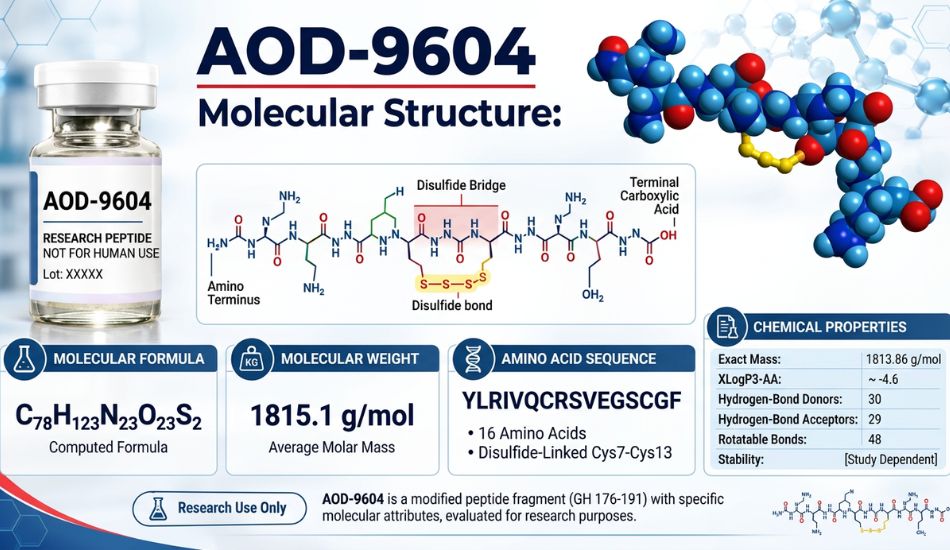
The peptide contains two cysteine residues that form a disulfide linkage. This structural feature is relevant when considering its three-dimensional conformation and chemical behavior.
AOD-9604 Amino Acid Sequence
The reported sequence of AOD-9604 is:
Tyr–Leu–Arg–Ile–Val–Gln–Cys–Arg–Ser–Val–Glu–Gly–Ser–Cys–Gly–Phe
Using the standard one-letter amino acid code, this is:
YLRIVQCRSVEGSCGF
Each amino acid contributes to the overall chemical characteristics of the peptide.
The sequence also provides an important reference point for analytical identification. When a research material is tested, the observed molecular characteristics can be compared against the expected identity of AOD-9604.
AOD-9604 Molecular Formula
The reported molecular formula for AOD-9604 is:
C78H123N23O23S2
The formula represents the elemental composition of the peptide.
It indicates the number of:
- Carbon atoms
- Hydrogen atoms
- Nitrogen atoms
- Oxygen atoms
- Sulfur atoms
present in the molecular structure.
The two sulfur atoms are associated with the cysteine residues within the peptide.
AOD-9604 Molecular Weight
The reported molecular weight of AOD-9604 is approximately:
1,815.1 g/mol
Molecular weight is an important analytical characteristic because mass spectrometry can be used to examine whether an observed molecular mass is consistent with the expected peptide.
However, the value shown in an analytical report can vary depending on the molecular form, ionization state, instrument, and analytical method.
Therefore, researchers should interpret mass-spectrometry data together with the complete analytical report rather than relying on a single numerical value.
For information about analytical documentation, see AOD-9604 COA: How to Read Purity, HPLC & Mass Spectrometry Results.
AOD-9604 Disulfide Bond
AOD-9604 contains two cysteine residues.
Cysteine residues can form a disulfide bond through their sulfur-containing side chains.
Disulfide bonds are important structural features in many peptides and proteins because they can influence molecular conformation.
For AOD-9604, this structural characteristic is also relevant when considering chemical stability and analytical characterization.
Changes involving the disulfide linkage can potentially alter the molecular form of a peptide, which is why appropriate analytical testing is important.
Why AOD-9604 Molecular Structure Matters in Research
Molecular structure is directly relevant to peptide identification and characterization.
Researchers need to distinguish the intended peptide from:
- Degradation products
- Truncated sequences
- Modified forms
- Impurities
- Aggregates
- Other peptide-related materials
The expected sequence and molecular mass provide important reference points for analytical testing.
This is why structural information should be considered alongside purity measurements.
AOD-9604 Structure and Analytical Testing
Several analytical approaches can be used to characterize peptide materials.
HPLC
High-performance liquid chromatography can separate components within a sample and provide information about chromatographic purity.
A major peak associated with the intended peptide can be evaluated alongside other detected components.
Mass Spectrometry
Mass spectrometry can provide molecular-mass information that helps researchers evaluate molecular identity.
Comparing observed and expected mass can help identify whether the material is consistent with the expected peptide.
Combined Analysis
Using more than one analytical method can provide stronger characterization than relying on a single measurement.
For example, HPLC can provide chromatographic information while mass spectrometry provides molecular-mass information.
Molecular Structure vs Purity
Molecular identity and purity are related but different concepts.
A sample can have a high reported chromatographic purity while still requiring additional information to establish its molecular identity.
Likewise, confirming molecular mass does not automatically establish that a sample is highly pure.
Researchers should therefore evaluate the complete analytical dataset.
Does Molecular Structure Determine Biological Activity?
Molecular structure is an important factor in understanding a peptide, but structural information alone does not establish biological or clinical effectiveness.
Researchers should distinguish between molecular identity, analytical characterization, biological activity, and clinical evidence. Confirming the expected sequence or molecular mass does not by itself demonstrate a biological effect.
For research on the biological mechanisms and evidence surrounding AOD-9604, see the dedicated AOD-9604 research and mechanism articles.
For this reason, researchers should distinguish between:
- Structural identity — what the molecule is
- Analytical characterization — whether the tested material is consistent with the expected molecular identity
- Biological activity — how the compound behaves in an experimental system
- Clinical evidence — what has been demonstrated in human research
AOD-9604’s molecular structure should therefore be evaluated separately from claims about biological or clinical effects.
For biological evidence, see AOD-9604 Studies: Human Trials, Preclinical Research & Evidence and AOD-9604 Mechanism of Action: Lipolysis, Adipocyte & Metabolic Research.
AOD-9604 Molecular Structure: Key Takeaway
AOD-9604 is a 16-amino-acid synthetic peptide with the reported sequence YLRIVQCRSVEGSCGF.
Its reported molecular formula is C78H123N23O23S2, with an approximate molecular weight of 1,815.1 g/mol.
The peptide contains two cysteine residues associated with a disulfide linkage, which is an important structural feature.
Understanding these characteristics helps researchers interpret analytical data, evaluate molecular identity, and distinguish structural information from claims about biological or clinical effects.
3 comments