
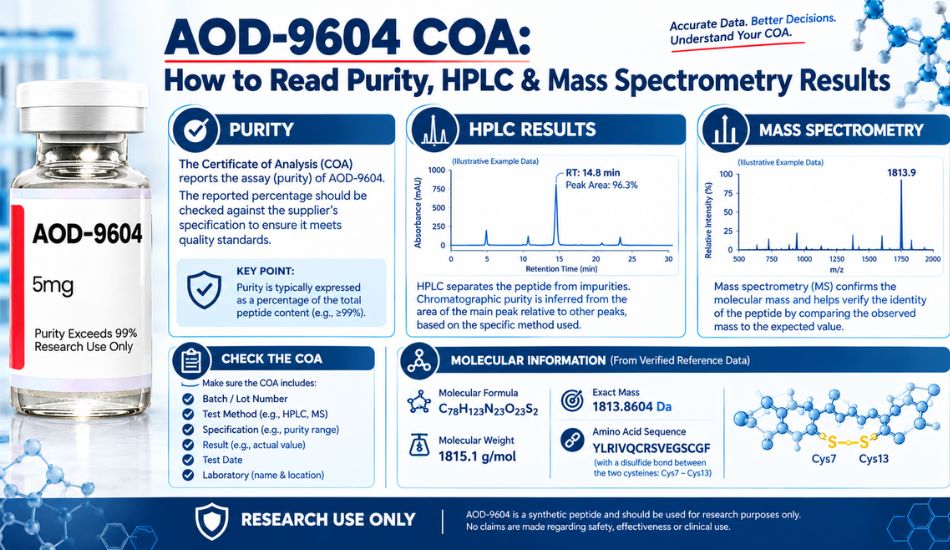
A Certificate of Analysis (COA) is a batch-specific document that provides analytical information about a research material.
For AOD-9604, a COA may include information about chromatographic purity, molecular identity, batch number, testing date, and other quality-control measurements.
A COA is useful analytical documentation, but it should not be treated as proof of clinical efficacy, human safety, or regulatory approval.
For the broader AOD-9604 research background, see AOD-9604 Research: Studies, Mechanism, Structure & Properties.
What Is an AOD-9604 COA?
A COA documents analytical testing performed on a particular batch.
Depending on the supplier and laboratory, an AOD-9604 COA may contain:
- Product name
- Batch or lot number
- Testing date
- HPLC purity
- Mass spectrometry
- Expected molecular weight
- Observed molecular mass
- Additional quality-control results
The batch number is particularly important because the results should correspond to the exact material being evaluated.
AOD-9604 HPLC Purity
High-performance liquid chromatography, or HPLC, is commonly used to evaluate chromatographic purity.
A reported purity percentage reflects the analytical result under the specific HPLC conditions used by the laboratory.
The number should therefore be interpreted together with the analytical method and report details.
A high HPLC purity result does not automatically establish that a material is safe, effective, sterile, or suitable for human use.
AOD-9604 Mass Spectrometry
Mass spectrometry can help characterize molecular identity by measuring molecular mass.
The reported molecular weight of AOD-9604 is approximately 1815.1 g/mol for the parent compound.
Observed analytical values may differ depending on the instrument, ionization method, molecular form, and sample preparation.
For this reason, researchers should compare mass-spectrometry results with the expected molecular form rather than relying on a single number without context.
For the underlying chemical specifications, see AOD-9604 Molecular Structure, Sequence, Formula & Molecular Weight.
HPLC vs Mass Spectrometry
The two techniques provide different types of information.
HPLC:
Primarily evaluates chromatographic separation and purity.
Mass spectrometry:
Helps characterize molecular mass and identity.
Using complementary analytical methods can provide a stronger assessment than relying on only one measurement.
Batch and Lot Information
A useful COA should clearly identify the batch being tested.
Important fields may include:
- Batch number
- Lot number
- Product identification
- Test date
- Laboratory identification
- Test method
- Results
- Specifications
Without clear batch information, it becomes more difficult to connect the analytical results with a specific research material.
Additional AOD-9604 Testing
Depending on the laboratory and material, a COA may include additional tests such as:
- Endotoxin testing
- Residual solvent testing
- Water content
- Appearance
- Microbial testing
Not every test is relevant to every research application, so the testing method and intended purpose should be considered.
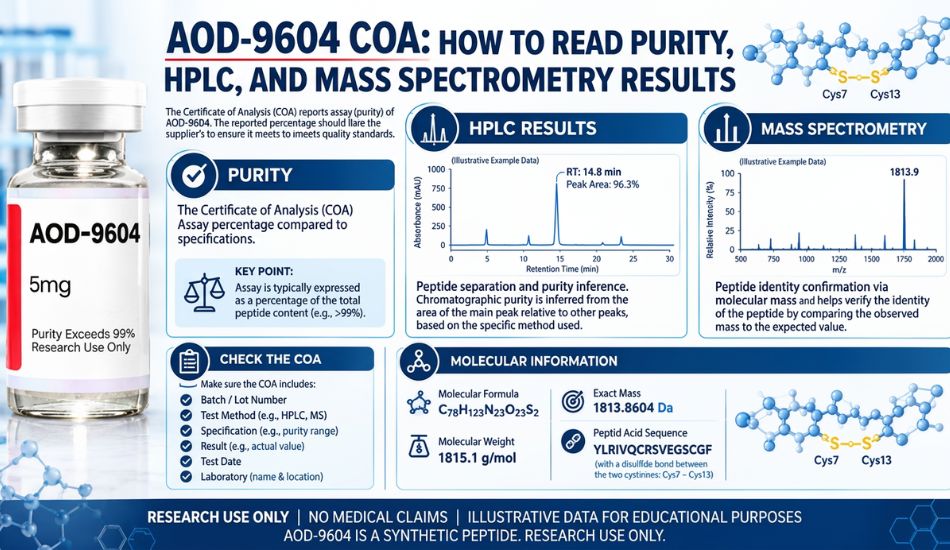
How to Evaluate an AOD-9604 COA
A practical review can follow this process:
1. Confirm the Product Identity
Make sure the document clearly identifies AOD-9604.
2. Check the Batch Number
Confirm that the COA corresponds to the batch being evaluated.
3. Review the HPLC Result
Look at the reported purity and analytical method.
4. Review Mass Spectrometry
Check whether the observed molecular mass is consistent with the expected molecular form.
5. Check the Testing Date
The date provides context for when the material was analyzed.
6. Review the Laboratory
Identify who performed the analysis and whether the report provides enough information to evaluate the testing.
What HPLC Purity Does Not Tell You
HPLC purity is useful but limited.
It does not by itself prove:
- Clinical efficacy
- Human safety
- Sterility
- Therapeutic effectiveness
- Regulatory approval
Analytical purity and biological efficacy are different concepts.
What Mass Spectrometry Does Not Tell You
Mass spectrometry can help confirm molecular mass and identity, but it does not independently establish clinical safety or effectiveness.
It should therefore be considered one component of analytical characterization.
COA vs Stability Testing
A COA generally reports analytical results for a batch at a specific point in time.
A stability study examines how the material changes over time under defined conditions.
These are different types of evidence.
For more information, see AOD-9604 Stability: Storage, Handling & Degradation Research.
AOD-9604 COA: Key Takeaway
A useful AOD-9604 COA should provide traceable, batch-specific analytical information.
HPLC can provide information about chromatographic purity, while mass spectrometry can help characterize molecular identity.
The strongest interpretation comes from reviewing the complete analytical report rather than focusing on a single purity number.
1 comment