
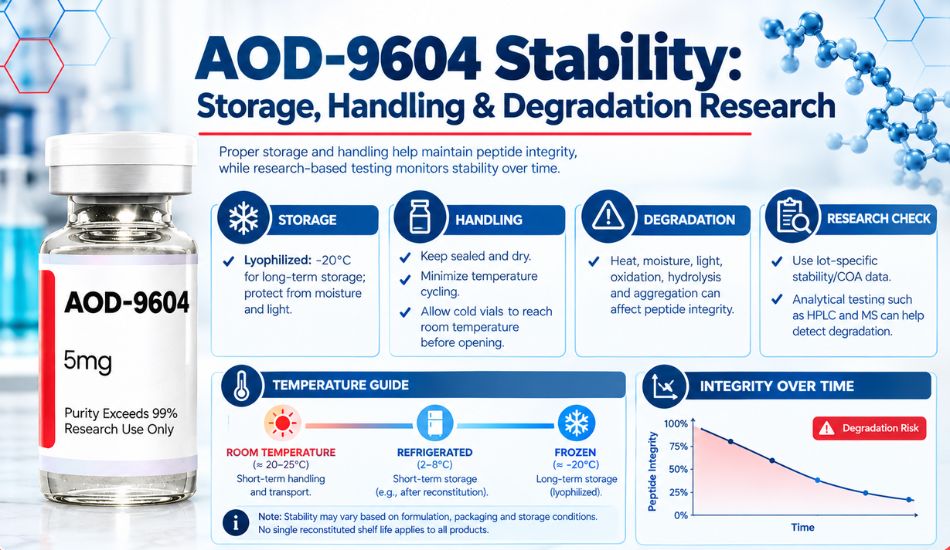
AOD-9604 is a synthetic peptide, so its chemical integrity can be affected by environmental conditions and handling practices.
Temperature, moisture, solution conditions, light exposure, storage duration, and repeated handling can all influence peptide stability.
For research purposes, stability should be evaluated using defined conditions and appropriate analytical testing rather than relying only on visual appearance.
This article examines AOD-9604 stability, including factors that can affect the peptide in dry and solution forms and the analytical methods used to evaluate degradation.
For the broader research background, see AOD-9604 Research: Studies, Mechanism, Structure & Properties.
What Does Peptide Stability Mean?
Peptide stability describes how well a peptide maintains its chemical and physical characteristics under specific conditions over a defined period.
A peptide can undergo molecular changes without producing an obvious change in appearance.
Potential degradation processes can include:
- Hydrolysis
- Oxidation
- Deamidation
- Aggregation
- Disulfide-related changes
- Other chemical modifications
The specific degradation pathway depends on the peptide’s molecular structure and environmental conditions.
Why AOD-9604 Stability Matters
Stability is important for reproducible laboratory research.
If a peptide changes during storage, researchers may no longer be working with material that has the same chemical characteristics as the original sample.
This can affect analytical measurements and experimental reproducibility.
For this reason, stability studies should examine the material under controlled conditions and at defined time points.
Factors That Can Affect AOD-9604 Stability
Several environmental factors can influence peptide stability.
Temperature
Temperature can affect the rate of chemical reactions.
Higher temperatures may accelerate certain degradation pathways, while temperature fluctuations can expose a peptide to repeated changes in environmental conditions.
Researchers should therefore use storage conditions supported by appropriate documentation or stability testing.
Moisture
Moisture can affect dry peptide materials.
Lyophilized peptides are designed to contain very little water, but exposure to humidity can alter the material and potentially affect chemical stability.
Appropriate packaging and controlled environmental conditions can reduce unnecessary moisture exposure.
Light
Some chemical compounds can be affected by prolonged exposure to light.
The effect depends on the molecular structure and exposure conditions.
Where light sensitivity has not been specifically established, researchers should avoid unnecessary prolonged exposure and follow documented storage procedures.
Solution Conditions
Once a peptide is placed into solution, its chemical environment changes.
Factors that may influence solution stability include:
- pH
- Temperature
- Concentration
- Solvent composition
- Container material
- Storage duration
The stability of a peptide in dry form therefore cannot automatically be assumed to remain unchanged after reconstitution.
Lyophilized AOD-9604 Stability
Lyophilization, commonly known as freeze-drying, removes much of the water from a preparation.
This process can improve the practical storage characteristics of many peptide materials.
However, lyophilization does not mean that a peptide is permanently stable.
The final stability depends on factors including:
- Residual moisture
- Packaging
- Temperature
- Humidity
- Storage duration
- Chemical structure
For general peptide information, see What Does Lyophilized Mean? Peptide Stability Explained.
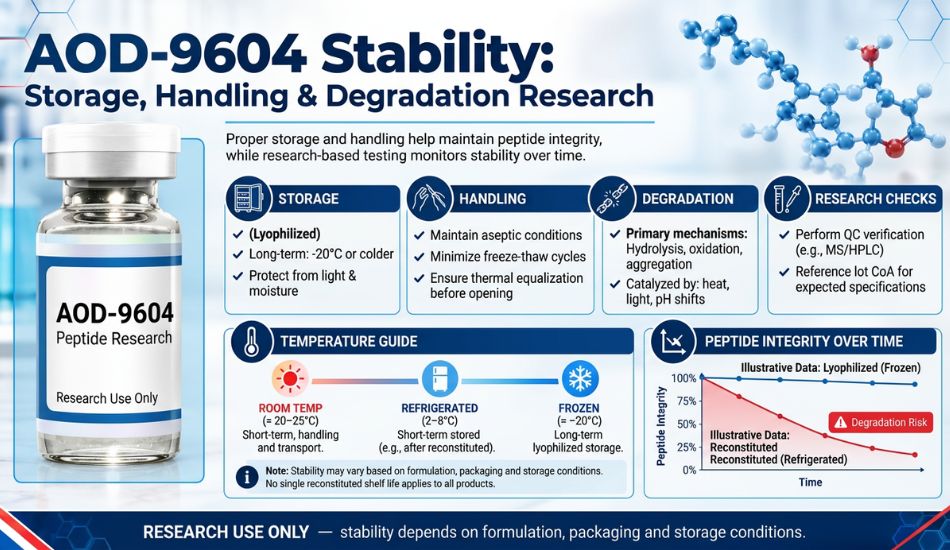
AOD-9604 Stability After Reconstitution
Reconstitution introduces the peptide into a liquid environment.
This can change the stability profile compared with the dry material.
Researchers should therefore distinguish between:
Dry-state stability
and
Solution-state stability
A stability period established for a lyophilized material should not automatically be applied to a reconstituted solution unless appropriate data support that conclusion.
AOD-9604 and Disulfide Stability
AOD-9604 contains two cysteine residues associated with a disulfide linkage.
Disulfide bonds can be affected by chemical conditions that promote oxidation or reduction.
Changes to the disulfide structure can alter the molecular form of a peptide.
Because of this, analytical characterization can be important when evaluating whether the expected molecular structure remains intact.
For structural information, see AOD-9604 Molecular Structure: Sequence, Formula, Weight & Chemical Properties.
Common Peptide Degradation Pathways
Hydrolysis
Hydrolysis involves chemical reactions with water and can contribute to peptide bond degradation under certain conditions.
Oxidation
Oxidation can affect susceptible amino acid residues or structural features.
Deamidation
Certain amino acid residues can undergo deamidation under appropriate conditions.
Aggregation
Peptide molecules can sometimes associate with each other and form larger assemblies or aggregates.
Disulfide Changes
Peptides containing cysteine residues can experience changes in disulfide bonding under particular chemical conditions.
The relevance of each pathway depends on the specific peptide and experimental environment.
How Is AOD-9604 Stability Evaluated?
A stability study generally involves storing a material under predefined conditions and testing it at predetermined intervals.
Researchers may examine:
- Chromatographic purity
- Molecular mass
- Degradation products
- Physical appearance
- Other relevant quality attributes
Testing at multiple time points allows researchers to evaluate whether measurable changes occur during storage.
HPLC for Stability Testing
HPLC can be useful for monitoring changes in chromatographic profiles.
For example, a stability study may compare the primary peptide peak at different time points.
The appearance of additional peaks or changes in the primary peak can indicate changes that require further investigation.
HPLC results should always be interpreted according to the specific analytical method used.
Mass Spectrometry for Stability Testing
Mass spectrometry can help investigate molecular-mass changes.
If degradation or modification occurs, the resulting molecular species may show a different mass from the expected peptide.
Combining mass spectrometry with chromatographic analysis can provide more information than either method alone.
For information on interpreting these analytical results, see AOD-9604 COA: How to Read Purity, HPLC & Mass Spectrometry Results.
Stability vs COA
A Certificate of Analysis and a stability study serve different purposes.
A COA generally provides analytical results for a particular batch at a particular point in time.
A stability study evaluates how a material changes under defined conditions over time.
Therefore, a COA showing high purity does not automatically establish long-term stability.
This distinction is important when evaluating peptide research materials.
Why Visual Appearance Is Not Enough
Visual inspection can provide useful basic information, but it cannot establish molecular integrity.
A peptide can undergo chemical degradation without obvious changes in:
- Color
- Clarity
- Texture
- Physical appearance
Analytical testing is therefore more appropriate for evaluating chemical stability.
Designing a Stability Study
A basic stability study should define:
- Starting material — Identify the exact batch being evaluated.
- Storage condition — Clearly define temperature and environmental conditions.
- Time points — Test the material at predetermined intervals.
- Analytical methods — Use appropriate methods such as HPLC and mass spectrometry.
- Acceptance criteria — Define what constitutes an acceptable result.
- Documentation — Record storage conditions and analytical results.
This approach allows researchers to distinguish actual stability data from assumptions.
AOD-9604 Stability: Key Takeaway
AOD-9604 stability can be influenced by temperature, moisture, light, solution conditions, storage duration, and handling.
Dry and reconstituted forms should be considered separately because their chemical environments differ.
Analytical methods such as HPLC and mass spectrometry can help researchers monitor purity, molecular identity, and potential degradation over time.
The most reliable conclusions should come from defined stability studies and documented analytical testing, rather than generic storage assumptions or visual inspection alone.
1 comment