
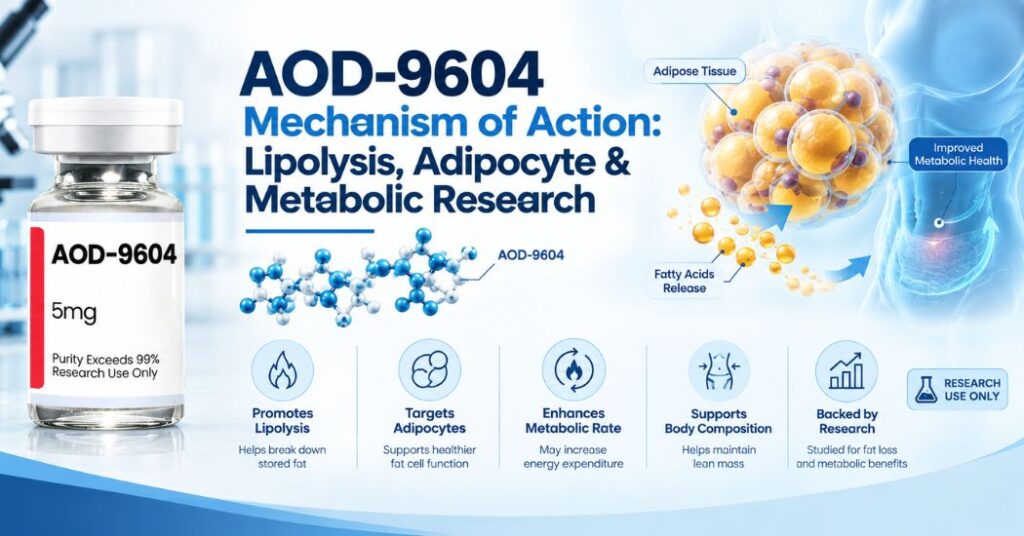
AOD-9604 is a synthetic 16-amino-acid peptide investigated primarily for its effects on lipid metabolism and adipose-tissue biology. Research has examined its potential influence on lipolysis, fatty-acid metabolism, adipocyte activity, and related metabolic pathways.
AOD-9604 was developed from the lipolytic region associated with human growth hormone. However, it is not the same molecule as full-length human growth hormone and should not be assumed to produce the same biological effects.
Understanding the AOD-9604 mechanism of action requires separating findings from laboratory experiments and animal models from evidence obtained in human clinical studies.
For the complete background, see AOD-9604 Research: Studies, Mechanism, Structure & Properties.
What Is the Proposed Mechanism of AOD-9604?
Research into AOD-9604 has focused heavily on its relationship with lipid metabolism and adipose tissue.
The main areas investigated include:
- Lipolysis
- Fatty-acid metabolism
- Adipocyte activity
- Fat oxidation
- Energy expenditure
- Beta-adrenergic signaling
- Growth-hormone-related pathways
The exact biological mechanism is not completely established. Different experimental studies have investigated different pathways and produced findings that need to be interpreted within their specific models.
This is important because describing one pathway as the definitive mechanism can overstate what the research currently demonstrates.
AOD-9604 and Lipolysis
Lipolysis is the biological process through which stored triglycerides in fat cells are broken down into fatty acids and glycerol.
One of the primary research interests surrounding AOD-9604 is whether it can influence this process.
Early experimental research reported lipolytic activity associated with AOD-9604 in adipose tissue models. Animal studies subsequently investigated whether these effects were associated with changes in body-fat accumulation and body weight.
These findings helped establish AOD-9604 as a subject of metabolic research.
However, increased lipolysis in a laboratory or animal model does not automatically translate into meaningful fat loss in humans.
AOD-9604 and Adipocyte Biology
Adipocytes are specialized cells that store energy in the form of triglycerides.
Researchers have investigated whether AOD-9604 influences adipocyte metabolism and the balance between fat storage and fat mobilization.
Research areas have included:
- Lipid accumulation
- Triglyceride metabolism
- Lipolytic activity
- Fat oxidation
- Adipose-tissue signaling
Some animal studies reported changes in adipose-related metabolic activity after AOD-9604 exposure.
The significance of these findings depends on the experimental model, dose, exposure duration, and measured endpoint.
Beta-3 Adrenergic Signaling
Beta-3 adrenergic receptors are involved in metabolic activity in adipose tissue.
Because of this role, researchers have investigated whether beta-3 adrenergic signaling contributes to the effects observed with AOD-9604.
Studies in obese mouse models reported changes in beta-3 adrenergic receptor expression following AOD-9604 treatment. Additional experiments using beta-3 adrenergic receptor knockout animals provided evidence that this pathway may be involved in some of the observed long-term effects.
However, this should not be simplified into the statement that AOD-9604 is a direct beta-3 adrenergic receptor agonist.
The research indicates a more complicated relationship between AOD-9604 and beta-3 adrenergic signaling.
This distinction is important when interpreting mechanistic claims.
AOD-9604 and Fat Oxidation
Fat oxidation refers to the use of fatty acids as an energy source.
Animal research has investigated whether AOD-9604 affects fat oxidation and energy expenditure.
Changes in these processes can help researchers understand how a compound may influence overall energy metabolism.
However, increased fat oxidation in an experimental model does not necessarily mean that the compound will produce clinically meaningful changes in body composition in humans.
Therefore, fat-oxidation findings should be considered part of the broader preclinical evidence rather than isolated proof of efficacy.
AOD-9604 and Energy Expenditure
Energy expenditure represents the amount of energy used by the body.
Some animal research has examined whether AOD-9604 affects energy expenditure alongside changes in fat metabolism.
These experiments are useful because changes in body weight can result from several factors, including energy intake, energy expenditure, fat storage, and metabolic activity.
Understanding these variables helps researchers distinguish between different possible mechanisms.
Relationship With Human Growth Hormone
AOD-9604 is associated with the lipolytic region of human growth hormone, but the two compounds are structurally different.
Human growth hormone is a 191-amino-acid protein, while AOD-9604 is a much smaller synthetic peptide.
Research has examined whether AOD-9604 can produce selected metabolic effects without reproducing the broader biological activity of full-length growth hormone.
This distinction is particularly important when interpreting research involving growth hormone receptors and the GH/IGF-1 axis.
For a detailed structural and biological comparison, see AOD-9604 vs Human Growth Hormone: Structure, Mechanism & Research.
AOD-9604 and the GH/IGF-1 Axis
Human growth hormone has an established role in the GH/IGF-1 signaling system.
Because AOD-9604 was developed in relation to a region of human growth hormone, researchers have investigated whether its activity depends on the same pathways.
The available evidence does not justify treating AOD-9604 as simply a smaller form of human growth hormone.
Instead, research has examined its biological activity separately, particularly in relation to lipid metabolism.
This distinction should remain clear when discussing AOD-9604 mechanisms.
Does AOD-9604 Directly Activate the Growth Hormone Receptor?
Experimental research has investigated whether AOD-9604 interacts with the human growth hormone receptor in the same way as full-length growth hormone.
Findings from receptor-related experiments indicate that AOD-9604 does not simply reproduce the receptor activity of intact human growth hormone.
This supports the view that its research profile should be considered independently from the complete GH molecule.
AOD-9604 and Anti-Lipogenic Research
In addition to lipolysis, research has examined whether AOD-9604 affects processes involved in lipid storage.
Anti-lipogenic activity refers broadly to effects that may reduce processes involved in lipid accumulation.
Preclinical studies have investigated these effects in adipose tissue and experimental models.
However, these findings should be described as experimental observations rather than established clinical outcomes.
What Do AOD-9604 Mechanism Studies Actually Show?
The available research suggests that AOD-9604 can influence several aspects of lipid metabolism in experimental settings.
The most frequently investigated areas include:
Lipolysis:
Breakdown of stored triglycerides.
Fat oxidation:
Use of fatty acids as an energy source.
Adipocyte biology:
Changes in metabolic activity within fat cells.
Beta-adrenergic signaling:
Potential involvement of beta-3 adrenergic pathways in observed metabolic effects.
Energy expenditure:
Changes investigated in animal models.
These findings provide a basis for continued scientific investigation, but they do not establish a single definitive mechanism applicable to humans.
Preclinical Mechanism vs Human Evidence
This distinction is critical.
A mechanism demonstrated in cells or animals may show that a compound has biological activity. It does not prove that the same mechanism produces a meaningful therapeutic outcome in people.
AOD-9604 is a good example.
Preclinical research generated interest because of reported metabolic and lipolytic effects. However, later human clinical research did not establish sufficient efficacy for obesity treatment.
For a detailed review of those studies, see AOD-9604 Studies: Human Trials, Preclinical Research & Evidence.
AOD-9604 Mechanism Research Limitations
Several limitations should be considered when interpreting the literature:
- Many mechanistic studies are preclinical.
- Animal models do not perfectly reproduce human metabolism.
- Experimental doses may differ from human exposure.
- Different studies use different models and endpoints.
- A biological mechanism does not automatically establish clinical efficacy.
These limitations make it important to distinguish mechanistic research from clinical evidence.
AOD-9604 Mechanism of Action: Summary
The AOD-9604 mechanism of action has been investigated primarily in relation to lipolysis, adipocyte metabolism, fat oxidation, and related metabolic signaling.
Research suggests that beta-adrenergic pathways may contribute to some observed effects, but the evidence does not support reducing the mechanism to a simple direct beta-3 receptor agonist model.
AOD-9604 also differs substantially from full-length human growth hormone despite its relationship to the hormone’s lipolytic region.
Overall, the strongest mechanistic evidence remains preclinical, while human research provides a more limited picture of clinical effectiveness.
2 comments