
Fat loss looks simple from the outside.
The body stores energy as fat. When energy requirements change, stored fat can be mobilized and used. But the biology behind that process is anything but simple.
Inside the body, fat storage and energy use are influenced by hormones, receptors, appetite signals, glucose metabolism, lipid metabolism, and communication between different tissues.
That complexity is why researchers are studying peptides from several different angles.
Some compounds are investigated for their relationship with lipid metabolism. Others are studied through appetite and amylin signaling. Some interact with incretin receptors involved in metabolic regulation.
So when researchers talk about fat loss peptides research, they are not necessarily looking for one molecule that simply “burns fat.”
They are investigating how different biological pathways influence metabolism, energy balance, appetite, and adipose-tissue biology.
That distinction is important.
A research finding can help explain a mechanism without proving that a compound produces the same outcome in humans.
What Are Fat Loss Peptides?
The phrase “fat loss peptide” is commonly used online to describe peptides or peptide-based compounds being investigated in connection with body weight, fat metabolism, appetite regulation, or metabolic signaling.
Scientifically, however, these compounds are not one uniform category.
They can have very different molecular targets.
For example, AOD-9604 has been investigated in relation to lipolytic and adipocyte pathways, while Cagrilintide is studied as an amylin-related compound. Tirzepatide interacts with GIP and GLP-1 receptors, while Retatrutide is studied as a multi-receptor agonist involving GIP, GLP-1, and glucagon receptors.
That means the better research question is not:
“Which peptide burns the most fat?”
It is:
“Which metabolic pathway does this compound affect, and what does the evidence actually show?”
That question provides a much stronger foundation for understanding peptide research.
Why Are Researchers Studying Peptides for Fat Metabolism?
Fat tissue is biologically active.
Adipocytes store triglycerides, respond to hormonal signals, communicate with other tissues, and participate in energy regulation.
Researchers can therefore study several processes involved in fat metabolism, including:
- Lipolysis
- Fatty-acid metabolism
- Adipocyte signaling
- Energy balance
- Appetite regulation
- Glucose metabolism
- Insulin-related signaling
- Mitochondrial function
- Hormonal signaling
Peptides can be useful research compounds because their structures allow them to interact with specific receptors or biological pathways.
But those pathways do not all lead to the same biological outcome.
For example, a compound that affects appetite signaling is being investigated from a different angle than one studied primarily for adipocyte or lipid metabolism.
Understanding that difference is the foundation of responsible fat-loss peptide research.
Understanding the Biology of Fat Loss
Before looking at individual compounds, it helps to understand what researchers mean when they study fat metabolism.
Lipolysis
Lipolysis is the process through which stored triglycerides are broken down into fatty acids and glycerol.
This is one of the major processes researchers examine when studying how stored energy can become available for metabolic use.
But lipolysis alone does not tell the entire story.
Released fatty acids can be oxidized, transported, reused, or stored again depending on the metabolic environment.
That is why researchers generally need to examine multiple pathways rather than treating increased lipolysis as synonymous with long-term fat loss.
Adipocyte Biology
Adipocytes are specialized cells that store energy as fat.
Research can examine how these cells develop, store lipids, respond to hormones, and communicate with other tissues.
Changes in adipocyte signaling can therefore provide useful information about metabolic biology.
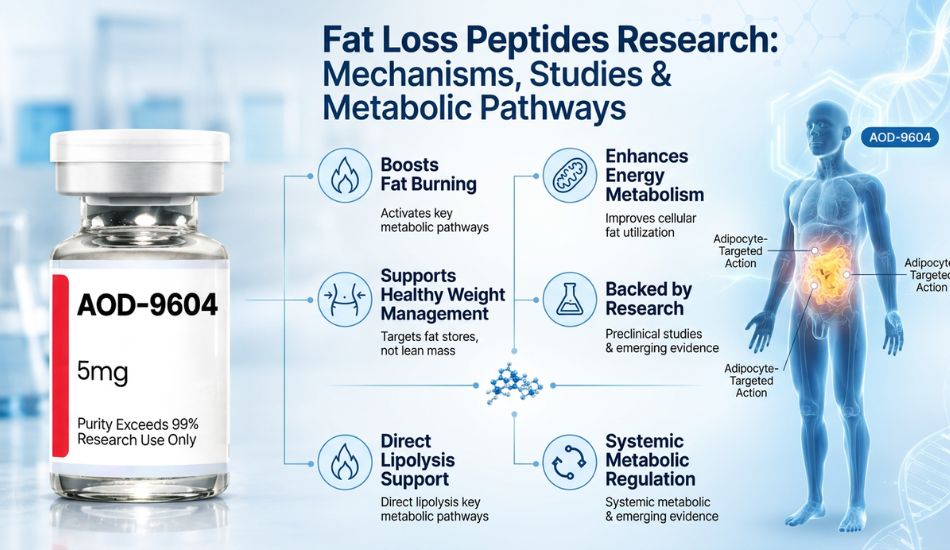
AOD-9604 research, for example, has focused on lipid-related and adipocyte pathways rather than treating the compound simply as a general weight-loss product.
Appetite and Energy Balance
Fat metabolism is also connected to how the body regulates food intake.
The brain, gastrointestinal system, pancreas, adipose tissue, and other organs communicate through hormones and signaling molecules.
This is where compounds such as Cagrilintide, Tirzepatide, and Retatrutide become particularly interesting from a research perspective.
Their mechanisms involve metabolic and appetite-related signaling rather than simply acting directly on stored body fat.
AOD-9604 and Lipid Metabolism Research
AOD-9604 is one of the compounds most closely associated with fat-metabolism research.
It is a modified fragment derived from human growth hormone and has been investigated for its relationship with lipid metabolism and lipolytic signaling.
The research question is particularly interesting because AOD-9604 has been studied in relation to adipocyte and fatty-acid pathways without treating the compound as a conventional growth-hormone replacement.
Hotspan’s current AOD-9604 research material describes the compound in the context of lipolytic signaling and adipocyte research.
What Does AOD-9604 Research Focus On?
Research has examined areas such as:
- Lipid metabolism
- Lipolytic signaling
- Adipocyte biology
- Fatty-acid pathways
- Metabolic signaling
This makes AOD-9604 an important part of the broader fat metabolism research conversation.
However, its research history also demonstrates why mechanism and clinical evidence should not be confused.
A biological effect observed in an experimental model does not automatically establish meaningful weight loss in humans.
Hotspan currently lists AOD-9604 as a Fat Metabolism Peptide in its Weight Management & Metabolic catalog.
Read the AOD-9604 Research Guide
View AOD-9604 Research Peptide
Cagrilintide and Amylin Signaling
The next research pathway moves away from direct lipid metabolism and toward appetite and metabolic regulation.
Cagrilintide is a long-acting synthetic analogue of amylin.
Amylin is a peptide hormone produced by pancreatic beta cells alongside insulin. Research into amylin-related pathways includes appetite regulation, gastric motility, and metabolic signaling.
Cagrilintide is studied as a dual amylin and calcitonin receptor agonist in experimental systems.
This creates a different research question from AOD-9604.
Instead of asking how a compound interacts with adipocyte lipid pathways, researchers can investigate how amylin-related receptor signaling affects appetite and metabolic processes.
Cagrilintide Research Areas
Current research interests include:
- Amylin receptor signaling
- Calcitonin receptor activity
- Appetite-related pathways
- Neuroendocrine signaling
- Gastric motility
- Metabolic regulation
Hotspan currently lists Cagrilintide within its Weight Management & Metabolic research category.
Read the Cagrilintide Research Guide
View Cagrilintide Research Peptide
Tirzepatide and GIP/GLP-1 Research
Another major area of metabolic research involves incretin signaling.
Tirzepatide is studied as a dual agonist of the GIP and GLP-1 receptors.
Both GIP and GLP-1 are involved in metabolic regulation, including glucose-dependent insulin signaling and appetite-related processes.
From a research perspective, this makes tirzepatide fundamentally different from AOD-9604.
AOD-9604 research centers on lipid and adipocyte pathways.
Tirzepatide research examines dual incretin receptor signaling.
Hotspan lists Tirzepatide under the research name GLP2-T and describes research applications involving GIPR and GLP-1R signaling, GPCR pathways, and downstream metabolic biomarkers.
What Researchers Study With Tirzepatide
Research can examine:
- GIP receptor activity
- GLP-1 receptor activity
- Receptor co-activation
- GPCR signaling
- Intracellular signaling
- Metabolic biomarkers
- Appetite-related mechanisms
Read the Tirzepatide Metabolic Research Guide
View GLP2-T / Tirzepatide Research Peptide
The key point is that tirzepatide belongs to a different mechanistic category from AOD-9604, even though both can appear in broader discussions about metabolic research.
Retatrutide and Multi-Receptor Metabolic Research
Retatrutide takes the metabolic research question one step further.
It is studied as a triple agonist targeting:
- GLP-1 receptors
- GIP receptors
- Glucagon receptors
Hotspan lists the compound as GLP3-R and describes its research focus around multi-receptor pharmacology, GPCR signaling, receptor co-activation, intracellular cAMP pathways, and downstream metabolic biomarkers.
This makes retatrutide particularly interesting from a pathway-interaction perspective.
Rather than investigating one receptor system, researchers can examine how simultaneous activity across three metabolic receptor pathways changes downstream signaling.
View GLP3-R / Retatrutide Research Peptide
AOD-9604 vs. Cagrilintide vs. Tirzepatide vs. Retatrutide
It can be tempting to put all four compounds into one “fat loss peptide” category.
Scientifically, that would remove too much information.
Their primary research contexts are different.
| Compound | Primary Research Context | Main Biological Pathway |
|---|---|---|
| AOD-9604 | Lipid metabolism | Lipolytic and adipocyte-related pathways |
| Cagrilintide | Appetite and metabolic research | Amylin/calcitonin receptor signaling |
| Tirzepatide | Incretin research | GIP and GLP-1 receptor signaling |
| Retatrutide | Multi-receptor metabolic research | GIP, GLP-1 and glucagon receptor signaling |
The table is useful because it shows why fat loss peptides research is not one single scientific category.
The endpoint may sometimes be related to body weight or metabolic health, but the underlying biology can be completely different.
What Does the Research Actually Tell Us?
One of the biggest mistakes in peptide content is treating every promising mechanism as proof of a final outcome.
Research evidence exists on a spectrum.
In Vitro Research
Cell-based experiments can help scientists investigate:
- Receptor activity
- Signaling pathways
- Gene expression
- Cellular metabolism
- Molecular interactions
These studies are valuable for understanding mechanisms.
But they do not establish what happens in a human body.
Animal Research
Animal models allow researchers to examine more complex interactions between organs and biological systems.
They can provide useful preclinical information.
However, animal findings also cannot automatically be translated into human outcomes.
Human Clinical Research
Human studies provide another level of evidence.
Study design matters greatly, including:
- Population
- Sample size
- Control group
- Duration
- Endpoint
- Statistical analysis
- Adverse-event monitoring
Two studies investigating apparently similar compounds can produce very different results because the study designs are different.
This is why a good research article should always distinguish mechanism, preclinical evidence, and clinical evidence.
Why “Fat Burning” Can Be Misleading
The phrase “fat burning” sounds straightforward.
Biologically, it is not.
Fat oxidation, lipolysis, appetite regulation, energy expenditure, glucose metabolism, and long-term changes in body composition are related but distinct concepts.
A compound can affect one pathway without producing every downstream effect associated with the phrase “fat loss.”
That is why researchers use more specific terminology.
Instead of saying:
“This peptide burns fat.”
A research-focused discussion might ask:
“Does this compound alter lipolytic signaling in the experimental model?”
That wording may sound less dramatic.
It is also much more scientifically useful.
What Should Researchers Look For in a Fat Loss Research Peptide?
Mechanism is only one part of the evaluation.
The research material itself also needs to be characterized.
Researchers may want to review:
- Exact compound identity
- Molecular form
- Purity
- Batch number
- Certificate of Analysis
- HPLC results
- Mass spectrometry
- Endotoxin testing
- Storage information
- Stability information
- Supplier documentation
Hotspan states that its research peptides are third-party tested and that batch-specific COA documentation is available. Its quality page describes ≥99% purity as the stated standard and identifies HPLC and mass spectrometry among its testing methods.
Review Hotspan COA & Quality Testing
A COA does not prove that a compound is an approved medicine.
It does provide analytical information about a particular batch, which can be important when evaluating research material.
Why Batch Documentation Matters
Imagine two vials carrying the same compound name.
They may still come from different manufacturers, different production batches, or different quality systems.
For laboratory work, that distinction matters.
A batch-specific Certificate of Analysis can provide information about the material being evaluated rather than relying only on a general supplier statement.
Hotspan states that a COA is available for every batch and that its research products are independently tested for purity and identity.
For researchers, documentation is therefore part of the purchasing decision—not an afterthought.
Research Use Only: An Important Distinction
There is another point that needs to remain clear throughout the discussion.
Hotspan’s research products are designated Research Use Only.
According to Hotspan’s current FAQ, these products are intended strictly for in-vitro laboratory research and experimentation and are not intended for human consumption, veterinary use, or therapeutic application.
That distinction matters because the word “peptide” covers many different types of compounds and uses.
A research compound is not automatically an approved medicine.
A research product is not automatically suitable for personal use.
And a published study involving a particular compound does not automatically validate every commercially available product carrying the same name.
For that reason, this pillar focuses on laboratory research, mechanisms, and evidence, rather than human-use instructions.
How to Read Fat Loss Peptide Research
When you find a study about a metabolic peptide, start with five questions.
1. What compound was actually studied?
Confirm the exact peptide, formulation, molecular structure, and experimental material.
2. What biological pathway was investigated?
Look for the receptor, signaling pathway, enzyme, hormone, or cellular process being studied.
3. What research model was used?
Was it:
- Cell culture?
- Animal research?
- Human observational research?
- Randomized clinical research?
4. What was the actual endpoint?
Was the study measuring:
- Receptor activation?
- Gene expression?
- Lipolysis?
- Glucose markers?
- Food intake?
- Body weight?
- Body composition?
These are not interchangeable outcomes.
5. Can the result be generalized?
A result from one experimental model may not apply to another.
This simple framework can prevent many of the exaggerated conclusions commonly found in peptide marketing.
The Future of Fat Loss Peptides Research
Metabolic research is moving toward increasingly detailed questions.
Instead of looking only at body weight, researchers can investigate the biological systems that influence it.
Those include:
- Appetite signaling
- Incretin biology
- Amylin pathways
- Lipid metabolism
- Adipocyte signaling
- Glucose regulation
- Energy expenditure
- Mitochondrial metabolism
- Receptor interactions
- Multi-pathway signaling
The four compounds discussed here illustrate that shift.
AOD-9604 provides a lipid-metabolism research angle.
Cagrilintide provides an amylin-signaling angle.
Tirzepatide provides a dual incretin-receptor model.
Retatrutide provides a multi-receptor model involving three metabolic pathways.
The field therefore becomes less about finding one “magic” peptide and more about understanding how metabolic systems communicate.
Building a Fat Loss Peptide Research Cluster
This pillar should become the central hub for Hotspan’s metabolic peptide content.
The supporting cluster can eventually cover:
AOD-9604 Research
Your existing AOD-9604 pillar and supporting articles can connect here.
Suggested relationship:
Fat Loss Peptides Research → AOD-9604 Research
Cagrilintide Research
A dedicated cluster can cover:
- Cagrilintide mechanism
- Amylin receptor signaling
- Cagrilintide research studies
- Cagrilintide vs other metabolic compounds
Tirzepatide Research
Supporting topics can cover:
- Tirzepatide mechanism
- GIP/GLP-1 receptor signaling
- Tirzepatide research studies
- Tirzepatide vs other metabolic research compounds
Retatrutide Research
Supporting topics can cover:
- Retatrutide mechanism
- GLP-1/GIP/glucagon signaling
- Retatrutide research studies
- Retatrutide molecular structure
Supporting Metabolic Research
Additional articles can target:
- Peptides and lipolysis research
- Peptides and adipocyte signaling
- Appetite signaling and peptide research
- Metabolic peptide research
- Research peptide COA guide
This gives Hotspan a clear topical structure instead of having multiple unrelated articles competing for similar keywords.
Frequently Asked Questions
What are fat loss peptides?
Fat loss peptides are peptides or peptide-based compounds studied in connection with biological processes such as lipid metabolism, appetite regulation, energy balance, or metabolic signaling. The mechanisms and evidence vary substantially between compounds.
What peptides are studied for fat metabolism?
AOD-9604 is studied in relation to lipolytic and adipocyte pathways. Other metabolic research compounds, including Cagrilintide, Tirzepatide, and Retatrutide, involve different appetite and receptor-signaling pathways.
What is AOD-9604 research focused on?
AOD-9604 has been investigated in relation to lipid metabolism, lipolytic signaling, and adipocyte biology.
What is Cagrilintide studied for?
Cagrilintide is studied as an amylin-related compound in research involving appetite regulation, receptor signaling, gastric motility, and metabolic pathways.
What is Tirzepatide studied for?
Tirzepatide is studied as a dual GIP and GLP-1 receptor agonist, with research examining incretin receptor pharmacology and downstream metabolic signaling.
What is Retatrutide?
Retatrutide is an investigational peptide studied as a triple agonist of GLP-1, GIP, and glucagon receptors. Research focuses on multi-receptor pharmacology and downstream metabolic signaling.
Are research peptides approved for personal weight loss?
Hotspan’s research products are designated for laboratory research and are not intended for human consumption or therapeutic use.
What should researchers check before buying a metabolic research peptide?
Researchers should review compound identity, purity, batch documentation, COA results, analytical testing, storage requirements, and the suitability of the material for their specific experimental design.
Final Takeaway
Fat loss is not controlled by one biological switch.
It is the result of interconnected systems involving appetite, hormones, receptors, adipose tissue, lipid metabolism, glucose regulation, and energy balance.
That is why researchers are investigating different peptide-based compounds from different angles.
AOD-9604 is connected to lipid and adipocyte research.
Cagrilintide provides an amylin-related research model.
Tirzepatide provides a dual GIP/GLP-1 receptor model.
Retatrutide expands the question to GLP-1, GIP, and glucagon receptor signaling.
These compounds should not be treated as interchangeable.
The better approach is to start with the biological question, examine the mechanism, evaluate the evidence, and then assess the research material itself.
For qualified researchers, Hotspan provides a dedicated Weight Management & Metabolic collection containing these research compounds, alongside batch-level testing and COA documentation.
Explore Hotspan’s Weight Management & Metabolic Research Collection