
Aging does not happen all at once.
It starts quietly.
Inside the body, cells gradually experience changes in energy production, signaling, repair, and stress responses. Some cells stop dividing normally and enter a state known as cellular senescence. Mitochondrial function can change. Tissue remodeling becomes more complex. The systems that once maintained cellular balance begin to behave differently.
For researchers, these changes raise a much bigger question:
What happens inside our cells as they age, and can individual biological pathways be studied more closely?
That question has helped make peptides an increasingly interesting area of laboratory research.
Today, scientists are investigating different peptides in relation to cellular signaling, tissue remodeling, mitochondrial function, genomic regulation, and other processes associated with aging.
This is where the broader field of anti aging peptide research begins.
But there is an important distinction.
A peptide being studied in an aging-related research model does not automatically make it an anti-aging treatment. The evidence, experimental model, and biological mechanism all matter.
Why Are Peptides Being Studied in Aging Research?
Aging is not controlled by one biological pathway.
Researchers study several interconnected processes, including cellular senescence, mitochondrial dysfunction, oxidative stress, inflammation, metabolic regulation, tissue remodeling, and changes in gene expression.
Peptides are interesting because many of them act as signaling molecules or interact with specific biological pathways.
That gives researchers an opportunity to study individual mechanisms rather than treating aging as one single process.
Think about it this way.
If an aging cell is like an old building, researchers are not simply asking whether the entire building can be made “new” again.
They are examining the individual systems:
- How is the structure maintained?
- How is damage repaired?
- How is energy produced?
- How do cells communicate?
- What happens when damaged cells stop functioning normally?
- Which signaling pathways change over time?
Different peptides can provide different experimental tools for investigating these questions.
The First Piece of the Puzzle: Cellular Senescence
Imagine a cell that has experienced years of biological stress.
Eventually, it may stop dividing but remain metabolically active. This state is known as cellular senescence.
Senescent cells have become an important area of aging research because their accumulation and signaling behavior are associated with age-related changes in tissues.
This is one reason researchers are interested in compounds that can be studied in relation to senescence pathways.
However, laboratory findings need to be interpreted carefully.
A change in a senescence marker in a cell model does not automatically mean that the same outcome occurs in a human being.
That distinction is critical when evaluating any compound described as an “anti-aging peptide.”
The research question comes first.
GHK-Cu: Looking at Tissue Remodeling and Cellular Signaling
One of the better-known peptides in this area is GHK-Cu.
GHK-Cu is a copper-binding tripeptide found naturally in biological systems. Research has examined its relationship with extracellular-matrix biology, fibroblast activity, oxidative-stress markers, immune-related signaling, and other cellular processes.
Why does that matter for aging research?
Because tissues do not simply remain structurally unchanged throughout life.
The extracellular matrix, collagen-related pathways, cellular communication, and tissue-remodeling processes all play roles in maintaining tissue structure.
That makes GHK-Cu interesting as a research compound.
The goal is not to assume that GHK-Cu “reverses aging.”
The more useful scientific question is:
How does GHK-Cu interact with cellular and extracellular-matrix pathways under controlled experimental conditions?
That is the type of question that can actually be investigated.
GHK-Cu Research at Hotspan
Hotspan currently offers GHK-Cu in 50 mg and 100 mg formats. The product page describes it as a copper-binding tripeptide used for laboratory research and provides access to COA and endotoxin documentation.
For researchers studying tissue biology, cellular signaling, or extracellular-matrix pathways, GHK-Cu represents one specific area of investigation within the larger field.
And then the research story moves somewhere completely different.
MOTS-c: A Look Inside Mitochondrial Signaling
Aging research cannot ignore mitochondria.
These structures are best known for their role in cellular energy production, but mitochondrial biology is considerably more complicated than that.
Mitochondria also participate in cellular signaling, metabolic regulation, and responses to stress.
This brings us to MOTS-c, a mitochondrial-derived peptide.
Researchers have investigated MOTS-c in relation to mitochondrial signaling, metabolic regulation, cellular stress responses, and aging-related biology.
Instead of focusing primarily on extracellular tissue structure, MOTS-c research gives scientists another perspective:
What happens when aging-related questions are examined through mitochondrial and metabolic signaling?
That difference is important.
GHK-Cu and MOTS-c may both appear in discussions about longevity research, but they are not interchangeable compounds and should not be treated as if they have identical mechanisms.
They represent different research questions.
MOTS-c Research at Hotspan
Hotspan currently lists MOTS-c as a mitochondrial research peptide within its Longevity & Cellular Health category. The site lists the compound in a 10 mg format and provides batch-related testing information.
For researchers interested in mitochondrial signaling and metabolic pathways, MOTS-c provides another experimental direction.
But there is still another part of the aging story.
Epithalon and the Question of Genomic Aging
The next chapter takes us closer to genomic regulation.
Epithalon, also known as Epitalon, is a synthetic tetrapeptide that has been studied in aging-related research models.
Hotspan’s product information describes research interests involving telomerase-related signaling, telomere regulation, gene transcription, circadian signaling, and immune-associated gene expression.
This makes Epithalon particularly interesting from a research perspective because it introduces questions surrounding genomic regulation and cellular aging.
Again, the important word is research.
The existence of laboratory studies does not establish Epithalon as a proven intervention for human aging.
Instead, researchers can examine how the compound interacts with specific biological pathways under controlled experimental conditions.
Epithalon Research at Hotspan
Hotspan currently lists Epithalon as a longevity research peptide in its Longevity & Cellular Health category. The product page also provides access to product documentation, including its COA section.
View Epithalon Research Peptide
Three Peptides, Three Different Research Questions
This is where the anti-aging peptide discussion becomes more interesting.
It is easy to put every longevity-related peptide into one large category.
- Science does not work that way.
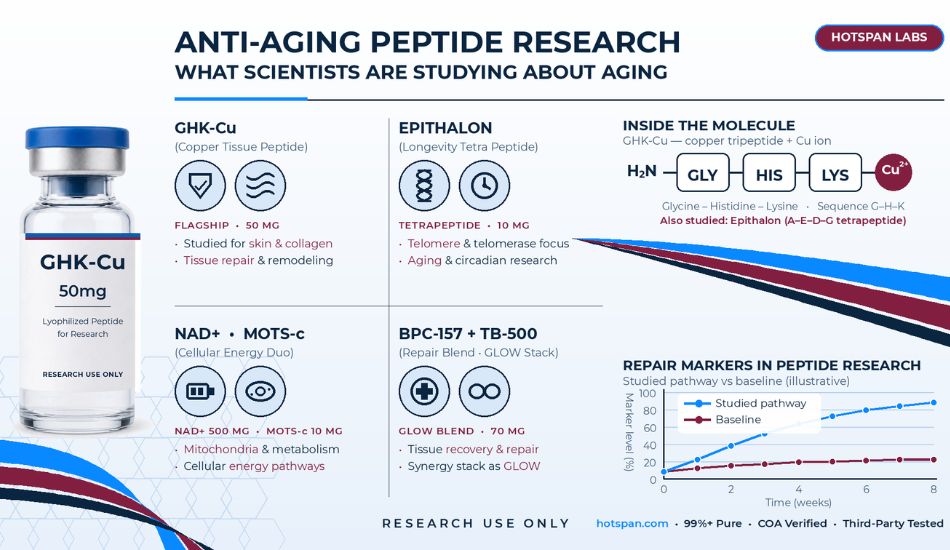
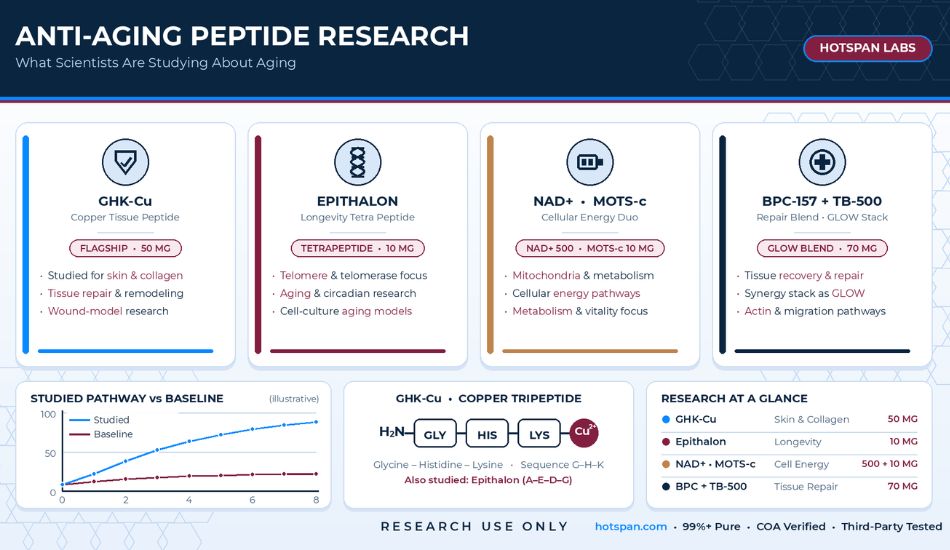
- GHK-Cu is associated with research into extracellular-matrix biology and cellular signaling.
- MOTS-c is studied in relation to mitochondrial and metabolic signaling.
- Epithalon is investigated in areas including genomic regulation, telomere-related pathways, and cellular aging models.
The broader subject may be aging, but the experimental questions are different.
| Research Compound | Research Focus |
| GHK-Cu | Extracellular matrix, cellular signaling, fibroblast-related pathways |
| MOTS-c | Mitochondrial signaling, metabolic regulation, cellular stress |
| Epithalon | Genomic regulation, telomere-related pathways, cellular aging |
This distinction is important when evaluating research peptides.
Rather than asking:
“Which peptide is the best anti-aging peptide?”
A researcher should begin with:
“Which biological pathway am I investigating?”
What Makes a Research Peptide Worth Investigating?
The compound itself is only part of the research equation.
Researchers also need to know what material they are actually working with.
That means documentation matters.
Depending on the experimental application, researchers may evaluate:
- Peptide identity
- Purity
- Batch information
- Certificate of Analysis
- Analytical testing
- Mass spectrometry
- Endotoxin information
- Storage requirements
- Molecular information
- Research-use designation
Hotspan currently promotes its research catalog around batch-level COA documentation and third-party testing, while individual product pages provide access to available product documentation.
This is an important part of the purchasing decision.
A researcher’s question should not simply be:
“Does this product claim to be pure?”
It should be:
“Can I review the documentation for the material I am considering for my research?”
Anti Aging Peptide Research Is Not the Same as Anti-Aging Treatment
This distinction should never get lost.
A laboratory compound can be interesting without being an approved treatment.
Research may involve:
- Cell cultures
- Molecular assays
- Animal models
- Biochemical experiments
- Mechanistic studies
- Preclinical models
Results from one research environment cannot automatically be transferred to humans.
That is especially important with peptides discussed online using terms such as “anti-aging,” “longevity,” or “healthspan.”
The responsible way to discuss these compounds is to describe what has been studied, which mechanisms are being investigated, and what remains uncertain.
Hotspan explicitly identifies its products as Research Use Only and states that they are intended for in-vitro research and laboratory experimentation rather than human consumption, therapeutic use, or clinical application.
How Researchers Can Think About Longevity Peptide Research
The aging process is too complicated to reduce to one compound.
One research project may focus on cellular senescence.
Another may examine mitochondrial signaling.
Another may investigate extracellular-matrix remodeling.
Another may focus on genomic regulation.
That is why the phrase anti aging peptide should be viewed as a broad research category rather than a claim that one molecule can stop or reverse aging.
The value is in understanding the biology.
And that requires connecting the compound to a specific mechanism.
Where Does the Research Go From Here?
The next generation of aging research will likely continue looking at how different biological systems interact.
Researchers are investigating relationships between:
- Cellular senescence
- Mitochondrial function
- Metabolic signaling
- Tissue remodeling
- Oxidative stress
- Inflammatory signaling
- Genomic regulation
- Cellular stress responses
Peptides can serve as useful experimental tools for examining some of these pathways.
But good research depends on more than finding an interesting molecule.
It depends on asking a precise question and using well-characterized research material to investigate it.
Choosing a Research Peptide Starts With the Research Question
The most useful way to approach an anti-aging peptide is not to start with the product.
Start with the biology.
Are you studying mitochondrial signaling?
Look at compounds such as MOTS-c.
Are you investigating extracellular-matrix and tissue-related pathways?
GHK-Cu may be relevant to that research question.
Are you examining genomic regulation and telomere-related mechanisms?
Epithalon represents another area of investigation.
From there, examine the literature, experimental model, peptide specifications, and available analytical documentation.
That approach creates a much clearer connection between the scientific question and the research material.
Exploring Anti Aging Peptide Research at Hotspan
Hotspan currently organizes GHK-Cu, MOTS-c, Epithalon, NAD+, Sermorelin, and Tesamorelin within its Longevity & Cellular Health category.
For qualified researchers evaluating compounds for laboratory work, the relevant product pages provide information about the individual peptides and available testing documentation.
Explore Hotspan’s Longevity & Cellular Health Research Peptides
The important point is simple:
There is no single peptide that explains aging.
There are biological pathways to investigate, experimental questions to ask, and evidence to evaluate.
That is what makes the field of anti aging peptide research worth following.
And for researchers, the next discovery may not come from finding one “magic” compound.
It may come from understanding one biological mechanism a little better.
Frequently Asked Questions
What is an anti aging peptide?
An anti aging peptide is a peptide being investigated in connection with biological processes associated with aging. Different compounds are studied for different mechanisms, including cellular signaling, tissue remodeling, mitochondrial function, and genomic regulation.
Which peptides are studied in aging research?
Research has examined multiple peptides in aging-related models. At Hotspan, GHK-Cu, MOTS-c, and Epithalon are among the compounds listed within the Longevity & Cellular Health research category.
Is GHK-Cu an anti aging peptide?
GHK-Cu is a copper-binding tripeptide studied in laboratory research involving extracellular-matrix biology, cellular signaling, fibroblast activity, and related pathways. It should not be described as a proven anti-aging treatment.
What is MOTS-c studied for?
MOTS-c is a mitochondrial-derived peptide studied in research involving mitochondrial signaling, metabolic regulation, cellular stress, and aging-related biology.
What is Epithalon studied for?
Epithalon is studied in research models involving areas such as telomerase-related signaling, telomere regulation, gene transcription, circadian signaling, and cellular aging.
Are Hotspan peptides for human use?
No. Hotspan identifies its products as Research Use Only and states that they are intended for in-vitro research and laboratory experimentation, not human consumption, therapeutic use, or clinical application.
Where can researchers find anti aging peptide research compounds?
Qualified researchers can review Hotspan’s Longevity & Cellular Health category and the individual product pages for compounds such as GHK-Cu, MOTS-c, and Epithalon, along with the available product and testing documentation.
Final Takeaway
Aging is not one problem with one solution.
It is a network of biological changes involving cells, mitochondria, tissues, signaling pathways, and genomic regulation.
That is why researchers are studying different peptides from different angles.
- GHK-Cu.
- MOTS-c.
- Epithalon.
Each represents a different research question.
The goal is not to turn laboratory findings into promises.
The goal is to understand the biology more precisely.
For qualified researchers, Hotspan provides access to research compounds in its Longevity & Cellular Health category with product-level information and available analytical documentation.Explore Hotspan Research Peptides