
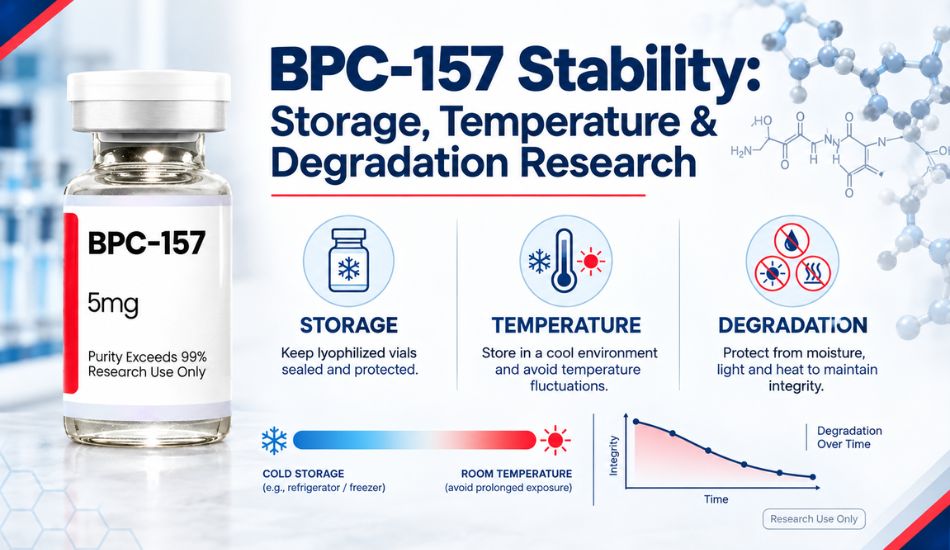
BPC-157 stability is an important consideration in peptide research because peptide integrity can be affected by environmental and formulation conditions. Temperature, moisture, pH, concentration, formulation, and handling can all influence the stability of peptide compounds.
For BPC-157 specifically, publicly available information should be interpreted carefully because detailed, standardized long-term stability data across different formulations and storage conditions remain limited.
BPC-157 is a synthetic pentadecapeptide with the molecular formula C62H98N16O22 and a molecular weight of approximately 1419.5 g/mol. Its chemical structure provides the foundation for understanding its identity, but molecular structure alone cannot establish how stable the peptide will remain under every storage condition.
For the broader chemical profile, see our BPC-157 Molecular Structure, Formula, Weight & Sequence guide.
What Does BPC-157 Stability Mean?
BPC-157 stability refers to the ability of the peptide to maintain its chemical and physical characteristics over time under defined conditions.
A stable peptide should retain its expected molecular identity and remain within acceptable specifications during the tested storage period.
Stability can involve several different factors, including:
- Chemical degradation
- Physical changes
- Aggregation
- Oxidation
- Hydrolysis
- Loss of purity
- Changes in molecular identity
- Changes caused by temperature or moisture
A stability claim is therefore meaningful only when the conditions and analytical methods used to evaluate it are clearly defined.
Why Is Peptide Stability Important?
Peptides are biological molecules made from amino acid residues, and their chemical behavior can differ from small-molecule compounds.
A peptide may undergo chemical changes without an obvious visual difference. A clear solution or intact-looking powder does not necessarily prove that the original peptide remains chemically unchanged.
For research purposes, analytical testing is therefore more reliable than appearance alone.
Techniques such as HPLC and mass spectrometry can help evaluate peptide purity and identity.
Our BPC-157 COA: How to Read Purity, HPLC & LC-MS Results guide explains how these analytical results can be interpreted.
BPC-157 and Temperature
Temperature is one of the major variables researchers consider when evaluating peptide stability.
Higher temperatures can accelerate chemical reactions and may increase the rate at which some peptide compounds undergo degradation.
However, it would be inaccurate to provide one universal temperature or storage period for every BPC-157 preparation without knowing the specific formulation and stability data for that preparation.
Research-grade stability should therefore be based on documented conditions rather than generic storage claims.
BPC-157 and Moisture
Moisture can also affect peptide stability.
For lyophilized materials, exposure to humidity can alter the physical characteristics of the material and may contribute to chemical degradation under some conditions.
This is one reason lyophilized peptide materials are generally handled differently from prepared solutions.
For a broader explanation of lyophilized peptides, see our [What Does Lyophilized Mean? Peptide Stability Explained] article.
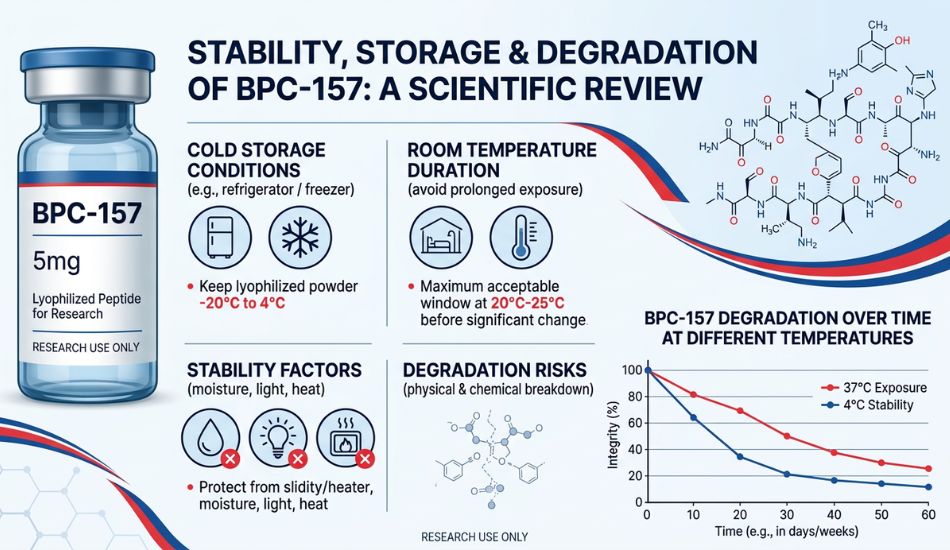
Lyophilized BPC-157 Stability
Lyophilization, commonly called freeze-drying, removes much of the water from a preparation.
The resulting dry material can provide advantages for storage and handling compared with an aqueous solution, but lyophilization does not mean a peptide is permanently stable.
The stability of a lyophilized peptide still depends on factors such as:
- Temperature
- Humidity
- Packaging
- Oxygen exposure
- Formulation
- Residual moisture
- Storage duration
Therefore, “lyophilized” describes the physical state or preparation method, not a guarantee of unlimited stability.
BPC-157 Stability After Reconstitution
Once a lyophilized peptide is converted into a solution, the stability profile can change.
The solution may be affected by:
- Solvent composition
- pH
- Concentration
- Temperature
- Container material
- Light exposure
- Microbial contamination
- Number of handling events
Because these variables differ between preparations, a universal post-reconstitution stability period should not be assumed without supporting data.
For research work, investigators should follow the specifications and validated stability information associated with the particular material being studied.
How Is BPC-157 Stability Tested?
Stability studies normally involve measuring changes in a compound over a defined period.
Depending on the research objective, analytical testing may evaluate:
HPLC
High-performance liquid chromatography can be used to monitor chromatographic purity and identify changes in the peptide profile.
Mass Spectrometry
Mass spectrometry can help investigate molecular mass and identify certain degradation or modification products.
Appearance
Physical appearance can provide useful information, but it is not sufficient by itself to establish chemical stability.
Assay or Purity Measurements
Quantitative analytical methods may be used to determine whether the target compound remains within specified limits.
The exact testing strategy depends on the material, formulation, analytical method, and purpose of the study.
What Can Cause Peptide Degradation?
Several chemical processes can contribute to peptide degradation.
These may include:
- Hydrolysis
- Oxidation
- Deamidation
- Aggregation
- Temperature-related degradation
- Repeated exposure to environmental conditions
The susceptibility of a particular peptide depends on its sequence, structure, formulation, and environment.
Therefore, degradation pathways identified for another peptide should not automatically be attributed to BPC-157.
BPC-157 Stability and Molecular Structure
BPC-157’s amino acid sequence is an important part of its chemical identity.
The sequence is:
GEPPPGKPADDAGLV
Its molecular formula is:
C62H98N16O22
Understanding the molecular structure helps researchers identify the compound and interpret analytical results.
However, structure alone cannot provide a complete stability profile. Actual stability needs to be measured under defined experimental conditions.
BPC-157 Stability and COA Testing
A certificate of analysis can provide information about a specific research batch, including analytical results that may help establish identity and purity at the time of testing.
However, a COA should not automatically be interpreted as a long-term stability study.
A purity result from one analytical test answers a different question from:
“How stable is this material after six months under a specified temperature and humidity?”
That second question requires appropriately designed stability testing.
How Should Researchers Evaluate BPC-157 Stability Information?
When reviewing stability claims, look for:
- Specific storage conditions
- Defined testing intervals
- Analytical methods
- Starting purity
- Observed degradation
- Formulation information
- Packaging conditions
- Lot or batch information
A statement such as “stable for X months” is much less useful if the testing conditions and analytical methodology are not provided.
BPC-157 Stability: What Is Actually Established?
The scientific literature contains extensive experimental interest in BPC-157, but detailed stability information is not as extensive as the broader biological literature.
Some published research has described BPC-157 as stable in human gastric juice, but this finding should not be interpreted as evidence of a universal shelf life or stability under all storage conditions (PubMed — BPC-157 stability research).
This means stability claims should be tied to specific formulations and analytical evidence whenever possible.
Researchers should distinguish between:
General peptide-handling principles
and
Validated BPC-157-specific stability data.
These are not the same thing.
Conclusion
BPC-157 stability depends on the physical and chemical conditions surrounding the peptide.
Temperature, moisture, formulation, pH, concentration, packaging, and handling can all influence peptide integrity. Lyophilization may improve handling and storage characteristics, but it does not eliminate the need for appropriate stability evaluation.
The most reliable approach is to use documented, compound-specific analytical data rather than assuming a universal storage period.
Frequently Asked Questions
Is BPC-157 stable?
BPC-157 can be studied under defined storage and formulation conditions, but stability depends on the specific preparation and environment. A universal stability period should not be assumed without supporting data.
Does temperature affect BPC-157 stability?
Temperature can influence peptide degradation rates. The actual effect depends on the formulation and storage conditions.
Is lyophilized BPC-157 more stable?
Lyophilization removes much of the water from a preparation and can improve storage characteristics, but it does not guarantee unlimited stability.
Does a COA prove BPC-157 stability?
No. A COA documents analytical results for a particular batch and test. It is not automatically equivalent to a long-term stability study.
How is BPC-157 degradation detected?
Researchers can use analytical techniques such as HPLC and mass spectrometry to investigate changes in purity, molecular mass, and degradation products.
See our BPC-157 Research: Studies, Mechanism, Structure & Properties
2 comments