
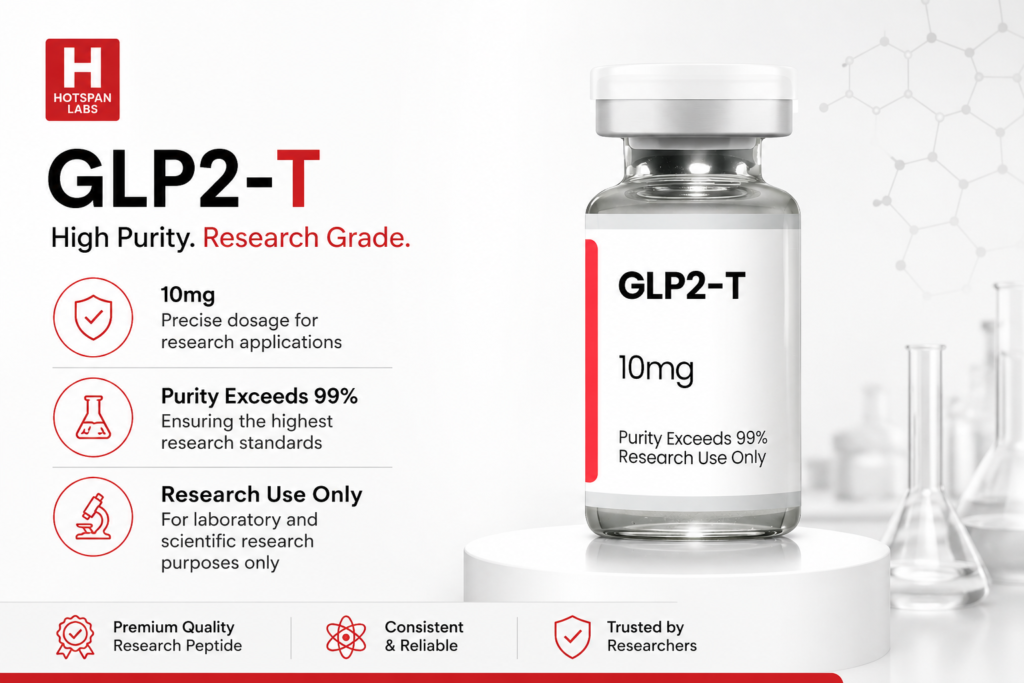
Tirzepatide (GLP2-T) is a synthetic peptide studied as a dual GIP/GLP-1 receptor agonist for its effects on appetite regulation, glucose control, and metabolic rate in laboratory research. It is sold strictly for Research Use Only and is not approved for human use.
Key Facts
| Also known as | GLP2-T |
| Classification | Synthetic dual GIP/GLP-1 receptor agonist peptide |
| Molecular weight | 5,211 Da |
| Primary research focus | Appetite regulation, metabolic rate, and glucose control models |
| Purity standard | ≥99%, HPLC and mass-spectrometry verified |
| Legal status | Research Use Only — not for human consumption |
What Is Tirzepatide?
Tirzepatide (GLP2-T) is a synthetic peptide studied as a dual agonist of the GIP and GLP-1 receptors — two natural hormone systems that regulate appetite and glucose metabolism. Unlike single-pathway compounds, Tirzepatide is investigated for activating both receptor systems simultaneously.
- GLP-1 (Glucagon-Like Peptide-1): studied for appetite suppression, slowed gastric emptying, insulin release, and increased energy expenditure.
- GIP (Glucose-Dependent Insulinotropic Polypeptide): studied for amplifying insulin secretion, enhancing GLP-1 signaling, and independently increasing metabolic rate.
Research models suggest combined GIP/GLP-1 activation produces stronger appetite suppression and glucose control than single-receptor agonists, though results vary by study design and dose.
How Does Tirzepatide Work in Research Models?
In research models, Tirzepatide is studied for a multi-step receptor-binding process:
- Binds GLP-1 receptors on appetite-regulating hypothalamic neurons
- Simultaneously binds GIP receptors on pancreatic insulin-secreting cells
- GLP-1 activation is associated with reduced appetite signaling
- GIP activation is associated with enhanced insulin release and glucose regulation
- Combined receptor activation is studied for effects on appetite, glucose control, and energy expenditure
What Metabolic Effects Are Studied?
Appetite Regulation
Research models report appetite reduction in the 20–40% range depending on dose, attributed to activation of POMC neurons, inhibition of neuropeptide Y signaling, increased leptin sensitivity, and slowed gastric emptying.
Glucose and Insulin Regulation
Tirzepatide’s GIP component is studied for glucose-dependent insulin secretion and glucagon inhibition. Research models report HbA1c reductions of 1–2%, an outcome relevant to metabolic-disease research.
Metabolic Rate
Research models report energy-expenditure increases of roughly 8–12%, associated with basal metabolic rate, thermogenesis, and brown adipose tissue activity.
Fat Mass Distribution
Research models suggest Tirzepatide preferentially affects visceral fat over subcutaneous fat, with relative preservation of lean mass compared to caloric-restriction-only models.
What Dosing Is Reported in Tirzepatide Research?
The following ranges reflect protocols described in published research models and are provided for research reference only.
- In vivo model dosing: initial dose 5mg/week, maintenance dose 10mg/week, high-dose protocols up to 15mg/week studied; 8–12 week study durations are common; once-weekly administration.
- In vitro dosing: 1–100 nM concentration range, with 10–50 nM as a typical working dose; 2–24 hour incubation periods; vehicle-only controls for baseline comparison.
- Titration protocols: many studies escalate gradually — 5mg/week for weeks 1–2, 7.5mg/week for weeks 3–4, 10mg/week from week 5 onward — to study dose-response relationships.
What Quality Standards Does Hotspan Tirzepatide Meet?
All Hotspan research peptides, including Tirzepatide, are produced and verified against a single set of quality standards, summarized here and referenced throughout this guide and other product pages.
- Third-party HPLC analysis: confirms ≥99% purity and identifies degradation products.
- Mass spectrometry verification: confirms molecular weight (5,211 Da) and sequence accuracy.
- Endotoxin testing (LAL assay): verified to <5 EU/vial.
- USA GMP manufacturing: batch-to-batch consistency under regular facility inspection.
- Certificate of Analysis: chromatogram, mass-spec data, endotoxin results, batch number, and chemist sign-off provided with every batch.
Full documentation is available in the COA Library linked below.
Product Specifications
Product: Tirzepatide (GLP2-T) · Molecular weight: 5,211 Da · Purity: ≥99% (HPLC + mass spectrometry) · Form: lyophilized powder · Sterility: endotoxin-tested, <5 EU/vial. Full specifications, storage stability, and reconstitution details are available on the product page.
| Available Quantity | Purity | COA Reference | Price | |
| 10mg vial | ≥99% | COA-TZP10 | $79 | Pilot studies |
| 30mg vial | ≥99% | COA-TZP30 | $179 | Maintenance dosing |
| Bulk / multi-vial | ≥99% | On request | Contact for pricing | Extended studies |
Storage and Stability
- Lyophilized (unopened): 12–24 months frozen at -20°C, 3–6 months refrigerated at 2–8°C, use within 2 weeks at room temperature.
- Reconstituted: 2–4 weeks refrigerated at 2–8°C, 3–6 months frozen at -20°C, 1+ year at -80°C for long-term banking; minimize freeze-thaw cycles, as each cycle reduces potency by roughly 5%.
- Degradation factors: light exposure, heat, repeated freeze-thaw cycles, contamination, and pH shifts all reduce peptide stability.
Frequently Asked Questions
How quickly do effects appear in research models?
Appetite-related changes are reported within 24–48 hours in research models. Measurable weight change (5%+) is typically reported within 2–4 weeks, with maximum effects studied over 8–12 weeks.
Is tolerance an issue in research models?
Studies report minimal receptor downregulation over 6–12 month research windows, which is one reason Tirzepatide is used in extended-protocol research.
What is a typical starting dose in research models?
Published protocols commonly start at 5mg/week (in vivo), escalating to a 10mg/week maintenance dose; 15mg/week is the highest dose studied.
How is research-grade Tirzepatide different from a prescription version?
Research-grade Tirzepatide is intended strictly for laboratory and in vitro use. A prescription version, where available, is FDA-regulated, physician-dosed, and offered through a separate medical program with its own supervision requirements.
How can I verify a batch’s quality?
Every batch ships with a Certificate of Analysis confirming ≥99% purity via HPLC, correct molecular weight via mass spectrometry, endotoxin below 5 EU/vial, and a chemist sign-off with batch traceability.
Can I order bulk quantities for extended research?
Yes. Contact support for volume pricing on multi-vial and institutional orders.
Related Research Resources
Research Use Only
Content on this page is for informational and educational purposes about peptide research. Products sold by Hotspan Labs are intended strictly for in vitro research and laboratory experimentation, not for human consumption or clinical application.