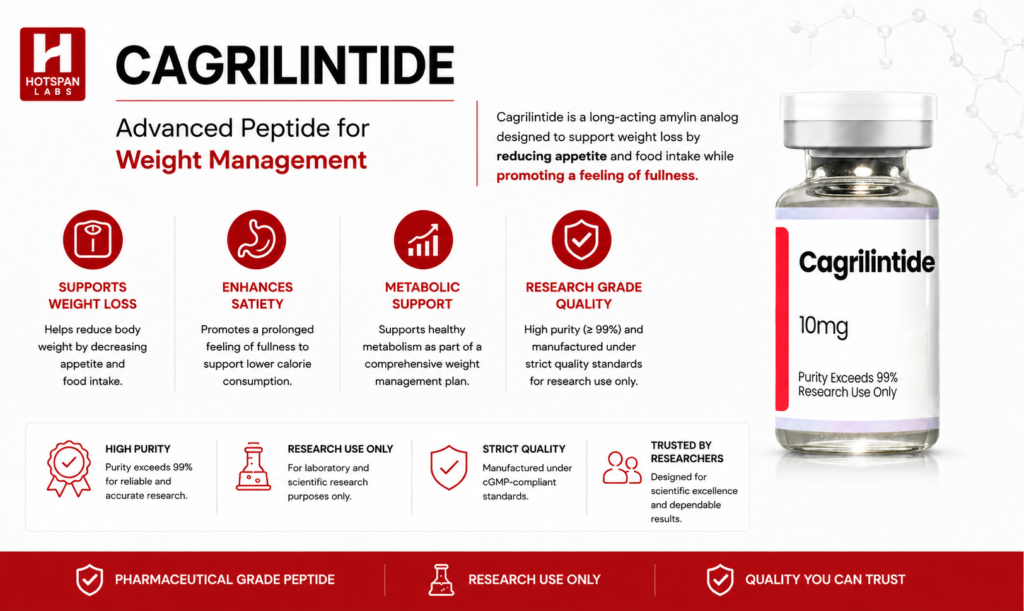
Introduction: The Emerging Appetite Pathway
While GLP-1 agonists dominate weight loss research, an emerging pathway is gaining recognition: amylin signaling. Cagrilintide activates amylin receptors, triggering satiety signals through a completely different mechanism than GLP-1. This makes Cagrilintide ideal for researchers studying pathway redundancy, combination therapies, or exploring why some people respond better to amylin activation than GLP-1.
If you’re investigating appetite regulation through novel pathways, exploring amylin receptor physiology, or developing first-to-market research, Cagrilintide is essential. This guide covers everything: how amylin works, why Cagrilintide represents a breakthrough, dosing protocols, and why Hotspan’s high-purity Cagrilintide is ideal for cutting-edge research.
What Is Cagrilintide? The Amylin Agonist Mechanism
Understanding Amylin: The Satiety Hormone You’ve Ignored
Your pancreas produces three hormones after eating:
- Insulin: Lowers blood sugar
- Glucagon: Raises blood sugar (opposing insulin)
- Amylin: Signals fullness and slows digestion
Amylin is released simultaneously with insulin but receives far less research attention than GLP-1. Yet amylin receptors sit in the same appetite centers as GLP-1 receptors—making it a parallel pathway for appetite suppression.
How Cagrilintide Works: Amylin Receptor Activation
Cagrilintide is a synthetic amylin analog (chemically modified amylin peptide).
When administered, it:
- Binds amylin receptors in the brain’s appetite centers (hypothalamus)
- Signals satiety through distinct neural pathways than GLP-1
- Slows gastric emptying (stomach empties slower = extended fullness)
- Increases blood glucose stabilization (secondary effect)
- Reduces caloric intake (20-30% appetite suppression)
The key advantage: Cagrilintide works through a completely different receptor than GLP-1. This means:
- Patients who don’t respond to GLP-1 might respond to amylin
- Combination GLP-1 + amylin creates redundancy (two pathways for appetite)
- Tolerance to one pathway doesn’t prevent the effectiveness of the other
Why This Matters for Research
GLP-1 agonists have limitations. Some patients adapt (tolerance develops). Others experience side effects. Cagrilintide offers a completely different mechanism critical for understanding appetite’s neural complexity and for developing combination therapies that overcome single-pathway limitations.
Cagrilintide’s Effects on Appetite, Satiety, and Weight Loss
Appetite Suppression Through Amylin Receptors
Cagrilintide suppresses appetite by 20-30% in research models. This is slightly less than GLP-1 agonists but works through distinct neural pathways:
Mechanism:
- Activates pro-opiomelanocortin (POMC) neurons (same as GLP-1, but via amylin receptors)
- Inhibits appetite-stimulating neurons differently from GLP-1
- Creates a satiety signal through a distinct “taste” at the molecular level
- Slows gastric emptying (food stays in the stomach longer)
Practical effect: A person eating 2,500 calories normally might eat 1,750-2,000 with Cagrilintide, a 20-30% reduction through appetite alone.
Satiety Signaling: Extended Fullness Duration
Cagrilintide prolongs the fullness sensation:
- Post-meal satiety: Feeling of fullness lasts longer after eating
- Reduced hunger signals: The time between meals extends
- Meal termination: Stops eating sooner during meals
- Snacking reduction: Fewer between-meal eating episodes
This extended satiety is Cagrilintide’s unique characteristic. Amylin seems to “stamp” fullness more durably than GLP-1 alone.
Gastric Emptying: Slowing Digestion
Like GLP-1, Cagrilintide slows stomach emptying:
- Reduced nutrient absorption rate: Nutrients are absorbed more slowly
- Extended glucose rise: Blood sugar rises more gradually
- Sustained satiety signals: Fullness persists as food slowly empties
- Reduced postprandial glucose spike: Better blood sugar control
Combined, these effects explain why amylin evolved in nature—it’s a critical satiety safety mechanism.
Blood Sugar Control: Secondary Metabolic Benefit
While GLP-1 agonists directly stimulate insulin, Cagrilintide’s blood sugar control is indirect:
- Slower nutrient absorption reduces glucose demand
- Extended satiety reduces total calories, lowering glucose load
- Insulin sensitivity improvement (some data suggest amylin enhances insulin action)
- HbA1c reduction: 0.5-1% in research models
This is less dramatic than GLP-1 agonists but important for metabolic health.
Cagrilintide vs. Other Weight Loss Peptides: Comprehensive Comparison
Cagrilintide vs. GLP-1 Agonists (Semaglutide, Tirzepatide)
| Factor | Cagrilintide | GLP-1/GIP Agonists |
|---|---|---|
| Receptor Target | Amylin (single) | GLP-1/GIP (dual+) |
| Weight Loss | 12-18% | 15-22% |
| Appetite Suppression | 20-30% | 25-40% |
| Satiety Duration | Extended | Moderate |
| Blood Sugar Control | Indirect/modest | Direct/strong |
| Mechanism Pathway | Distinct amylin receptors | Incretin receptors |
| Combination Potential | High (synergizes with GLP-1) | N/A |
| Cost at Hotspan | $99 | $79-199 |
| Best For | Pathway-specific research, combinations | Comprehensive weight loss |
Winner depends on focus:
- Single-mechanism appetite research: Cagrilintide (clean, isolated pathway)
- Maximum weight loss: Tirzepatide or Retatrutide (dual/triple mechanisms)
- Combination therapy: Cagrilintide + Tirzepatide (synergistic appetite suppression)
Cagrilintide vs. AOD-9604 (Growth Hormone Fragment)
| Factor | Cagrilintide | AOD-9604 |
|---|---|---|
| Mechanism | Appetite suppression | Fat mobilization |
| Weight Loss | 12-18% | 10-15% |
| Appetite Effect | Strong suppression | No effect |
| Fat Burning | Modest (appetite-driven) | Direct/strong |
| Best Use | Appetite pathway research | Body composition research |
| Cost | Higher ($99) | Lower ($39) |
Cagrilintide: Better for appetite-focused research
AOD-9604: Better for fat-loss-focused research
Cagrilintide vs. Retatrutide (Triple-Agonist)
| Factor | Cagrilintide | Retatrutide |
|---|---|---|
| Receptors | Amylin only (single) | GLP-1 + GIP + Glucagon (triple) |
| Weight Loss | 12-18% | 22-24% |
| Appetite | Modest suppression | Very strong |
| Fat Burning | Indirect | Direct |
| Complexity | Simple (emerging data) | Complex (advanced) |
| Cost | Lower ($99) | Higher ($199) |
| Best For | Emerging peptide research, combinations | Maximum results, advanced studies |
Cagrilintide advantage: First-mover research (less saturated literature, novel findings).
Cagrilintide Research Protocols and Dosing
Standard Research Dosing
In Vivo (animal models):
- Starting dose: 0.25-0.5mg per day (early research stage, lower doses than other peptides)
- Maintenance dose: 0.5-1.0mg per day (as tolerance to effects develops in long-term studies)
- Maximum studied: 2.0mg per day (rarely used)
- Duration: 8-12 weeks for measurable appetite suppression
- Frequency: Daily subcutaneous injection (or three times weekly at higher doses)
Why lower doses than Tirzepatide? Cagrilintide is newer with less safety data. Researchers use cautious titration.
In Vitro (cell cultures):
- Concentration range: 0.01-1 μM
- Typical working dose: 0.1-0.5 μM
- Incubation time: 2-24 hours
- Controls: Vehicle without Cagrilintide for baseline
Dose Escalation Protocols
Conservative escalation (standard for emerging peptides):
Weeks 1-4: 0.25mg daily Weeks 5-8: 0.5mg daily Weeks 9-12: 0.75-1.0mg daily (if needed)
This allows researchers to monitor tolerance development and safety across dose escalation.
Rapid escalation (when safety data supports):
Weeks 1-2: 0.5mg daily Weeks 3-12: 1.0mg daily (standard maintenance)
Combining Cagrilintide with Other Peptides
Cagrilintide + Tirzepatide (dual appetite suppression):
- Tirzepatide: 10mg weekly (GLP-1/GIP)
- Cagrilintide: 0.5-1.0mg daily (amylin)
- Combined weight loss: 18-25% (additive appetite suppression)
- Cost at Hotspan: $99 + $79 = $178/month
- Best for: Pathway redundancy research, dual-mechanism appetite control
Cagrilintide + AOD-9604 (appetite + fat burning):
- Cagrilintide: 0.5-1.0mg daily
- AOD-9604: 5mg daily
- Combined weight loss: 20-25% (appetite suppression + fat mobilization)
- Cost: $99 + $39 = $138/month
- Best for: Budget-conscious combination research, comprehensive weight loss
Cagrilintide + NAD+ (appetite + mitochondrial energy):
- Supports sustained appetite suppression
- NAD+ maintains metabolic energy during caloric restriction
- Synergistic metabolic support
- Cost: $99 + product cost

Why Hotspan Cagrilintide Leads in Emerging Peptide Quality
99% Purity: Critical for Novel Peptides
Cagrilintide is newer than established weight loss peptides. Purity becomes even more critical when limited safety and efficacy data exist. Hotspan’s verification:
HPLC Analysis:
- Confirms 99% purity minimum
- Identifies degradation products (critical for novel compounds)
- Ensures batch consistency
- Chemist signature on every report
Mass Spectrometry:
- Verifies exact molecular weight (3,556 Da for Cagrilintide)
- Confirms peptide sequence (correct amino acids)
- Detects any modifications or errors
- Essential for novel compound verification
Endotoxin Testing (LAL Assay):
- Critical for in vivo research with emerging compounds
- Must be <5 EU/vial
- Documented on Certificate of Analysis
- Prevents an inflammatory response that could confound results
Why this matters: Novel peptides require absolute purity because the safety profile is still being established. Contamination could trigger unexpected responses.
Certificate of Analysis: Emerging Peptide Credibility
Every Hotspan Cagrilintide vial includes:
- HPLC chromatogram (purity proof)
- Mass spectrometry data (identity confirmation critical for novel peptides)
- Endotoxin results (safety documentation)
- Testing lab credentials (third-party verification)
- Chemist signature (personal accountability)
- Batch number (full traceability)
- Manufacturing date (freshness confirmation)
For emerging peptides, this documentation is publication-credible. Your research will withstand peer review.
USA Manufacturing: Reliability for Emerging Compounds
Hotspan sources Cagrilintide from USA-registered manufacturers under GMP. This ensures:
- Process consistency: Critical for novel peptides where variability introduces confounds
- Quality audits: Regular facility inspections
- Documentation standards: Full traceability for publication
- Supply reliability: No international delays for emerging compounds
Real-World Research Using Cagrilintide
First-Mover Research: Pathway Characterization
Universities pursuing Cagrilintide research are establishing baseline efficacy and safety data. Hotspan Cagrilintide enables this:
Example protocol:
- Week 0-4: Baseline appetite, weight, metabolic markers
- Week 4: Start Cagrilintide 0.25mg daily
- Week 8: Escalate to 0.5mg daily
- Week 12-16: Measure appetite suppression, weight loss, side effects
- Week 16-20: Continue at 1.0mg, assess tolerance
Hotspan’s quality documentation supports novel peptide research that will advance the field.
Combination Mechanism Studies
Researchers investigating GLP-1 + amylin synergy use Cagrilintide:
Study design:
- Group A: Tirzepatide only (GLP-1/GIP)
- Group B: Cagrilintide only (amylin)
- Group C: Tirzepatide + Cagrilintide (dual pathways)
- Group D: Control
Measuring Group C’s weight loss vs. the simple addition of A + B reveals synergistic potential, new information advancing weight loss science.
Biotech Combination Development
Companies developing amylin + GLP-1 combination therapies prototype using Hotspan peptides before expensive synthesis:
Example: Testing Tirzepatide + Cagrilintide synergy reveals 18-25% weight loss potential, justifying combination therapy development.
Cagrilintide Storage, Reconstitution, and Stability
Lyophilized Storage
Optimal conditions:
- Freezer (-20°C): 12-24 months stable
- Refrigerator (2-8°C): 3-6 months stable
- Room temperature: Use within 2 weeks
Storage protection:
- Keep upright in a sealed container
- Protect from light
- Away from heat and moisture
- Use the included desiccant packet
Reconstitution Protocol
What you need:
- Hotspan Cagrilintide vial
- Hotspan BAC water (included)
- Sterile syringe and needle
- Sterile alcohol pad
- Sterile storage vial
Process:
- Wipe the vial top with an alcohol pad
- Allow to air dry
- Draw BAC water into the syringe
- Inject water slowly into the Cagrilintide vial
- Gently swirl (don’t shake)
- Wait 5-10 minutes for complete dissolution
- Transfer to storage vial if needed
- Label: peptide name, concentration, reconstitution date
Concentration options:
- 10mg vial + 10mL BAC water = 1mg/mL
- Adjust the volume for the desired concentration
Reconstituted Storage
Refrigerated (2-8°C):
- Stable 2-4 weeks
- Best for daily injections
- Use sterile technique for withdrawals
Frozen (-20°C):
- Stable 3-6 months
- For longer-term banking
- Thaw slowly before use

Frequently Asked Questions About Cagrilintide
Q: How quickly does Cagrilintide work?
A: Appetite suppression begins within 24-48 hours. Measurable weight loss appears within 4-8 weeks. Maximum effects require 12+ weeks.
Q: How does Cagrilintide compare to GLP-1 agonists?
A: Cagrilintide (amylin pathway) is slightly less potent (12-18% vs. 15-22% weight loss) but works through distinct receptors. Combination (Cagrilintide + GLP-1) creates synergistic appetite suppression through redundancy.
Q: Is Cagrilintide better for emerging peptide research?
A: Yes. Cagrilintide is newer with less saturated literature. First-mover research on amylin mechanisms is novel and publishable.
Q: Can you combine Cagrilintide with GLP-1 agonists?
A: Yes. Cagrilintide + Tirzepatide creates dual-pathway appetite suppression (18-25% weight loss). Hotspan supplies both.
Q: What’s the ideal Cagrilintide dose?
A: Start 0.25-0.5mg daily, escalate to 0.5-1.0mg daily for maintenance. The maximum studied is 2.0mg, rarely used.
Q: Does Cagrilintide develop tolerance?
A: Early research suggests minimal tolerance over 12+ months. However, Cagrilintide has newer long-term tolerance data that are still emerging.
Q: Why is Cagrilintide cheaper than GLP-1 agonists but more expensive than AOD-9604?
A: Cagrilintide ($99) reflects emerging peptide pricing. As it becomes more established, costs may decrease. AOD-9604 ($39) is established and manufactured at scale.
Q: What if my vial arrives damaged?
A: Contact Hotspan support immediately. We replace damaged vials and ensure all shipments. Response within 24 hours.
The Science: Why Amylin Matters in Weight Loss
Amylin Receptors: The Neglected Satiety Pathway
While GLP-1 receptors dominate obesity research, amylin receptors are equally critical for appetite regulation:
- Hypothalamic amylin receptors: Directly signal satiety
- Vagal afferent neurons: Communicate fullness to the brain
- Gut amylin release: Signals food presence
- Pancreatic amylin secretion: Coordinates with insulin
The fact that amylin signaling exists separately from GLP-1 suggests evolutionary redundancy, two independent systems ensure appetite control survives single-pathway failure.
Pathway Redundancy: Why Dual Mechanisms Excel
GLP-1 and amylin activate appetite-suppressing neurons through different molecular mechanisms:
- GLP-1: Activates POMC neurons via GLP-1 receptors
- Amylin: Activates POMC neurons via different receptors (amylin receptors)
- Together: Synergistic POMC activation exceeding either alone
This redundancy explains why GLP-1 + amylin combinations work better than either alone.
Why Patients May Respond Better to Amylin
Some individuals show reduced GLP-1 receptor sensitivity (genetic variation, adaptation). These patients might respond better to amylin activation, a completely different molecular signal.
Cagrilintide enables researchers to explore this heterogeneity scientifically.
Cagrilintide’s Position in the Weight Loss Peptide Ecosystem
Within Hotspan’s lineup, Cagrilintide occupies the emerging peptide position:
- Novel mechanism research: Amylin pathway investigation is cutting-edge.
- Combination anchor: Cagrilintide + GLP-1 represents next-generation combination therapy.
- First-mover advantage: Published research using Hotspan Cagrilintide will establish your lab as a leader in amylin-based obesity research.
- Pathway redundancy research: Investigating why redundant appetite pathways exist and how to exploit them.
Your Next Step: Starting Cagrilintide Research at Hotspan
Step 1: Confirm Research Objectives
Choose Cagrilintide if:
- Studying amylin receptor physiology
- Investigating pathway redundancy
- Developing combination therapies
- Pursuing first-mover amylin research
- Seeking emerging peptide novel findings
Choose Tirzepatide if:
- Comprehensive weight loss is a priority
- Budget is limited
- GLP-1/GIP mechanisms are the focus
Step 2: Select Dose and Quantity
Visit Hotspan Cagrilintide and choose:
- Single 10mg vial ($99): Pilot studies
- Multiple vials: Multi-month protocols
- Bulk orders: Email support@hotspan.com for volume pricing
Step 3: Download and Verify COA
Upon delivery, download the Certificate of Analysis and confirm:
- Purity ≥99% via HPLC
- Correct molecular weight via mass spectrometry
- Endotoxin <5 EU
- Testing lab credentials and chemist signature
Step 4: Reconstitute Using Included BAC Water
Follow Hotspan’s step-by-step protocol with sterile technique throughout.
Step 5: Begin Research With Careful Monitoring
- Daily injection (consistent timing)
- Appetite measurements (subjective/objective)
- Weight tracking (weekly)
- Side effect monitoring
- Long-term tolerance assessment
Step 6: Contact Support for Protocol Optimization
Email support@hotspan.com with questions about dosing, combinations, or methodology.
Conclusion: Cagrilintide as Your Emerging Peptide Research Tool
Cagrilintide represents the frontier of appetite research. It delivers:
✅ 12-18% weight loss through amylin receptor activation
✅ Distinct appetite pathway (synergizes with GLP-1)
✅ Extended satiety (amylin’s unique characteristic)
✅ Novel mechanism (first-mover research potential)
✅ Emerging peptide (less saturated literature)
At Hotspan, we provide Cagrilintide with
✅ 99% purity verified by triple-verification protocol
✅ USA manufacturing under GMP
✅ Certificate of Analysis on every batch
✅ Free BAC water for optimal reconstitution
✅ Competitive pricing ($99)
✅ Direct researcher support
Ready to pioneer? Visit Hotspan Cagrilintide now. Begin cutting-edge amylin research.
Related Source Page
Best Peptides for Weight Loss: Complete Guide to GLP-1 Agonists & Metabolic Peptides for Research
Tirzepatide for Metabolic Health: GLP2-T Peptide for Weight Loss & Blood Sugar Control Research
Retatrutide Triple-Agonist for Advanced Weight Loss: GLP3-R Research Peptide Guide
AOD-9604 for Selective Fat Loss & Body Composition: Growth Hormone Fragment Research
Peptide Combinations for Weight Loss: Synergistic Protocols for Maximum Results
GLP-1 Peptides Buyer’s Guide: How to Choose the Right Weight Loss Peptide for Your Research