
Muscle recovery sits at the intersection of cellular repair, inflammation biology, extracellular matrix remodeling, and mitochondrial energy dynamics. Researchers studying these pathways increasingly look at peptides for muscle recovery as molecular tools that interact directly with the signaling networks governing how tissue responds to stress, damage, and regeneration signals.
This guide covers every major peptide category relevant to muscle recovery research — the underlying biology, the specific compounds studied, how they map to recovery pathways, and where Hotspan’s ≥99% GMP-manufactured compounds fit within each research domain.
What Happens at the Cellular Level During Muscle Recovery?
Before evaluating which peptides researchers study for muscle recovery, it helps to understand the biological cascade that repair processes involve. Skeletal muscle recovery after mechanical stress progresses through overlapping phases:
Phase 1 — Inflammatory Signaling (0–72 hours)
Damaged myofibers release damage-associated molecular patterns (DAMPs) that trigger localized inflammatory signaling. Macrophages infiltrate and clear debris. Pro-inflammatory cytokines (IL-1β, TNF-α, IL-6) peak, then transition toward anti-inflammatory mediators. This phase is essential premature suppression of inflammation impairs satellite cell activation.
Phase 2 — Satellite Cell Activation and Proliferation
Muscle stem cells (satellite cells) activate in response to growth factor signals, primarily hepatocyte growth factor (HGF) and fibroblast growth factors (FGFs). They proliferate, differentiate into myoblasts, and begin fusing with damaged fibers.
Phase 3 — Extracellular Matrix Remodeling
Fibroblasts remodel the ECM scaffold that supports myofiber regeneration. Collagen turnover, glycosaminoglycan synthesis, and angiogenesis occur simultaneously. This is where compounds studied for fibroblast signaling and vascular biology intersect with muscle recovery research.
Phase 4 — Mitochondrial Biogenesis and Energy Restoration
Mitochondria, the energy generators of muscle cells, must recover and expand their network to restore cellular energy capacity. AMPK and PGC-1α pathways drive this process.
Peptides studied for muscle recovery research target one or more of these phases at the receptor and signaling pathway level.
The Core Peptides For Muscle Recovery Research
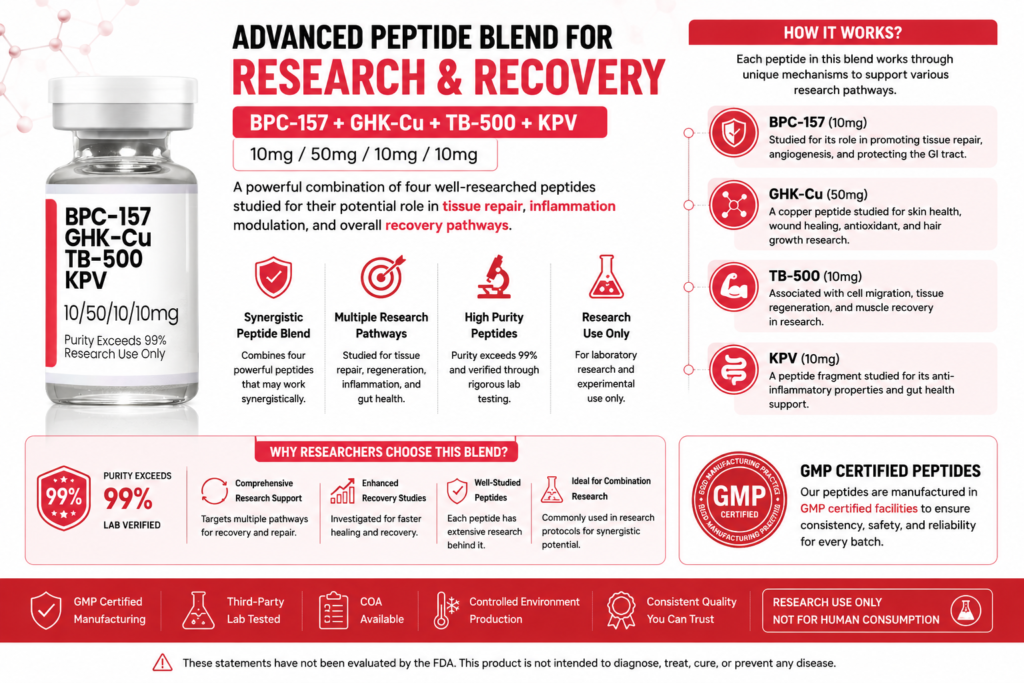
BPC-157 — The Tissue Repair Signaling Peptide
BPC-157 (Body Protection Compound-157) is a synthetic 15-amino-acid pentadecapeptide and one of the most extensively studied compounds in preclinical tissue repair research. It originates from a fragment sequence associated with gastric-derived cytoprotective protein systems.
What research evaluates with BPC-157:
- Fibroblast migration and proliferation dynamics
- Extracellular matrix (ECM) organization and remodeling
- Endothelial cell signaling related to angiogenesis
- Nitric oxide–linked signaling pathways
- Oxidative stress biomarkers in tissue models
- Growth factor–associated vascular adaptation
BPC-157 appears frequently in muscle and connective tissue repair literature because its studied pathways fibroblast signaling, ECM organization, angiogenesis, and nitric oxide modulation map directly onto the biological processes active during the ECM remodeling phase of muscle recovery.
Available at Hotspan — two dosage variants:
| Dosage | Price | COA |
|---|---|---|
| 5mg | $39 | HL 3664990 |
| 10mg | $79 | HL 9216929 |
Both variants are independently tested, lyophilized, ≥99% pure, with batch-specific COA and endotoxin reports.
TB-500 — The Actin Dynamics and Cell Migration Peptide
TB-500 is a synthetic 43-amino-acid analogue of Thymosin Beta-4 (Tβ4), a naturally occurring actin-binding molecule distributed throughout human tissue. It is one of the most structurally studied peptides in cytoskeletal and cell migration biology.
What research evaluates with TB-500:
- Actin monomer (G-actin) sequestration and filament (F-actin) dynamics
- Cell migration kinetics in fibroblast and endothelial models
- Extracellular matrix reorganization
- Angiogenesis-associated transcriptional programs
- Epithelial and stromal re-epithelialization kinetics
- Oxidative stress signaling
- Tissue remodeling endpoints under controlled conditions
Actin dynamics are central to muscle fiber integrity actin and myosin form the contractile apparatus of skeletal muscle. TB-500’s studied role in actin regulation, cell migration, and ECM remodeling makes it a compound of significant interest in muscle recovery biology research.
Available at Hotspan:
| Dosage | Price | COA |
|---|---|---|
| 10mg | $69 | HL 7308120 |
BPC-157 + TB-500 Stack — Dual-Pathway Tissue Repair Research
BPC-157 TB-500 is Hotspan’s pre-blended combination of both repair peptides purpose-built for researchers who study how fibroblast signaling (BPC-157) and actin/cytoskeletal dynamics (TB-500) interact within the same experimental model.
The research rationale for combining them is pathway complementarity:
| Compound | Primary Pathway | Research Focus |
|---|---|---|
| BPC-157 | Fibroblast biology, NO signaling, angiogenesis | ECM remodeling, vascular adaptation |
| TB-500 | Actin dynamics, cytoskeletal organization, cell migration | Fiber integrity, tissue remodeling kinetics |
Using the pre-blended compound eliminates the variable of reconstituting two separate vials at different concentrations, a significant source of protocol error in multi-compound studies.
Available at Hotspan:
| Dosage | Price | COA |
|---|---|---|
| 10mg | $99 | HL 9562504 |
MOTS-c — The Mitochondrial Recovery Peptide
MOTS-c is a 16-amino-acid mitochondrial-derived peptide (MDP), a class of signaling molecules encoded within the mitochondrial genome itself rather than nuclear DNA. It is encoded within the mitochondrial 12S rRNA gene.
This makes MOTS-c structurally unique among peptides studied for recovery biology. While BPC-157 and TB-500 address structural and vascular aspects of tissue repair, MOTS-c targets the energy infrastructure that powers the repair process.
What research evaluates with MOTS-c:
- Metabolic signaling pathways in mitochondria
- Inter-organelle communication between mitochondria and nucleus
- AMPK-related metabolic regulation signals
- Cellular stress response pathways
- Mitochondrial-derived signaling in metabolic and recovery models
Muscle tissue is the most mitochondria-dense tissue in the body. After mechanical stress, mitochondrial biogenesis driven by AMPK and PGC-1α is essential for restoring cellular energy capacity. MOTS-c’s role in mitochondrial signaling research positions it at the intersection of energy biology and recovery pathway research.
Available at Hotspan:
| Dosage | Price | COA |
|---|---|---|
| 10mg | $59 | HL 8553761 |
CJC-1295 Ipamorelin — GH Axis Signaling in Recovery Research
The CJC-1295 Ipamorelin blend targets the growth hormone secretory axis — two receptor pathways that regulate growth factor availability in tissue repair contexts.
Growth hormone and IGF-1 interact with satellite cell activation, protein synthesis signaling, and ECM turnover. Researchers studying how GH axis signaling influences recovery biology use this blend to model dual-receptor engagement of the somatotropic cascade. Full compound breakdown is available in Hotspan’s CJC-1295 Ipamorelin sourcing guide.
Available at Hotspan:
| Dosage | Price |
|---|---|
| 10mg | $79 |
NAD+ — Cellular Energy and DNA Repair Signaling
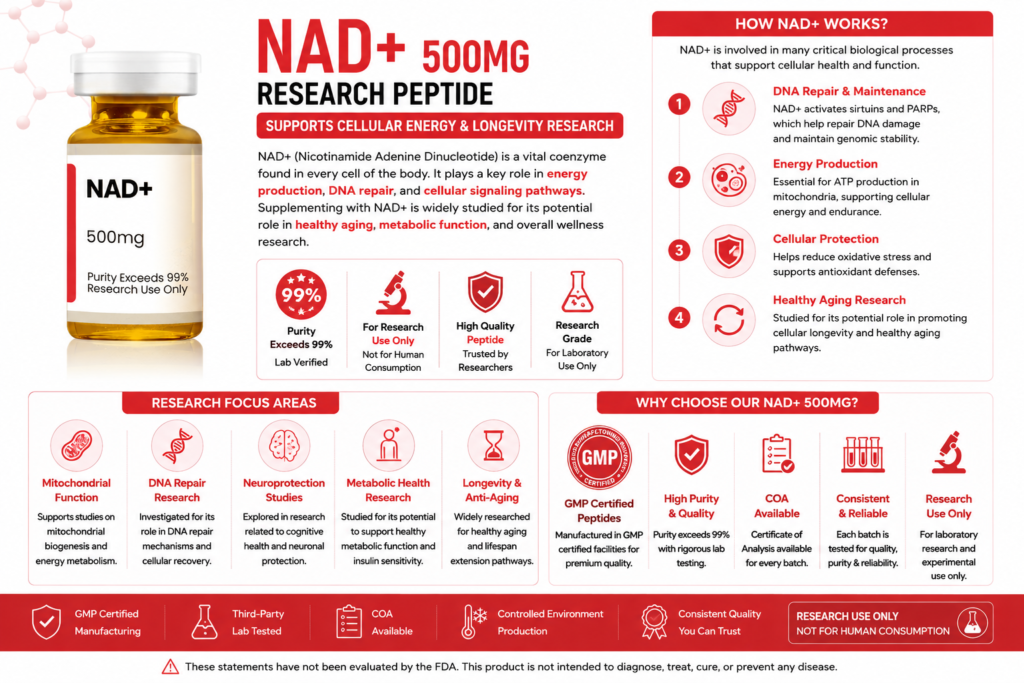
NAD+ (Nicotinamide Adenine Dinucleotide) occupies a unique position in recovery biology research. It is not a peptide it is a coenzyme, but it operates alongside peptide signaling networks in pathways that directly intersect with muscle recovery biology.
Research evaluates NAD+ in models examining:
- Sirtuin (SIRT1, SIRT3) activation — deacetylases involved in mitochondrial biogenesis and cellular stress responses
- PARP-1 activity — DNA repair signaling activated by cellular damage
- AMPK pathway interactions — energy sensing mechanisms active post-exertion
- Mitochondrial respiratory chain function
- Cellular senescence and metabolic aging markers
NAD+ declines with age in muscle tissue, and this decline correlates with reduced mitochondrial function and satellite cell activity. Research models investigating the NAD+-SIRT1-PGC-1α axis provide a molecular window into age-related muscle recovery biology.
Available at Hotspan — two dosage variants:
| Dosage | Price |
|---|---|
| 500mg | $69 |
| 1000mg | $99 |
GLOW Stack — Multi-Pathway Recovery Research
GLOW combines BPC-157 + GHK-Cu + TB-500 into a single 70mg compound, the broadest multi-pathway tissue and repair research stack in Hotspan’s catalog.
The addition of GHK-Cu, the copper tripeptide detailed in Hotspan’s peptides for anti-aging skin guide, expands the research scope to include collagen pathway regulation, glycosaminoglycan synthesis, and ECM structural repair alongside the fibroblast and actin signaling pathways of BPC-157 and TB-500.
For researchers studying connective tissue integrity alongside muscle fiber repair, GLOW provides simultaneous access to three mechanistically distinct but biologically overlapping pathways.
Available at Hotspan:
| Dosage | Price |
|---|---|
| 70mg | $169 |
The Muscle Recovery Signaling Map: Which Peptide Targets Which Pathway?
Understanding which compounds target which biological phase prevents protocol gaps and helps researchers design studies that address recovery biology comprehensively.
| Recovery Phase | Key Biology | Primary Peptides to Study | Hotspan Products |
|---|---|---|---|
| Inflammatory transition | Cytokine signaling, macrophage activity | BPC-157 (NO signaling, oxidative stress) | BPC-157 5mg / 10mg |
| ECM remodeling | Fibroblast activity, collagen turnover | BPC-157, GHK-Cu, TB-500 | BPC-157 TB-500, GLOW |
| Cytoskeletal repair | Actin dynamics, fiber integrity | TB-500 | TB-500 10mg |
| Angiogenesis | Endothelial signaling, vascular adaptation | BPC-157, TB-500 | BPC-157 TB-500 |
| GH axis / growth factor | IGF-1 signaling, satellite cell context | CJC-1295 Ipamorelin | CJC-1295 Ipamorelin 10mg |
| Mitochondrial biogenesis | AMPK, PGC-1α, energy restoration | MOTS-c, NAD+ | MOTS-c 10mg, NAD+ 500/1000mg |
| Collagen / structural ECM | Glycosaminoglycans, fibroblast signaling | GHK-Cu | GHK-Cu 50mg / 100mg |
FAQs: Peptides For Muscle Recovery Research
Q: What peptides do researchers study most for muscle recovery?
The most studied compounds in muscle and connective tissue repair biology are BPC-157 (fibroblast signaling, ECM remodeling, angiogenesis), TB-500 (actin dynamics, cytoskeletal organization, cell migration), and MOTS-c (mitochondrial signaling, energy pathway regulation). NAD+ is also extensively studied for its role in sirtuin activation and DNA repair signaling relevant to post-stress cellular recovery.
Q: What is the difference between BPC-157 and TB-500 in recovery research?
BPC-157 targets fibroblast biology, nitric oxide–linked signaling, and angiogenesis pathways, the vascular and ECM remodeling side of tissue repair. TB-500 targets actin dynamics and cell migration, the cytoskeletal and structural side. They operate through different mechanisms and are frequently studied in combination because their pathways are complementary rather than redundant.
Q: Why does mitochondrial health matter in muscle recovery research?
Skeletal muscle cells contain higher mitochondrial density than most tissues. After mechanical stress, mitochondrial function declines transiently, and recovery of that function drives cellular energy restoration. MOTS-c and NAD+ are studied in models specifically examining how mitochondrial signaling supports this recovery process.
Q: What is the GLOW stack used to study?
GLOW combines BPC-157 + GHK-Cu + TB-500 into a single 70mg compound. Researchers use it to study the intersection of fibroblast signaling (BPC-157), copper tripeptide collagen pathway effects (GHK-Cu), and actin dynamics (TB-500) within a single experimental model relevant to both connective tissue and muscle repair biology.
Q: Is CJC-1295 Ipamorelin relevant to muscle recovery research?
Yes — in the context of GH axis biology. Growth hormone and IGF-1 signaling interact with satellite cell activation and protein synthesis pathways that operate during the regeneration phase of muscle recovery. CJC-1295 Ipamorelin models dual-receptor engagement of the somatotropic cascade for researchers studying GH axis influence on recovery biology.
Q: Are these peptides safe for human use?
All Hotspan compounds are for in vitro research and laboratory experimentation only. They are not approved for human consumption, therapeutic use, or clinical application. These are research tools not treatments.
Sourcing Standards: Why Purity Matters in Recovery Research
Recovery biology research involves measuring subtle pathway-level signals, cytokine profiles, gene expression changes, protein synthesis rates, and mitochondrial output. Impurities in research compounds introduce off-target signaling that can completely invalidate these measurements.
Hotspan builds every compound to the standard recovery biology research demands:
| Quality Standard | Hotspan Delivers |
|---|---|
| Purity | ≥99% — every compound |
| Testing | Independent CLIA-certified lab |
| Method | HPLC-UV + Mass Spectrometry |
| COA | Batch-specific, downloadable |
| Endotoxin | Batch-specific LAL testing |
| Manufacturing | US-registered GMP facility |
| Format | Lyophilized — ambient-stable shipping |
| Reconstitution | Free BAC water with every order |
Full quality and testing documentation is available at Hotspan’s Quality & Testing page. For researchers evaluating GMP standards across the full catalog, our GMP certified peptides guide covers the complete verification framework.
Research Use Disclosure
All peptides available at Hotspan are intended strictly for in vitro research and laboratory experimentation only. These compounds are not approved for human consumption, therapeutic use, or clinical application. They must be handled exclusively by licensed, qualified research professionals under appropriate laboratory conditions.
Nothing in this article constitutes medical advice, clinical guidance, or health claims. All research findings referenced reflect in vitro and preclinical literature only.
Explore Hotspan’s Muscle Recovery Research Catalog
| Compound | Research Focus | Dosage | Price |
|---|---|---|---|
| BPC-157 | Fibroblast signaling, ECM, angiogenesis | 5mg / 10mg | $39 / $79 |
| TB-500 | Actin dynamics, cell migration, cytoskeletal repair | 10mg | $69 |
| BPC-157 TB-500 | Dual-pathway tissue repair stack | 10mg | $99 |
| MOTS-c | Mitochondrial signaling, metabolic recovery | 10mg | $59 |
| NAD+ | Sirtuin activation, DNA repair, mitochondrial function | 500mg / 1000mg | $69 / $99 |
| CJC-1295 Ipamorelin | GH axis, satellite cell signaling context | 10mg | $79 |
| GLOW Stack | BPC-157 + GHK-Cu + TB-500 multi-pathway | 70mg | $169 |
| GHK-Cu | Collagen pathways, ECM structural repair | 50mg / 100mg | $49 / $89 |
→ Browse the full Hotspan recovery peptide catalog → View quality & testing documentation → Get a physician-supervised protocol
© Hotspan Labs, LLC. All products for research use only. Not for human consumption. For use by qualified researchers only.