
Finding GMP certified peptides for sale has become the single most important sourcing decision a peptide researcher can make. As the market for research-grade compounds has expanded, so has the gap between legitimate, documentation-backed suppliers and low-quality manufacturers selling underspecified compounds with no analytical traceability.
This guide exists to close that information gap. It explains exactly what GMP certification means in the context of peptide manufacturing, what documentation you should demand before purchasing any research peptide, and how Hotspan’s quality infrastructure maps against every standard that matters for serious in vitro research.
What Does “GMP Certified” Mean for Research Peptides?
GMP stands for Good Manufacturing Practice, a system of quality controls governing how compounds are synthesized, tested, packaged, and stored. In pharmaceutical and research contexts, GMP compliance is the regulatory baseline for ensuring product consistency, identity, and purity.
For research peptides specifically, GMP manufacturing standards address:
- Raw material sourcing — API (active pharmaceutical ingredient) quality controls at the synthesis stage
- Facility standards — cleanroom manufacturing environments that minimize contamination risk
- Process controls — validated synthesis protocols with documented batch records
- In-process testing — quality checks at multiple stages during synthesis, not just at the end
- Final product testing — third-party analytical verification before any batch is released
- Traceability — full chain of custody documentation from API to finished compound
When a supplier advertises GMP certified peptides for sale, the key question is: which steps of the GMP framework do they actually follow, and can they prove it with documents?
Why GMP Compliance Matters for In Vitro Research
Research peptides that fail GMP standards don’t just produce bad data they can make it impossible to distinguish whether experimental results reflect the compound’s actual mechanism or an artifact of contamination.
Here are the specific failure modes that GMP manufacturing is designed to prevent:
Peptide Identity Errors
Without rigorous synthesis protocols and mass spectrometry verification, a compound labeled as BPC-157 could contain sequence errors, truncated fragments, or entirely different peptides that happen to share a similar molecular weight range. HPLC alone cannot confirm identity MS confirmation is required.
Purity Impurities
Peptide synthesis produces deletion sequences, oxidized variants, and aggregation products alongside the target compound. In non-GMP manufacturing, these remain in the final product and can trigger off-target signaling in cell culture models, invalidating results.
Endotoxin Contamination
Lipopolysaccharides (LPS) fragments of bacterial cell walls are ubiquitous in non-sterile manufacturing environments. Endotoxins are potent immune activators in mammalian cell culture systems. Even picogram quantities can dramatically alter cytokine profiles, proliferation rates, and gene expression, meaning any experiment studying immune signaling, inflammation, or cellular stress becomes uninterpretable without endotoxin testing.
Moisture and Degradation
Improperly lyophilized or stored peptides degrade into fragments that bear no relationship to the original compound. GMP protocols define lyophilization cycles, storage temperatures, and packaging specifications precisely to prevent this.
Hotspan’s GMP Manufacturing Standards: What the Documentation Shows
Hotspan Labs manufactures all peptides in USA-registered facilities following Good Manufacturing Practices. Here is exactly what that means in practice not marketing language, but specific, documentable quality infrastructure:
Independent Third-Party Testing
Every batch undergoes testing at an independent CLIA-certified laboratory, not Hotspan’s own in-house lab. This separation matters because supplier self-testing creates obvious conflicts of interest. Hotspan’s Certificates of Analysis include the testing lab principal chemist’s signature and the exact analytical methodology used.
Testing methodology: HPLC with UV detection coupled with Mass Spectrometry (HPLC-UV/MS), the dual-method standard that confirms both purity (HPLC) and molecular identity (MS).
COA + Endotoxin Report on Every Batch
Not spot-checked. Not sampled. Every batch receives a Certificate of Analysis and a batch-specific endotoxin report. Both are available for download directly from each product page on Hotspan.com.
≥99% Purity Standard
Research applications typically require 95–99%+ purity for reliable results. Hotspan’s ≥99% standard exceeds what most in vitro protocols require and meets pharmaceutical-grade purity thresholds.
American Peptide Association Membership
Hotspan Labs is a member of the American Peptide Association, an industry body focused on compliance, transparency, and research-grade production standards. Membership reflects accountability to a peer community with shared quality standards, not just internal self-certification.
US-Only Manufacturing
All synthesis, lyophilization, QC, and packaging happen in US-registered facilities. Full chain of custody documentation is maintained and available on request.
GMP Certified Peptides For Sale at Hotspan: Full Catalog
Every peptide listed below meets Hotspan’s GMP-aligned manufacturing standard: ≥99% purity, independently tested, COA + endotoxin report available, lyophilized, US-manufactured.
Performance & Recovery
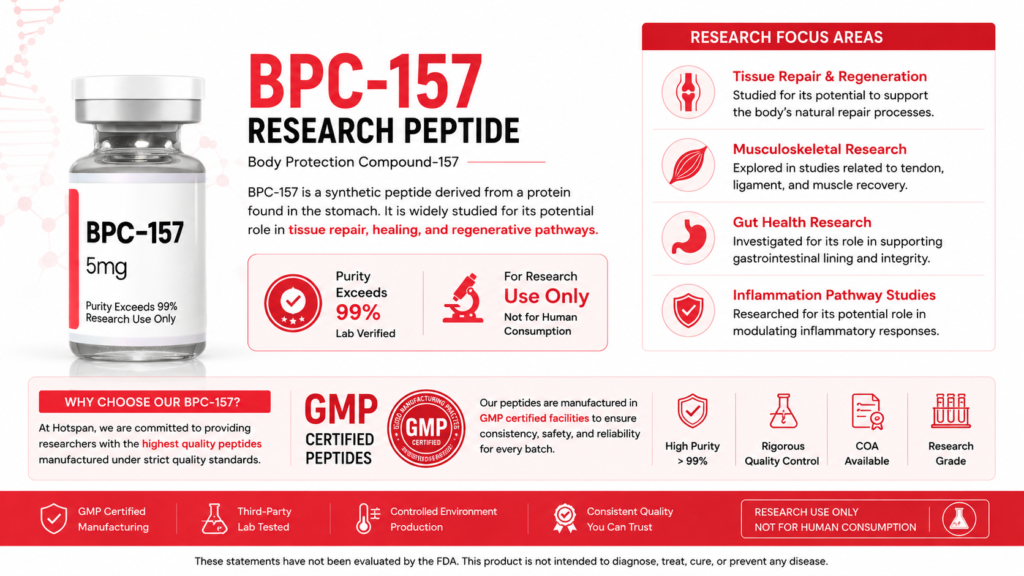
BPC-157 — Body Protection Compound-157. A synthetic 15-amino-acid pentadecapeptide studied in models examining fibroblast biology, extracellular matrix organization, endothelial cell signaling, and nitric oxide-linked pathways.
| Dosage | Price |
|---|---|
| 5mg | $39 |
| 10mg | $79 |
TB-500 — Thymosin Beta-4 Fragment. Studied in preclinical models for actin regulation, endothelial signaling, and extracellular matrix dynamics.
| Dosage | Price |
|---|---|
| 10mg | $69 |
BPC-157 TB-500 — Pre-Blended Stack Combined compound for researchers studying synergistic tissue repair and vascular signaling pathways simultaneously.
| Dosage | Price |
|---|---|
| 10mg | $99 |
Skin & Aesthetics
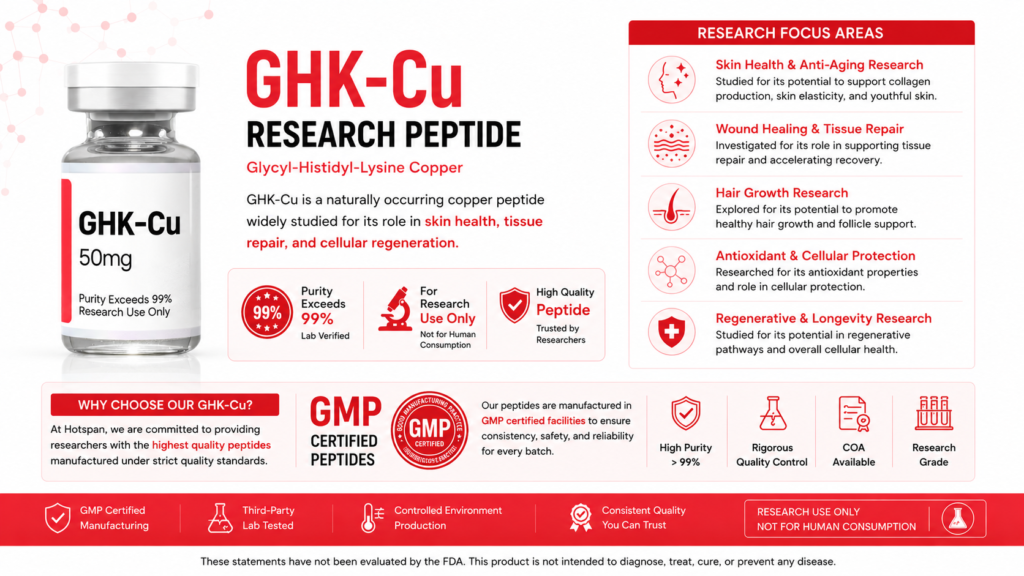
GHK-Cu — Copper Tripeptide. The most extensively researched peptide in dermatological biology. Studied for fibroblast activity, collagen pathway regulation, and oxidative stress signaling. Foundational to peptides for anti-aging skin research covered in depth in our dedicated skin peptide guide.
| Dosage | Price |
|---|---|
| 50mg | $49 |
| 100mg | $89 |
GLOW Stack — BPC-157 + GHK-Cu + TB-500 (70mg — $169)
KLOW Stack — BPC-157 + GHK-Cu + TB-500 + KPV (80mg — $189)
Multi-compound skin and repair stacks. Both meet the same ≥99% purity standard per constituent compound.
Melanotan 2 — α-MSH Analogue Studied in melanogenesis models and skin pigmentation research.
| Dosage | Price |
|---|---|
| 10mg | $49 |
GH Axis Research
CJC-1295 Ipamorelin — GHRH + GHS-R1a Dual Blend. The pre-blended combination of a GHRH analogue (CJC-1295 No DAC) and a selective ghrelin receptor agonist (Ipamorelin). Full sourcing guide in our CJC-1295 Ipamorelin research blog.
| Dosage | Price |
|---|---|
| 10mg | $79 |
Ipamorelin — GHS-R1a Selective Agonist (10mg — $49) Sermorelin — GHRH Analogue (5mg — $49) Tesamorelin — Stabilized GHRH Analogue (10mg — $79)
Longevity & Cellular Health
Epithalon — Telomere Biology Tetrapeptide Studied for telomerase activity, cellular senescence, and longevity-related gene expression.
| Dosage | Price |
|---|---|
| 10mg | $49 |
NAD+ — Nicotinamide Adenine Dinucleotide. Studied extensively in cellular energy metabolism, DNA repair pathway, and sirtuin activation research.
| Dosage | Price |
|---|---|
| 500mg | $69 |
| 1000mg | $99 |
MOTS-c — Mitochondrial-Derived Peptide (10mg — $59)
Studied in models examining mitochondrial signaling, metabolic regulation, and cellular stress responses.
Weight Management & Metabolic
AOD-9604 — GH Fragment 176-191 (5mg — $39)
Cagrilintide — Amylin Analogue (10mg — $99)
GLP2-T — Dual GIP/GLP-1 Agonist Research Compound
| Dosage | Price |
|---|---|
| 10mg | $79 |
| 30mg | $179 |
GLP3-R — Triple Agonist Research Compound
| Dosage | Price |
|---|---|
| 10mg | $99 |
| 30mg | $199 |
Cognitive & Neuropeptides
Semax — ACTH-Derived Neuropeptide (10mg — $39)
Selank — Tuftsin Analogue Anxiolytic Peptide (10mg — $39)
Vitality & Intimacy
PT-141 — Bremelanotide, Melanocortin Receptor Agonist (10mg — $39)
Kisspeptin — GnRH Axis Signaling Peptide (10mg — $59)
Exosomes
Umbilical Exosomes — Available in 3 concentrations:
| Concentration | Price |
|---|---|
| 5 Billion | $399 |
| 10 Billion | $599 |
| 20 Billion | $799 |
How to Evaluate Any “GMP Peptide” Supplier: The Research Checklist
Not every supplier claiming GMP compliance delivers on it. Here is the verification framework researchers should apply to any vendor offering GMP certified peptides for sale:
| Quality Checkpoint | What to Ask | What Hotspan Provides |
|---|---|---|
| Purity claim | Exact % — not “high purity” | ≥99% — batch-specific |
| Testing lab | Independent or in-house? | Independent CLIA-certified lab |
| COA availability | Downloadable? Batch-specific? | Yes — every batch, every product |
| Endotoxin testing | Batch-specific LAL or equivalent? | Yes — every batch |
| Identity confirmation | HPLC only, or HPLC + MS? | HPLC-UV + Mass Spectrometry |
| Manufacturing location | US or overseas? | US-registered GMP facility |
| Industry body membership | APA or equivalent? | American Peptide Association member |
| Reconstitution supplies | Included or extra cost? | Free BAC water with every order |
| Chain of custody | Documented? | Available on request |
If a supplier cannot provide batch-specific COA + endotoxin reports with independent lab letterhead, they are not offering true GMP-grade compounds regardless of what their website claims.
Storage and Reconstitution Standards for GMP Research Peptides
Quality doesn’t end at manufacturing. Maintaining compound integrity through proper storage and reconstitution is essential for data reliability.
| Parameter | GMP Standard | Hotspan Guidance |
|---|---|---|
| Lyophilized storage | -20°C (long-term) | Stable 12–24 months at -20°C |
| Short-term lyophilized | 2–8°C | Stable for shorter periods |
| Reconstituted storage | 2–8°C, few days | Aliquot at -20°C or -80°C for longer |
| Freeze-thaw cycles | Minimize | Avoid repeated cycles |
| Reconstitution vehicle | Sterile BAC water | Included free with every order |
| Shipping format | Lyophilized, ambient | Protective packaging, ambient temp |
FAQs: GMP Certified Peptides For Sale
Q: What does “GMP certified” actually mean when buying research peptides?
It means the manufacturing facility follows documented Good Manufacturing Practice protocols covering synthesis controls, in-process testing, final product verification, and batch traceability. For peptide researchers, the practical output of GMP compliance is a batch-specific COA from an independent lab confirming identity and purity, plus endotoxin test results.
Q: Is ≥99% purity necessary for in vitro research?
Most in vitro protocols require 95%+ purity minimum for interpretable results. At sub-95% purity, impurity concentrations can reach levels that trigger off-target signaling in cell culture systems. Hotspan’s ≥99% standard exceeds what most protocols require and eliminates purity as a confounding variable in experimental design.
Q: How do I verify a COA is legitimate?
A legitimate COA from an independent lab will include: the testing laboratory’s name and contact information, the chemist’s signature, the batch number matching the product label, the analytical method used (HPLC/MS), and a specific purity percentage, not a range. Hotspan’s COAs include all of these and are downloadable directly from each product page.
Q: Does GMP manufacturing guarantee the compound is safe for human use?
No. GMP compliance in the research peptide context governs manufacturing quality for research use only. All Hotspan compounds are intended strictly for in vitro research and laboratory experimentation. Human consumption is strictly prohibited regardless of purity or GMP status.
Q: What is the difference between GMP and pharmaceutical-grade peptides?
Pharmaceutical-grade peptides are GMP-manufactured AND carry FDA regulatory approval for a specific clinical indication. Research-grade GMP peptides follow the same manufacturing quality standards but are produced for laboratory use, not clinical application. Hotspan’s ≥99% purity meets pharmaceutical-grade purity thresholds, but these compounds are for research use only.
Research Use Disclosure
All peptides available at Hotspan are intended strictly for in vitro research and laboratory experimentation only. These compounds are not approved for human consumption, therapeutic use, or clinical application. They must be handled exclusively by licensed, qualified research professionals under appropriate laboratory conditions.
Nothing in this article constitutes medical advice, clinical recommendation, or health claims.
Where to Buy GMP Certified Peptides
Hotspan delivers on every checkpoint in the GMP quality framework:
- ✅ ≥99% purity — batch-specific
- ✅ Independent CLIA-certified lab testing
- ✅ HPLC-UV + Mass Spectrometry identity confirmation
- ✅ COA on every batch — downloadable
- ✅ Endotoxin tested — every batch
- ✅ US-registered GMP manufacturing
- ✅ American Peptide Association member
- ✅ Lyophilized, ambient-stable shipping
- ✅ Free BAC water with every order
- ✅ Full catalog in stock — ships now
→ Browse all GMP certified peptides for sale at Hotspan → View Hotspan’s Quality & Testing documentation → Get a physician-supervised prescription protocol
© Hotspan Labs, LLC. All products are for research use only. Not for human consumption. For use by qualified researchers only.Share