
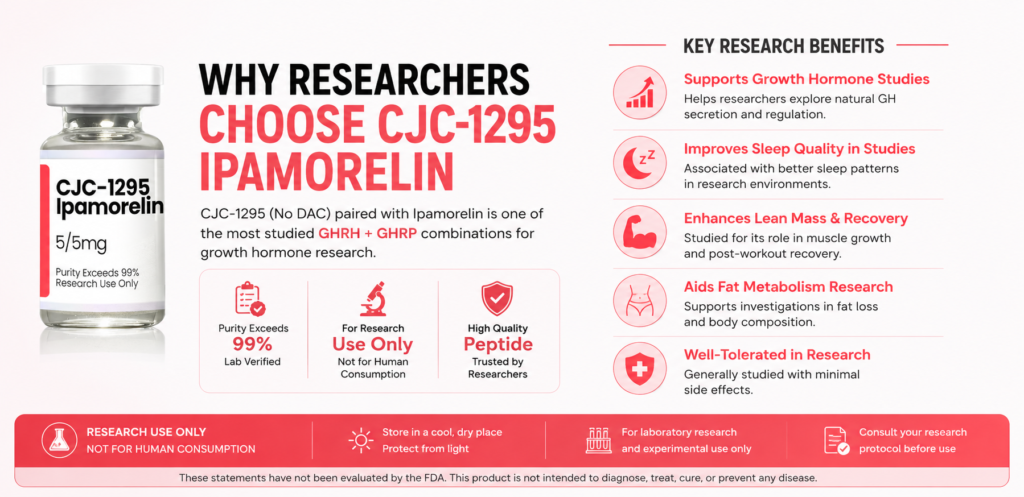
Sourcing a CJC-1295 Ipamorelin blend starts with identifying the material an experiment actually needs. The compound names are only the beginning: the CJC variant, amount of each component, analytical documentation, and suitability of a fixed mixture all affect the research question.
A well-specified blend gives researchers a practical way to examine two GH-axis inputs within one experimental model. The useful connection is between the published pharmacology, a defined laboratory material, and the endpoint the project will actually measure.
This guide explains the distinctions that matter when evaluating a two-peptide blend and identifies the relevant products listed by Hotspan.
What Is the CJC-1295 Ipamorelin Blend?
The blend combines a growth hormone–releasing hormone analogue with a growth hormone secretagogue associated with ghrelin-receptor signaling. Both relate to the growth hormone axis, but they are different molecules acting through different receptor systems.
Hotspan describes its blend as CJC-1295 No DAC, also called Modified GRF 1–29, plus Ipamorelin. The variant designation matters because the CJC-1295 name is not used consistently across research and commercial discussions.
| Component | Receptor pathway associated with the material | Research distinction |
|---|---|---|
| CJC-1295 No DAC / Modified GRF 1–29 | GHRH receptor | GHRH-analogue signaling without the DAC modification |
| Ipamorelin | Growth hormone secretagogue receptor, GHS-R1a | Ghrelin-receptor-related pharmacology |
Studying the two inputs together can help investigate coordinated signaling. Different receptor targets do not, by themselves, prove that a particular mixture produces a beneficial or synergistic outcome.
For the broader pharmacology, see Hotspan’s CJC-1295 and Ipamorelin research overview. The practical question here is narrower: how do you determine whether the material being sourced matches the experiment?
Confirm DAC Status Before Comparing Research
DAC refers to a drug affinity complex modification associated with albumin binding and extended exposure. A No-DAC preparation should not automatically inherit pharmacokinetic claims from an albumin-binding CJC-1295 preparation.
An informative human study by Ionescu and Frohman investigated a long-acting CJC-1295 molecule that binds endogenous albumin. Researchers examined growth hormone secretion patterns and IGF-I responses, reporting increased trough and mean GH secretion with preserved pulsatility. This was not a study of a commercially supplied No-DAC/Ipamorelin blend. Pulsatility study:
Before applying a paper to a proposed research material, check the full molecular description rather than relying on a shortened name. Relevant details can include sequence, structural modification, salt form, formulation, and whether the study examined one compound or a combination.
The distinction is especially important when comparing a single-agent study with a two-component catalog product. Matching part of a product name does not establish that its formulation, exposure, or measured response will match the publication.
Hotspan’s CJC-1295 Ipamorelin blend listing explicitly identifies the CJC component as No DAC. Its displayed product image carries a 5/5 mg label. That is a declared product format—not an independent analytical confirmation of every batch, and not an instruction for personal administration.
What Do the Component Studies Actually Establish?
CJC-1295: Human Hormone-Response Research
Teichman and colleagues reported two randomized, placebo-controlled, double-blind studies of long-acting CJC-1295 in healthy adults. The studies evaluated pharmacokinetics, GH and IGF-I responses, and safety observations over relatively short research periods. They demonstrated sustained changes in the measured hormone concentrations under their study conditions. Human CJC-1295 research:
Those are useful pharmacological findings. They support a discussion of target-related activity and exposure, not an assumption that the same study proved outcomes for a No-DAC blend or demonstrated improvements in physique, strength, or injury recovery.
A sourcing decision should therefore distinguish the exact material tested from a similarly named product. For a blend, evidence about each component is relevant background, while direct evidence about the defined combination answers an additional question.
Ipamorelin: Preclinical Selectivity and Human Pharmacology
The foundational study by Raun and colleagues examined ipamorelin in rat pituitary cells, rats, and swine. It reported GH-releasing activity and characterized selectivity relative to other secretagogues in the models evaluated. In the swine experiments, ACTH and cortisol responses differed from those seen with some earlier compounds. Original pharmacology study:
This supports a specific preclinical selectivity discussion. It does not justify a universal claim that ipamorelin has no hormonal effects or adverse effects in every human setting. The species, exposure, comparator, and measured hormones remain part of the finding.
Human research also exists. Gobburu and colleagues studied ipamorelin pharmacokinetics and pharmacodynamics in healthy volunteers, measuring plasma ipamorelin and GH after intravenous administration and modeling their relationship. The work characterized drug disposition and GH responses; it was not a body-composition trial of a No-DAC/Ipamorelin blend. Human PK/PD study:
Together, these studies provide a scientific rationale for investigating GH-axis signaling. A stronger experiment then connects that rationale to a specified formulation and a directly measured endpoint. A laboratory project investigating receptor activity needs different supporting information from a clinical claim about a physical outcome.
How to Evaluate a Two-Peptide Certificate of Analysis
A blend introduces analytical questions that do not arise in exactly the same way with a single-compound vial. The documentation should make it possible to distinguish component identity, composition, quantity, and purity.
A peer-reviewed consensus paper by Hoofnagle and colleagues discusses these distinctions for peptides used in mass-spectrometry-based assays. It explains why net peptide content is different from a weighed amount that also includes associated water and counterions. Its scope is peptide assay standards, not a universal regulatory specification for every research blend. Analytical recommendations:
The underlying measurement principle is useful when assessing a blend: a purity percentage is not automatically a quantitative result for the amount of each peptide.
| Documentation item | Question it should help answer |
|---|---|
| Identity of each component | What evidence supports the stated CJC variant and Ipamorelin identity? |
| Declared composition | What amount of each peptide is specified, and in which units? |
| Ratio basis | Is the ratio expressed by mass, by moles, or on another defined basis? |
| Purity and quantitative methods | What does each reported result measure, and can the method distinguish relevant components and impurities? |
| Batch traceability | Does the document identify the same lot as the material being evaluated? |
| Additional testing and stability | Which attributes were actually tested, under what conditions, and when? |
For a field-by-field introduction, use Hotspan’s peptide Certificate of Analysis guide. Then return to the blend-specific question: does the available evidence characterize both ingredients adequately for the planned work?
A Declared Mass Ratio Is Not Automatically a Molar Ratio
A label presenting 5 mg of one component and 5 mg of another describes equal declared masses. It does not necessarily describe equal numbers of molecules, because the components have different molecular masses. The distinction becomes important when an experimental design specifies concentrations or ratios on a molar basis.
The declared format also needs to be distinguished from a batch-specific quantitative assay. Researchers should review what the report actually establishes rather than assuming a single chromatographic percentage independently verifies every component amount.
Similarly, an endotoxin report, an identity result, a sterility test, and a stability study answer different questions. One should not be presented as proof of all the others. Storage claims should follow applicable, material-specific documentation rather than a generic shelf life applied to every peptide mixture.
Which Relevant Research Products Does Hotspan Offer?
Hotspan lists the combined CJC-1295 No-DAC/Ipamorelin material discussed above. Its description identifies the two receptor-related research components, while the product image presents the declared 5/5 mg format. The listing also references an endotoxin report; researchers should review the actual batch documentation needed for their own analytical requirements.
Hotspan also offers Ipamorelin as a standalone research product. A single-component material can be relevant when an experiment needs to isolate ghrelin-receptor-related activity, include an individual-component control, or evaluate composition independently of a fixed mixture.
A separate CJC-1295 listing is also available to evaluate. Before selecting it as a component control, verify its DAC designation and molecular form against the blend specification. Having both blended and standalone catalog options lets researchers consider different experimental designs rather than forcing every project into one format.
Research-use distinction: Hotspan supplies these materials strictly for in vitro laboratory research, not for human or animal administration. A published human study does not convert a catalog research product into the study formulation or a patient treatment.
Whether a fixed blend is useful depends on the design. It may simplify some stock handling, but it does not remove the need for appropriate controls. Experiments investigating interactions may require a vehicle group, each component alone, and the defined combination. Claims of synergy require a suitable quantitative comparison, not simply the presence of two different receptor pathways.
Before procurement, confirm the current product specification, DAC designation, declared component amounts, batch identity, analytical methods, and relevant storage information. If a needed detail is absent or ambiguous, request clarification rather than filling the gap with an assumption from a different product or paper.
Frequently Asked Questions
What is the CJC-1295 Ipamorelin blend studied for?
It is relevant to laboratory investigations of coordinated GHRH-receptor and ghrelin-receptor-related signaling. A research description should identify the experimental endpoint rather than promise muscle growth, fat loss, or another personal outcome.
Why does No DAC matter?
It identifies a molecular distinction that can affect how research findings are interpreted. Data from a long-acting, albumin-binding preparation should not automatically be attributed to a No-DAC preparation or a two-component blend.
Does a high purity result verify the component ratio?
Not by itself. Purity, identity, and quantitative composition are different analytical questions. Review the method, units, and component-specific results rather than interpreting a headline percentage as a complete blend characterization.
Can researchers source the components separately from Hotspan?
Hotspan lists standalone Ipamorelin and a separate CJC-1295 product. Before selecting a standalone CJC material as a comparison or control, confirm its DAC status and molecular form with the relevant product and batch documentation. The name alone is not enough.
Is a fixed blend always preferable to separate materials?
No. A fixed blend may fit a defined composition, while separate materials allow independent component controls or different experimental ratios. The appropriate choice follows the research question and available characterization data.
Does laboratory research labeling permit personal use?
No. Hotspan’s research materials are not intended for human or animal administration. Research procurement and published pharmacology should remain separate from personal dosing, treatment, or self-experimentation instructions.
Final Thoughts
A useful CJC-1295 Ipamorelin blend sourcing decision connects three things: the research question, the exact molecular materials, and the evidence available for the batch.
DAC status, component identity, declared ratio, quantitative content, and purity should not be collapsed into one general quality claim. The published component studies provide meaningful pharmacological context, while the laboratory material still needs its own appropriate characterization.
Hotspan’s blend and standalone listings give researchers relevant products to evaluate. Start with the experimental design, confirm the material’s specifications, and use the literature and batch documents together rather than treating either as a substitute for the other.