
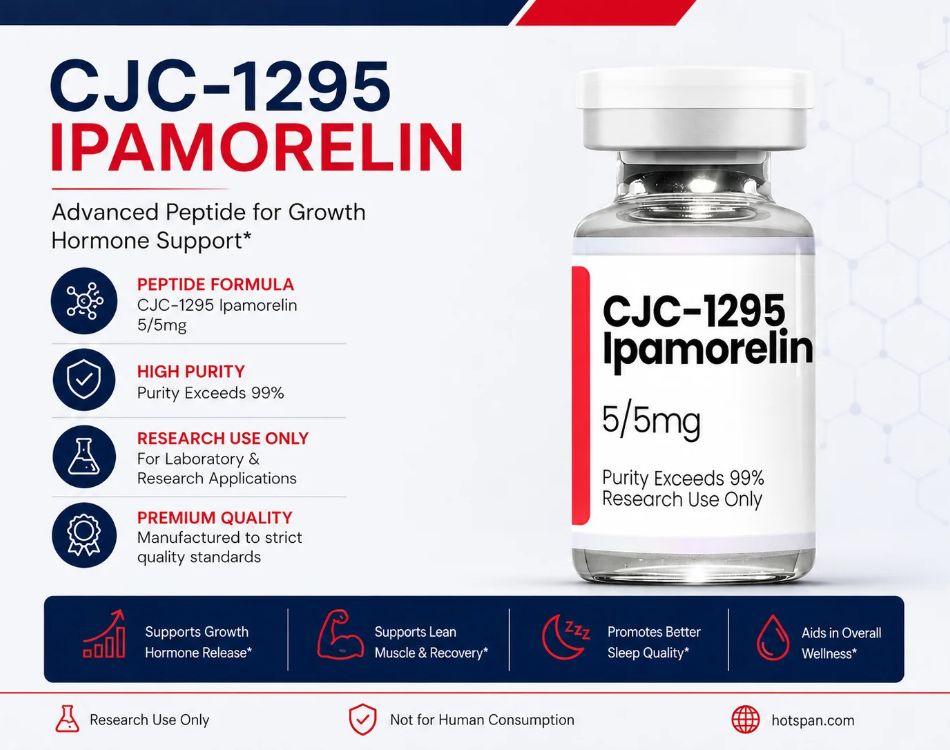
Peptides for muscle growth and fat loss attract attention because some compounds influence hormone, metabolic, or tissue-repair pathways. However, no research peptide is FDA-approved to build muscle or cause general weight loss in healthy adults. The strength of evidence differs sharply among CJC-1295 ipamoreliPeptides for muscle growthn, AOD-9604, tesamorelin, BPC-157, and TB-500, so they should never be treated as one interchangeable category.
This guide separates laboratory mechanisms from demonstrated human outcomes. It also explains regulatory status, sports restrictions, and the research applications of relevant Hotspan products without providing human-use instructions.
Which peptides are most studied for muscle growth and fat loss? (Quick answer)
The most-studied peptides for muscle growth are CJC-1295 with ipamorelin and tesamorelin, which act on growth-hormone pathways. AOD-9604 has been studied for fat loss but failed its largest human trial. BPC-157 and TB-500 are researched mainly for tissue repair in animals not proven for human muscle growth or fat loss.
| Goal | Most studied peptide | What human evidence shows |
| Muscle growth | CJC-1295 + Ipamorelin | Raises GH and IGF-1; muscle gain itself not proven in trials |
| Belly fat (medical use only) | Tesamorelin | FDA-approved only for HIV lipodystrophy, not general weight loss |
| Fat loss | AOD-9604 | Large human obesity trial failed to show significant weight loss |
| Recovery / repair | BPC-157 + TB-500 | Animal and cell studies only; human trials lacking |
Detailed study results, safety limits, and regulatory status for each compound are explained below.
Research-use-only notice: Hotspan research products are intended strictly for in vitro testing and laboratory experimentation. They are not drugs, foods, dietary supplements, or cosmetics and are not intended for human or animal consumption, diagnosis, treatment, cure, or disease prevention. Product references below describe laboratory applications only.
Do peptides work for muscle growth and fat loss?
Research commonly focuses on four areas:
GH–IGF-1 signaling: CJC-1295, ipamorelin, and tesamorelin are investigated for effects on growth hormone pathways.
Lipid metabolism: AOD-9604 is studied for interactions with adipocyte and fatty-acid signaling.
Cellular repair: BPC-157 and TB-500 appear in preclinical work involving cell migration, extracellular-matrix organization, and vascular biology.
Body composition: Only specific prescription products have meaningful human evidence for narrowly defined medical populations; that evidence does not validate research chemicals for bodybuilding or routine weight management.
A laboratory finding—such as receptor activation or increased IGF-1—is not proof of greater strength, visible muscle gain, faster recovery, or clinically meaningful fat loss. Those outcomes require dedicated human trials.
What are peptides, and how do they work?
Peptides are short chains of amino acids that can function as hormones, signaling molecules, protein fragments, or laboratory probes. Their effects depend on their sequence, structure, formulation, and biological target.
“Peptide” is therefore a chemical category, not a benefit. Insulin, collagen peptides, GLP-1 medicines, GHRH analogues, and experimental compounds all work differently and carry different evidence and risks. Calling a substance a peptide does not make it natural, effective, or safe.
How are peptides studied for muscle growth and fat loss?
Growth hormone-releasing hormone signaling
Growth hormone-releasing hormone (GHRH) signals the pituitary gland through the GHRH receptor. Synthetic analogues are examined for downstream effects on growth hormone (GH), insulin-like growth factor 1 (IGF-1), and related molecular readouts. CJC-1295 and tesamorelin belong to this broad research area, but they are chemically and clinically distinct.
Ghrelin-receptor signaling
Growth hormone secretagogues interact with GHSR-1a, often called the ghrelin receptor. Ipamorelin is investigated within this class. A secretagogue can alter hormone release, but a hormonal response alone does not establish better body composition.
Adipocyte and lipid-metabolism signaling
Fat-metabolism experiments may measure lipolysis, lipogenesis, fatty-acid oxidation, or energy-regulation markers. AOD-9604 became a research subject because it is derived from a C-terminal region of human growth hormone and showed metabolic activity in early models.
Cellular and tissue-repair mechanisms
BPC-157 and TB-500 are studied mainly in cells and animals. Research questions include fibroblast activity, actin regulation, angiogenesis-related signaling, cell migration, and extracellular-matrix dynamics. These endpoints may help scientists understand repair biology, but they cannot predict an injured athlete’s recovery time.
Best peptides for muscle growth and fat loss: research comparison
| Compound | Main research question | Current evidence boundary |
| CJC-1295 | How does GHRH-receptor activation affect GH and IGF-1? | Early human work on the DAC form measured hormones, not muscle, strength, or fat loss. Direct human evidence for the no-DAC form is sparse. |
| Ipamorelin | How does GHSR-1a activation influence GH release? | Pharmacologic activity does not establish safe or effective body recomposition. |
| CJC-1295 (No DAC) + Ipamorelin | What happens when two GH-related receptor pathways are examined together? | No robust human trial proves that this blend builds muscle or reduces fat. |
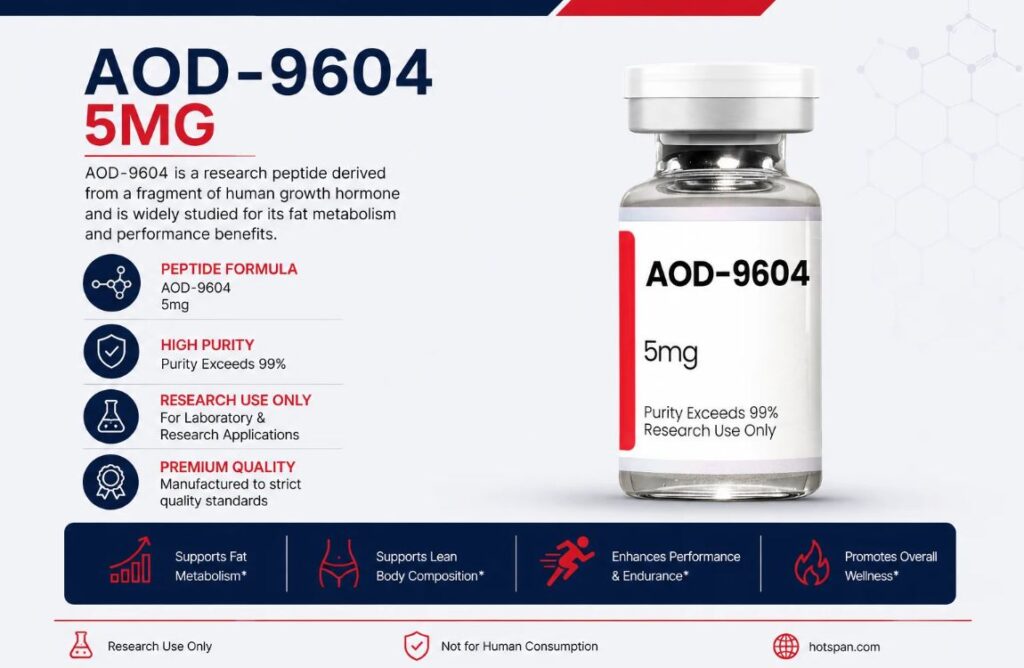
| AOD-9604 | Can a GH fragment affect lipid-metabolism pathways independently of full GH activity? | Preclinical findings were promising, but a later obesity trial did not establish significant weight-loss efficacy. |
| Tesamorelin | How does a stabilized GHRH analogue affect GH signaling and visceral adipose tissue? | An approved medicine has evidence for one HIV-lipodystrophy indication, not general weight loss or bodybuilding. |
| BPC-157 | How does this peptide affect cellular and repair-related pathways? | Musculoskeletal findings are predominantly preclinical, with inadequate controlled human evidence. |
| TB-500 | How do thymosin-beta-4-fragment pathways affect actin and cell migration? | Human orthopedic and performance data are lacking. |
Do CJC-1295 and ipamorelin support muscle growth?
CJC-1295 is associated with GHRH-receptor signaling, while ipamorelin acts through the ghrelin receptor. Their different targets explain why researchers may study them together, but a plausible combination is not the same as a clinically validated one.
A frequently cited 2006 study evaluated long-acting CJC-1295 with DAC in healthy adults. Researchers observed increases in GH and IGF-1 while GH pulsatility was preserved. They did not test whether participants gained muscle, became stronger, recovered faster, or lost body fat.
This detail prevents two common errors:
Results from CJC-1295 with DAC should not automatically be assigned to CJC-1295 without DAC (Modified GRF 1–29).
Results from CJC-1295 alone do not prove outcomes for a CJC-1295/ipamorelin blend.
The FDA has also identified safety concerns around bulk CJC-1295 and ipamorelin used in compounding, including limited data, possible immunogenicity, impurities, and serious adverse-event reports in certain contexts. More controlled research is needed before benefit-risk conclusions can be drawn.
Does AOD-9604 work for fat loss?
No. AOD-9604 remains an investigational GH fragment rather than an established fat-loss treatment. Early cell, animal, and short-term clinical work created interest in its effects on lipid-related pathways. An earlier 12-week trial reported a modest result at one dose, but the effect was not dose-dependent. A larger 24-week Phase 2b obesity study later failed to show significant weight loss versus placebo, after which obesity-drug development was discontinued.
That negative result is as important as the proposed mechanism. It illustrates why a compound can influence a pathway in a model yet fail to produce a useful clinical outcome.
The FDA reports limited safety information for AOD-9604 and notes concerns involving immunogenicity, peptide-related impurities, and active-ingredient characterization in compounded products. Its scientifically appropriate role is as a laboratory research subject, not a proven weight-management option.
Does tesamorelin reduce belly fat or build muscle?
Tesamorelin has the strongest human evidence among the compounds in this article, but only within a narrow boundary. An FDA-approved tesamorelin medicine is indicated to reduce excess abdominal fat in adults with HIV-associated lipodystrophy. The current label says it is not indicated for weight-loss management and that long-term cardiovascular safety has not been established.
The supporting trials involved a specific clinical population. They cannot be generalized to healthy adults pursuing cosmetic fat loss or athletic performance.
An additional distinction is essential for accuracy: an approved tesamorelin medicine has a defined manufacturer, formulation, strength, quality system, and prescribing label. Research-grade tesamorelin is a non-clinical laboratory material. Sharing an ingredient name does not make the two products interchangeable.
Do BPC-157 and TB-500 build muscle or improve recovery?
BPC-157 and TB-500 are better described as experimental subjects in repair-related research. A 2026 sports-medicine review concluded that BPC-157 findings involving tendon and muscle repair remain largely unvalidated in human trials; human orthopedic evidence for TB-4 and TB-500 was also lacking.
Online descriptions often jump from a cellular effect to a promised recovery benefit. That shortcut is scientifically unsound. Cell migration, vascular signaling, or collagen organization in an animal model cannot establish that a compound heals human injuries or adds lean mass.
FDA evaluations raise further questions about insufficient human safety information, immune reactions, aggregation, and impurities. Those uncertainties prevent responsible clinical recommendations.
Hotspan research peptides related to these pathways
The following products fit the pathways discussed above. They are listed as research tools, not as solutions for personal fitness goals.
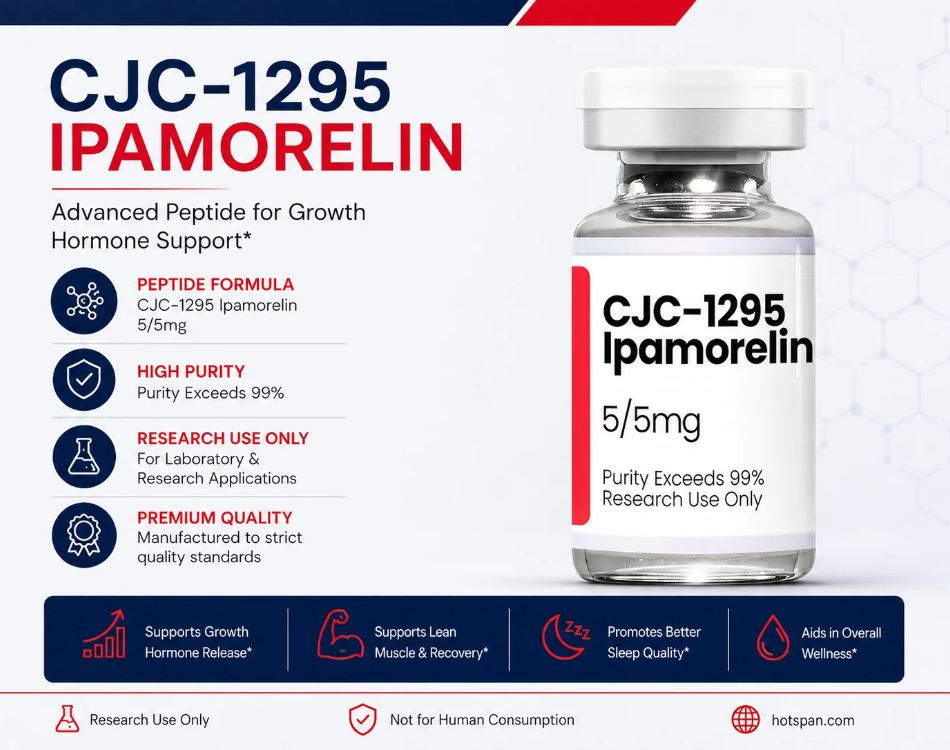
CJC-1295 (No DAC) + Ipamorelin
Designed for controlled investigation of coordinated GHRH-receptor and GHSR-1a signaling. Because it contains the no-DAC form, researchers should not cite CJC-1295 DAC findings as direct evidence for this material.
View AOD-9604 research specifications →
AOD-9604
Relevant to experimental models examining adipocyte signaling, fatty-acid metabolism, and energy-regulation mechanisms. Any study design should account for the inconsistent translation from preclinical findings to human obesity outcomes.
View tesamorelin research specifications →
Tesamorelin
A laboratory material for GHRH-receptor binding, cAMP-linked signaling, and GH/IGF-associated molecular readouts. Hotspan tesamorelin is not EGRIFTA WR or another approved prescription product.
View tesamorelin research specifications →
BPC-157 + TB-500
A blend for in vitro study of cytoskeletal organization, extracellular-matrix dynamics, fibroblast signaling, and vascular-biology pathways. Its research positioning should not be converted into injury-recovery claims.
View BPC-157 + TB-500 research specifications →
Peptides vs. steroids: how are they different?
Peptides are amino-acid chains that may bind specific receptors or influence signaling systems. Anabolic-androgenic steroids are testosterone derivatives that act primarily through androgen receptors.
Their different chemistry does not establish a safety ranking. Experimental peptides may present risks from biological activity, immune responses, contamination, incorrect identity, sterility failures, or unknown long-term effects. Without direct comparative trials, claims that peptides are “safer than steroids” are marketing language rather than scientific conclusions.
Are muscle-growth and fat-loss peptides FDA-approved?
No peptide is FDA-approved to increase muscle mass in healthy adults. Some peptide medicines are approved for unrelated, carefully defined indications. Approval belongs to a specific product and use; it does not transfer to a similarly named research chemical.
CJC-1295, ipamorelin, AOD-9604, BPC-157, and TB-500 have no FDA approval for muscle gain or general fat loss.
Tesamorelin’s approved indication concerns excess abdominal fat in adults with HIV-associated lipodystrophy.
Approval of GLP-1 or other peptide-based medicines does not validate GH-axis research compounds.
Current status should be verified through the official Drugs@FDA database because regulations and labels can change.
Are peptides for muscle growth banned in tested sports?
Many are. The World Anti-Doping Agency lists growth hormone-releasing factors, secretagogues, mimetics, and fragments within prohibited categories. Its examples include CJC-1295, tesamorelin, ipamorelin, and AOD-9604. BPC-157 is prohibited as a non-approved substance.
Athletes are generally responsible for substances detected in their samples. Labels such as “research use only” or “natural signaling” do not create an exemption. Anyone subject to testing should consult the current WADA list and an authorized anti-doping organization.
Are research peptides safe? Key risks and limitations
A compound-specific risk assessment may need to address:
- Limited or absent long-term human data;
- Immune and hypersensitivity reactions;
- Hormone or glucose-regulation changes;
- Cardiovascular uncertainty;
- Edema-related effects associated with some GH-axis medicines;
- Peptide aggregation and degradation;
- Incorrect concentration, identity, sterility, or purity; and
- Anti-doping consequences when research information is misapplied to sport.
Certificates of analysis can provide useful analytical information, but they do not prove clinical safety or effectiveness.
How can readers judge the quality of peptide research?
Identify the experimental model
Cell and animal studies answer early mechanistic questions. Their results should be labeled as preclinical rather than presented as human benefits.
Check the exact compound
DAC status, amino-acid sequence, salt form, formulation, and purity can change experimental behavior. Similar names do not guarantee equivalent materials.
Match the outcome to the claim
Hormone concentrations and receptor activity are surrogate measurements. Claims about strength, body fat, pain, or function require studies that directly measure those outcomes.
Prioritize controlled human evidence
Randomization, adequate sample size, relevant controls, appropriate duration, and adverse-event monitoring all improve reliability. Testimonials cannot replace these safeguards.
Look for null results and limitations
A balanced review reports failed trials, short follow-up, missing data, and uncertainty. Content that mentions only mechanisms or positive findings is incomplete.
What has stronger evidence for changing body composition?
The most reliable foundation combines progressive resistance training, nutrition suited to the goal, adequate protein, sustainable energy balance, sleep, and recovery. People experiencing unexplained muscle loss, weight change, fatigue, or possible hormonal symptoms should seek qualified medical assessment rather than self-treating with research chemicals.
When a diagnosed condition warrants medication, a licensed clinician can discuss approved options, contraindications, and monitoring. Laboratory products do not substitute for medical care.
Frequently asked questions
Why are GH and IGF-1 mentioned in muscle peptide research?
GH can stimulate production of IGF-1, and both participate in growth and metabolic signaling. Researchers measure them to understand pathway activity, but higher laboratory values do not by themselves demonstrate improved physique or performance.
Can a peptide target fat without changing body weight?
Different studies may measure visceral fat, total fat mass, waist circumference, or scale weight. A change in one measurement does not guarantee a change in the others, which is why study endpoints and participant populations must be read carefully.
Does “clinically studied” mean FDA-approved?
No. A compound may appear in preclinical work or early human trials without completing the studies required for approval. FDA approval also applies only to the reviewed formulation and indication.
Is a high-purity research peptide safe to consume?
No such conclusion can be drawn. Analytical purity does not establish sterility, appropriate formulation, dosing, pharmacology, or human safety. Research-use-only materials must remain in qualified laboratory settings.
Can online peptide testimonials be trusted?
Testimonials can describe personal perceptions, but they cannot control for training, diet, concurrent substances, placebo effects, natural recovery, or inaccurate product identity. They rank far below controlled studies as evidence.
Why are some peptides banned by WADA without an approved medical use?
WADA can prohibit non-approved substances and classes that may affect performance or athlete safety. A lack of medical approval does not keep a compound outside anti-doping rules.
Are peptide “stacks” supported by clinical trials?
Most combinations promoted online have not undergone robust trials that establish efficacy, interactions, or long-term safety. Combining mechanisms may also combine uncertainties.
What does research use only mean?
It means the material is supplied for controlled laboratory experimentation—not human or veterinary administration, dietary use, diagnosis, or treatment.
The bottom line
The phrase peptides for muscle growth and fat loss covers compounds with different targets and very different evidence. CJC-1295 and ipamorelin are associated with GH signaling, AOD-9604 with metabolic research, tesamorelin with a narrowly approved medical application in a specific formulation, and BPC-157/TB-500 with preclinical repair models.
The responsible interpretation is to keep mechanisms, human outcomes, approved medicines, and research materials separate. Doing so answers consumer questions accurately while preserving the clear boundary required for research-use-only products.