
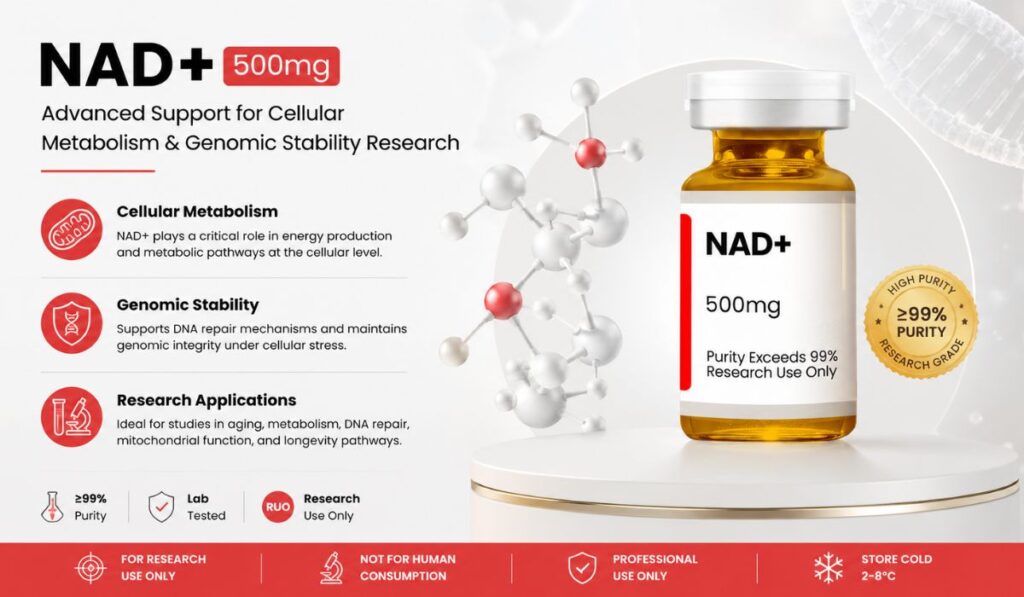
Overview: Nicotinamide Adenine Dinucleotide (NAD+) is an essential pyridine nucleotide coenzyme investigated extensively in cellular metabolism, mitochondrial respiration, and genomic integrity research models. As a vital electron carrier, NAD+ facilitates cellular ATP synthesis and serves as a required substrate for enzymatic DNA repair pathways. Hotspan supplies high-purity NAD+ strictly for laboratory, analytical, and in vitro research applications.
Key Compound Specifications
| Parameter | Specification |
| Chemical Name | Nicotinamide Adenine Dinucleotide (Beta-NAD+) |
| Molecular Weight | 663.43 g/mol |
| Classification | Dinucleotide Coenzyme / Analytical Research Compound |
| Primary Applications | Mitochondrial bioenergetics, PARP/Sirtuin kinetics, DNA repair assays |
| Purity Standard | ≥99% (HPLC & Mass Spectrometry Verified) |
| Sterility & Safety | Endotoxin Tested (<5 EU/vial via LAL Assay) |
| Regulatory Status | Laboratory Research Use Only — Not for Human or Veterinary Consumption |
What Is NAD+?
NAD+ (Nicotinamide Adenine Dinucleotide) is a foundational dinucleotide present in all biological systems. It functions in two distinct capacities within experimental models:
- Redox Reactions: Interconverting between oxidized (NAD+) and reduced (NADH) states to drive cellular bioenergetics.
- Enzymatic Substrate Consumption: Serving as a consumed cofactor for enzymes involved in DNA strand break detection, epigenetic regulation, and post-translational modification.
In age-stratified cellular models, baseline NAD+ availability reports an observed decline over time, making NAD+ homeostasis a primary focus in experimental gerontology and metabolic research.
Biochemical Mechanisms Studied in Experimental Models
1 . Mitochondrial Respiration & Bioenergetics
In cellular energy assays, NAD+ functions as a rate-limiting electron acceptor within metabolic pathways:
- Glycolysis & TCA Cycle: Functions as an essential cofactor for dehydrogenase enzymes.
- Electron Transport Chain (ETC): Drives Complex I activity through NADH oxidation, supporting proton gradients required for ATP synthase activity.
- Mitochondrial Biogenesis: Activates NAD+-dependent sirtuin deacetylases (SIRT1/SIRT3) that regulate transcriptional coactivators (such as PGC-1α) involved in mitochondrial density research.
2 . Genomic Maintenance & Enzymatic Repair Assays
In DNA damage research models, NAD+ serves as a direct chemical substrate for two critical enzyme families:
- Poly(ADP-Ribose) Polymerases (PARPs): PARP1 and PARP2 consume NAD+ to synthesize poly(ADP-ribose) chains at sites of single- and double-strand DNA breaks, recruiting DNA repair machinery. High DNA damage accelerates NAD+ consumption in in vitro models.
- Sirtuins (SIRT1–SIRT7): NAD+-dependent deacetylases that regulate chromatin structure, histone modification, and base-excision repair kinetics.
Reported Experimental Working Concentrations & Handling
Notice: The parameters below reflect working ranges reported in published in vitro and laboratory literature and are provided strictly for analytical reference.
- In Vitro Assays: Typical working concentrations in cell culture models range from 0.1 mM to 5.0 mM, with 0.5–1.0 mM commonly utilized for acute incubation assays (1–48 hours).
- Enzymatic Kinetics Assays: Purified PARP and Sirtuin enzymatic assays typically evaluate NAD+ substrate kinetics within 10 µM to 1.0 mM assay buffers.
- Solubility & Reconstitution: Highly soluble in sterile aqueous buffers (dH2O or PBS). Aqueous solutions should be prepared immediately prior to experimentation due to hydrolysis susceptibility in liquid state.
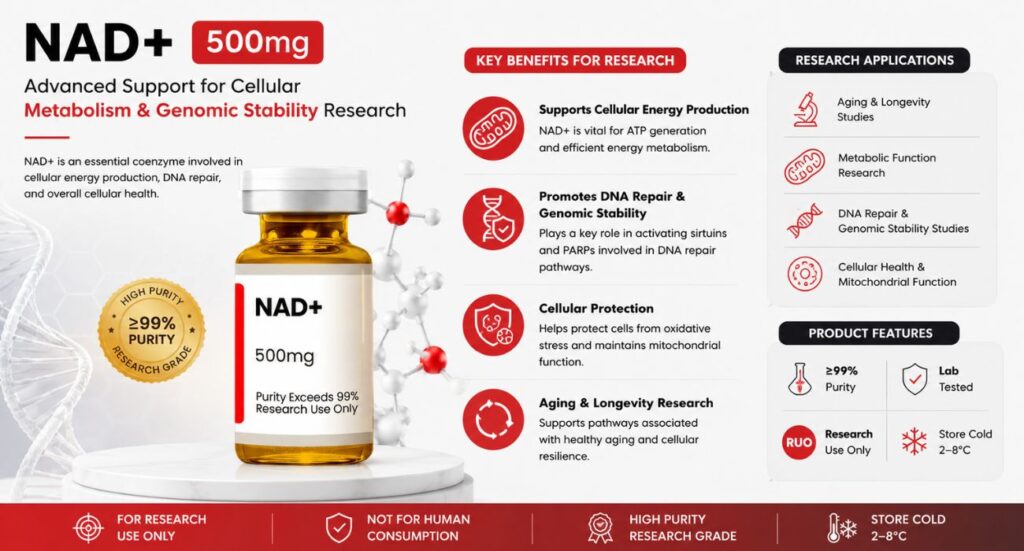
Analytical Standards & Quality Verification
Every batch of Hotspan NAD+ undergoes multi-tiered analytical verification to ensure reproducible experimental results:
- High-Performance Liquid Chromatography (HPLC): Confirms ≥99% chemical purity and verifies absence of breakdown products (such as free nicotinamide or AMP).
- Mass Spectrometry (MS): Verifies exact molecular weight (663.4 Da) and structural identity.
- Endotoxin Analysis: Quantified via Chromogenic LAL Assay to guarantee <5 EU/vial.
- US Manufacturing Assurance: Synthesized and processed under US GMP facilities under standardized quality management protocols.
- Traceable Documentation: Batch-specific Certificates of Analysis (COAs) are accessible through our COA Library.
Available Catalog Quantities
| Option | Purity | COA Reference | Research Pricing |
| 500 mg Lyophilized Vial | ≥99% | COA-NAD500 | $59 |
| Option | Purity | COA Reference | Research Pricing |
| 1000 mg Lyophilized Vial | ≥99% | COA-NAD1000 | $99 |
| Bulk Analytical Supply | ≥99% | Upon Request | Contact Research Sales |
Reconstitution, Storage & Handling Guidelines
- Lyophilized Powder (Unopened): Stable for 12–24 months stored at -20°C. For short-term storage (3–6 months), store at 2–8°C. Protect from ambient humidity and direct light.
- Reconstituted Aqueous Solutions: Solution state NAD+ is prone to spontaneous hydrolysis over time.
Reconstituted aliquots should be used immediately or frozen at -80°C. Avoid repeated freeze-thaw cycles.
Frequently Asked Questions (Research FAQ)
What biological pathways require NAD+ as a cofactor?
NAD+ is required for mitochondrial ATP production via the electron transport chain and serves as an obligate substrate for PARP DNA-repair enzymes and Sirtuin deacetylases in metabolic and genomic research models.
How is research-grade NAD+ verified for experimental consistency?
Hotspan provides a batch-specific Certificate of Analysis with every shipment containing HPLC chromatograms, mass spectrometry data, LAL endotoxin assay results, and batch sign-off documentation.
Read out other Blog: Does NAD+ Support Anti-Aging Research? Energy and DNA Repair Explained