
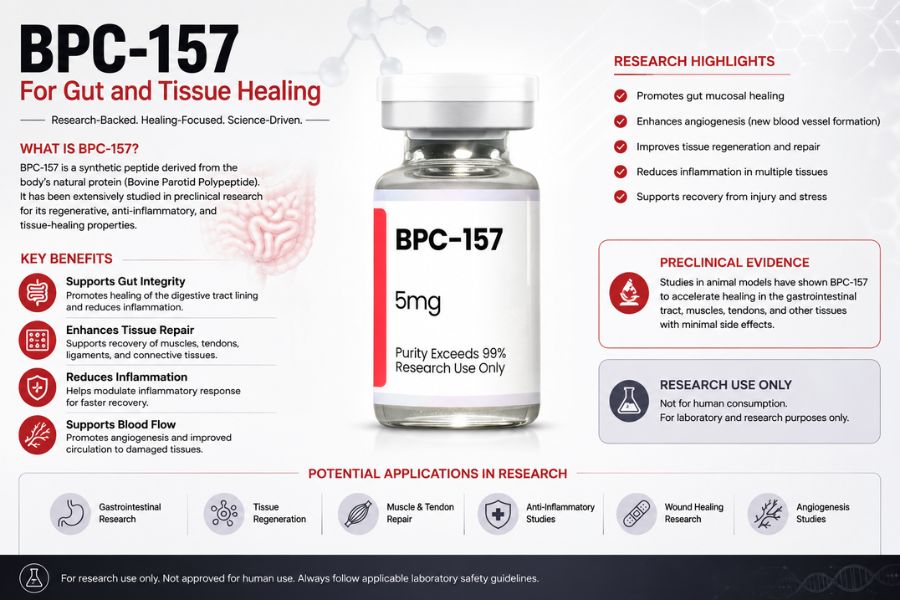
Quick Answer: BPC-157 is a synthetic 15-amino-acid peptide studied for its role in repairing intestinal barrier tissue and other tissue types in laboratory research. It is sold strictly for Research Use Only and is not approved for human use.
BPC-157 gut research is one of the most studied areas within the broader preclinical literature surrounding this experimental peptide. Researchers have investigated BPC-157 in gastrointestinal injury models, intestinal tissues, mucosal integrity, vascular responses, inflammatory signaling, and processes associated with intestinal barrier function.
The interest comes from the complex relationship between intestinal tissue, blood vessels, inflammatory pathways, and epithelial integrity.
However, the current evidence needs to be interpreted carefully. Most BPC-157 gut research has been conducted in animals or other preclinical models. These findings do not establish BPC-157 as an approved treatment for gastrointestinal disease or prove that experimental effects translate directly to humans.
For the complete scientific background, see our BPC-157 Research: Studies, Mechanism, Structure & Properties.
What Is BPC-157 Gut Research?
BPC-157 gut research refers to experimental studies investigating how BPC-157 interacts with gastrointestinal tissues and biological processes.
Researchers have examined areas such as:
- Intestinal tissue integrity
- Gastrointestinal injury models
- Intestinal barrier function
- Mucosal responses
- Vascular signaling
- Inflammatory processes
- Tissue remodeling
- Gastrointestinal healing models
These studies use different experimental systems, so their findings should not be treated as one uniform body of evidence.
Why Is the Intestinal Barrier Important?
The intestinal barrier is a complex biological system that separates the contents of the gastrointestinal tract from underlying tissues.
It involves:
- Intestinal epithelial cells
- Tight junctions
- Mucus
- Immune components
- Blood vessels
- Supporting connective tissue
When researchers study intestinal barrier function, they may examine changes in epithelial integrity, permeability, inflammatory signaling, tissue structure, and related biological markers.
This is why research into BPC-157 and the gut often overlaps with vascular and inflammatory research.
BPC-157 and Intestinal Barrier Research
Preclinical studies have investigated whether BPC-157 influences processes associated with intestinal barrier integrity.
Some experimental models have examined tissue changes following gastrointestinal injury or other induced conditions.
Researchers have investigated potential relationships between BPC-157 and:
- Epithelial integrity
- Vascular responses
- Inflammatory signaling
- Tissue remodeling
- Barrier-associated processes
These findings have contributed to the scientific interest surrounding BPC-157.
However, an experimental change in intestinal permeability, tissue morphology, or another biological marker does not automatically demonstrate that the peptide treats a human gastrointestinal disorder.
BPC-157 and Gastrointestinal Tissue Research
The gastrointestinal tract is exposed to mechanical, chemical, microbial, inflammatory, and vascular influences.
Because of this complexity, gastrointestinal research often evaluates several biological processes simultaneously.
Experimental BPC-157 studies have investigated gastrointestinal tissue responses under different injury models. A PubMed review specifically discusses BPC-157, gastrointestinal tract healing and vascular recruitment.
The research has contributed to hypotheses involving tissue integrity, vascular function, inflammatory responses, and repair-associated processes.
The exact findings depend on the experimental model, species, injury method, timing, and measured outcome.
BPC-157 and Vascular Research
Blood flow is important for gastrointestinal tissue function.
Vascular changes can affect oxygen delivery, nutrient availability, inflammatory signaling, and tissue remodeling.
BPC-157 research has therefore investigated vascular biology alongside gastrointestinal responses.
Researchers have examined processes involving endothelial cells, angiogenesis, nitric oxide signaling, and vascular integrity.
Our [BPC-157 Mechanism of Action: Research & Pathways] article provides a deeper explanation of these mechanisms.
BPC-157 and Nitric Oxide Signaling
Nitric oxide is an important signaling molecule involved in vascular function.
Experimental BPC-157 research has investigated interactions between the peptide and nitric oxide-related pathways.
These investigations are relevant because vascular signaling can influence tissue responses in the gastrointestinal system.
However, mechanistic evidence should not be confused with clinical evidence.
A laboratory or animal finding involving nitric oxide does not establish that BPC-157 produces a clinically meaningful gastrointestinal effect in humans.
BPC-157 and Inflammatory Signaling
Inflammation is another recurring subject in gastrointestinal BPC-157 research.
Experimental gastrointestinal injury can produce changes in inflammatory mediators, vascular permeability, epithelial integrity, and tissue structure.
Researchers have investigated whether BPC-157 influences some of these responses.
The most accurate way to describe this evidence is that BPC-157 has been studied for effects on inflammatory and tissue responses in experimental models.
It is not currently appropriate to describe these findings as proof that BPC-157 is an established human anti-inflammatory treatment.
BPC-157 and Tissue Repair Research
Tissue repair involves several coordinated processes.
These include:
- Cellular proliferation
- Extracellular-matrix remodeling
- Fibroblast activity
- Vascular responses
- Inflammatory regulation
- Epithelial restoration
BPC-157 research has investigated several of these processes in experimental models.
The relationship between these mechanisms is one reason the peptide has attracted interest across gastrointestinal and musculoskeletal research.
For the pathway-level discussion, see BPC-157 Mechanism of Action.
What Do BPC-157 Gut Studies Actually Show?
The available literature suggests that BPC-157 can produce measurable biological responses in several experimental gastrointestinal models.
Research has investigated:
- Gastrointestinal tissue responses
- Intestinal barrier-related processes
- Vascular activity
- Inflammatory responses
- Tissue remodeling
However, the evidence is predominantly preclinical.
This means the research can help generate biological hypotheses, but it cannot by itself establish clinical efficacy in humans.
Animal Research vs Human Research
This distinction is critical.
Animal models are useful for studying biological mechanisms and determining whether a compound warrants additional research.
However, animal physiology does not perfectly reproduce human physiology.
A compound can produce a promising result in an animal model while producing a different outcome in human clinical research.
Therefore, BPC-157 gut research should currently be described as preclinical gastrointestinal research, rather than established clinical evidence.
Is BPC-157 Proven for Gut Health?
No.
There is not enough human clinical evidence to describe BPC-157 as a proven treatment for gastrointestinal disease or general gut health.
The existing literature provides scientific interest and preclinical findings, but further human research would be required to establish efficacy, appropriate dosing, safety, and long-term outcomes.
What Researchers Still Need to Study
Important unanswered questions include:
- Human pharmacokinetics
- Human dose-response relationships
- Long-term safety
- Clinical efficacy
- Differences between gastrointestinal conditions
- Interaction with existing treatments
- Mechanistic translation from animal models to humans
These questions cannot be answered solely through preclinical research.
BPC-157 Gut Research and the Broader Research Cluster
The gut topic is one part of a larger BPC-157 research ecosystem.
For the overall evidence base, read:
BPC-157 Studies: What Does Scientific Research Show?
For biological pathways:
BPC-157 Mechanism of Action: Research & Pathways
For chemical information:
BPC-157 Molecular Structure, Formula, Weight & Amino Acid Sequence
For analytical characterization:
BPC-157 COA: How to Read Purity, HPLC & LC-MS Results
Conclusion
BPC-157 gut research has investigated intestinal tissues, gastrointestinal injury models, barrier-related processes, vascular responses, inflammation, and tissue-remodeling mechanisms.
The research is scientifically relevant but remains primarily preclinical.
The strongest way to understand the current evidence is to separate experimental findings from clinical conclusions. BPC-157 remains an investigational research peptide, and current evidence does not establish it as an approved treatment for gastrointestinal conditions.
For the complete scientific overview, return to our BPC-157 Research pillar.
3 comments