
BPC-157 studies have investigated the peptide across a range of experimental models, including gastrointestinal, vascular, musculoskeletal, inflammatory, and tissue-repair research. Much of the published evidence comes from animal and laboratory studies rather than large controlled human trials.
For a broader overview of BPC-157 research, see our [BPC-157 Research: Studies, Mechanism, Structure & Properties] guide.
BPC-157 is a synthetic pentadecapeptide consisting of 15 amino acids. Scientific interest has developed around its reported biological effects in experimental models, particularly those involving tissue responses, vascular function, inflammation, and gastrointestinal systems.
However, the current evidence needs to be interpreted carefully. Research findings from animals, isolated tissues, or laboratory models do not automatically demonstrate that the same effects occur in humans.
What Is BPC-157?
BPC-157 is a synthetic peptide commonly described in the scientific literature as a pentadecapeptide. Its amino acid sequence is GEPPPGKPADDAGLV.
Researchers have investigated BPC-157 because experimental studies have reported activity across several biological systems. The research literature includes studies involving gastrointestinal injury models, vascular responses, tissue repair, inflammatory processes, and other experimental conditions.
The peptide’s molecular information can be reviewed separately in our detailed guide to [BPC-157 Molecular Structure, Formula, Weight & Sequence].
What Do BPC-157 Studies Focus On?
The BPC-157 research literature is broad, but several areas appear repeatedly.
These include:
- Gastrointestinal and intestinal-barrier research
- Tissue-repair models
- Angiogenesis and vascular research
- Inflammatory signaling
- Nitric oxide-related pathways
- Musculoskeletal and orthopedic research
- Pharmacokinetics and distribution
- Experimental safety studies
The majority of these findings come from preclinical research.
BPC-157 and Gastrointestinal Research
One of the recurring areas of BPC-157 research involves gastrointestinal systems.
Experimental studies have examined responses involving intestinal tissues, gastrointestinal injury models, and processes associated with mucosal integrity.
This research has contributed to interest in BPC-157 as an experimental compound for studying gastrointestinal biology. However, findings from animal models should not be interpreted as evidence that BPC-157 is an established treatment for human gastrointestinal disorders.
For a more detailed discussion, see our [BPC-157 Gut Research: Intestinal Barrier & Gastrointestinal Studies] guide.
BPC-157 and Tissue-Repair Research
Another major research area concerns tissue repair.
Preclinical studies have investigated processes involving vascular responses, fibroblast activity, collagen-related processes, and inflammatory signaling. These mechanisms are relevant to tissue remodeling and repair, which has led researchers to examine BPC-157 in several experimental injury models.
A 2025 systematic review of BPC-157 in orthopedic and sports-medicine research identified 36 relevant studies after screening 544 articles. The included literature was overwhelmingly preclinical: 35 studies were preclinical and only one was clinical. The review reported promising findings in experimental musculoskeletal models while also emphasizing the lack of clinical safety data.
PubMed — Emerging Use of BPC-157 in Orthopaedic Sports Medicine: A Systematic Review
This distinction is important when evaluating claims about BPC-157. Experimental evidence can identify biological activity, but it does not establish clinical effectiveness.
BPC-157 and Angiogenesis Studies
Angiogenesis refers to the formation of new blood vessels from existing vascular structures.
Recent research has investigated BPC-157 in relation to angiogenic signaling. One experimental study reported that BPC-157 promoted angiogenesis through an FBXO22-dependent mechanism involving stabilization of BACH1.
PubMed — BPC157 drives angiogenesis through FBXO22-dependent stabilization of BACH1
The study examined cellular and experimental models rather than demonstrating a clinically established effect in humans.
This type of research is important because vascular responses can influence tissue remodeling and repair. Nevertheless, mechanistic findings from laboratory models require further validation before they can be translated into therapeutic conclusions.
Our [BPC-157 Mechanism of Action] article examines these pathways in greater detail.
BPC-157 and Nitric Oxide Research
Nitric oxide is an important signaling molecule involved in vascular function.
BPC-157 research has investigated interactions between the peptide and nitric oxide-related pathways. Experimental work has examined vascular responses and endothelial function.
A recent study using human internal mammary artery tissue reported concentration-dependent vasorelaxation associated with endothelial nitric oxide activity. This is useful as a human-tissue experimental finding, but it should not be confused with a clinical trial in people.
The distinction between ex vivo human tissue research and clinical research is essential when interpreting BPC-157 evidence.
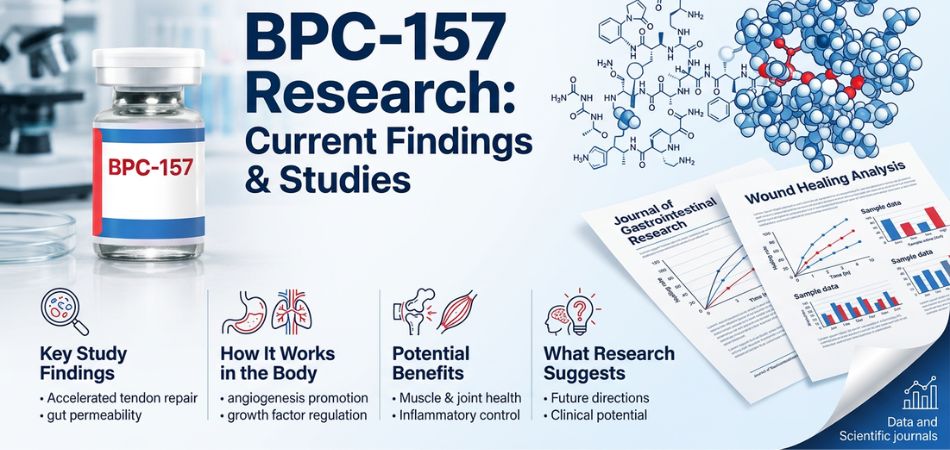
BPC-157 Pharmacokinetic Research
Understanding how a compound behaves in the body is another important part of peptide research.
A pharmacokinetic study in rats and beagle dogs investigated the absorption, distribution, metabolism, and excretion of BPC-157. The researchers reported a relatively short half-life of less than 30 minutes in the tested species, while bioavailability varied between experimental models and administration routes.
These findings demonstrate why pharmacokinetic data need to be interpreted by species and administration route.
Animal pharmacokinetic results cannot simply be converted into human dosing recommendations.
BPC-157 Safety Studies
Preclinical safety research has also been conducted.
A 2020 safety evaluation examined single-dose and repeated-dose toxicity in several animal species. The study reported no test-related effects in the single-dose experiments and generally favorable tolerance in the tested repeated-dose animal models.
However, animal safety studies cannot establish the long-term safety profile of a compound in humans.
More recent human research remains extremely limited. A 2025 pilot study investigated intravenous BPC-157 in only two human participants. The sample size was far too small to establish clinical safety or efficacy.
PubMed — Safety of Intravenous Infusion of BPC157 in Humans: A Pilot Study
What Does Human Research Show?
This is where the current BPC-157 evidence needs the most caution.
The research base is much larger in animals and laboratory systems than in humans. Reviews published in 2025 and 2026 continue to describe substantial preclinical investigation while identifying important translational limitations.
A 2026 review noted the absence of an approved BPC-157 formulation, validated dosing regimen, and completed Phase II clinical trial.
PubMed — BPC-157 as an Investigational Peptide Therapeutic
Therefore, statements about BPC-157’s effectiveness in humans should not be presented as established scientific conclusions.
Is BPC-157 FDA Approved?
BPC-157 should not be presented as an FDA-approved therapeutic drug.
FDA materials evaluating BPC-157 for regulatory purposes state that neither BPC-157 free base nor BPC-157 acetate is a component of an FDA-approved drug and that there is no USP/NF monograph for either substance.
This regulatory status is separate from whether researchers can investigate the compound in appropriate laboratory or clinical research settings.
What Are the Main Limitations of BPC-157 Research?
The current literature has several important limitations.
Heavy reliance on preclinical models
A large proportion of published research uses rodents, isolated tissues, or cellular models.
Limited human clinical evidence
Human studies remain very small compared with the volume of animal research.
Limited long-term data
There is insufficient evidence to establish the long-term effects of BPC-157 in humans.
Translational uncertainty
A biological effect observed in an experimental model does not necessarily produce the same effect in humans.
Lack of standardized clinical use
There is currently no established, universally validated clinical dosing protocol for BPC-157.
BPC-157 Research: What Can We Conclude?
The scientific literature provides substantial evidence that BPC-157 has been investigated in experimental models across multiple biological systems.
Research has examined gastrointestinal biology, tissue repair, angiogenesis, vascular signaling, inflammation, pharmacokinetics, and safety.
However, the strength of evidence differs considerably between these areas. The strongest body of literature remains preclinical, while human clinical evidence is still limited.
For this reason, BPC-157 is best described as an investigational peptide with extensive preclinical research, rather than as an established human therapy.
For the broader picture, return to our main [BPC-157 Research: Studies, Mechanism, Structure & Properties] pillar.
Frequently Asked Questions
What do BPC-157 studies show?
BPC-157 studies have investigated several biological processes, including vascular responses, tissue repair, gastrointestinal systems, inflammation, and related signaling pathways. Most available evidence is preclinical.
Are BPC-157 studies conducted in humans?
A small number of human investigations exist, but human clinical evidence remains very limited compared with animal and laboratory research.
Is BPC-157 clinically proven?
No. Current evidence does not establish BPC-157 as a clinically proven treatment for human diseases or injuries.
What areas of BPC-157 research have been studied?
Research has examined BPC-157 across gastrointestinal, vascular, tissue-repair, musculoskeletal, inflammatory, pharmacokinetic, and other experimental models. However, most of the available evidence remains preclinical, and the amount of research in an area does not by itself establish clinical effectiveness in humans.
Where can I find the scientific background of BPC-157?
The main BPC-157 Research provides an overview, while the supporting pages cover individual topics such as mechanism, molecular structure, stability, COA testing, and gastrointestinal research.