
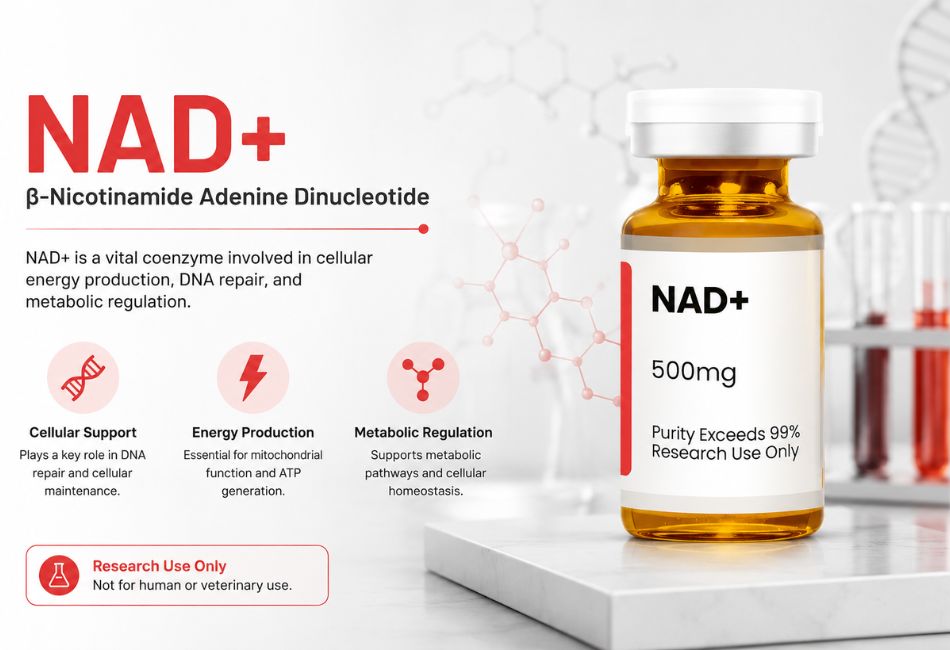
Short answer: Yes — within preclinical and in vitro research. NAD+ is studied as a central cofactor in cellular energy metabolism and DNA repair signaling, both of which decline with age. That dual role is why NAD+ sits at the center of current longevity research.
Research Use Only. Everything below reflects laboratory and preclinical literature. It is not medical advice, and Hotspan’s NAD+ is not intended for human or animal use outside licensed research settings.
Key Takeaways
- NAD+ is a redox cofactor, not a peptide, required for both ATP production and DNA repair enzyme activity.
- Published research shows plasma and tissue NAD+ levels decline measurably with age.
- NAD+ is a required substrate for sirtuins (longevity-linked genes) and PARPs (DNA repair enzymes).
- Human clinical trials on NAD+ precursors remain limited; most mechanistic evidence comes from preclinical and cell-based models.
- Hotspan supplies ≥99% pure NAD+ at 500mg ($69) and 1000mg ($99), with a COA and endotoxin report per batch.
What Is NAD+ Research for Cellular Energy and Longevity?
NAD+ (nicotinamide adenine dinucleotide) is a redox cofactor present in every living cell. It exists in two states — oxidized (NAD+) and reduced (NADH) — and shuttles electrons through the metabolic reactions that keep cells running.
Researchers study NAD+ because it sits at the intersection of two aging-related systems:
- Energy metabolism — NAD+ drives glycolysis, the citric acid cycle, and oxidative phosphorylation, the pathways that generate ATP.
- DNA repair signaling — NAD+ is a required substrate for PARPs (poly-ADP-ribose polymerases), enzymes that repair damaged DNA strands.
This dual role is why NAD+ for energy and DNA repair has become a core research thread in longevity science.
How NAD+ Connects to Anti-Aging Research
The Decline Problem
A 2019 plasma metabolome study published in Rejuvenation Research (Clement, Wong, Poljak, Sachdev & Braidy) found that the NAD+ metabolome is measurably dysregulated across normal aging in humans, with related metabolites shifting alongside declining NAD+ availability. Separate preclinical work has linked this decline to reduced mitochondrial oxidative capacity and slower DNA repair kinetics in aged tissue.
This matters because both of NAD+’s core jobs — powering mitochondria and fueling DNA repair enzymes — become less efficient as substrate availability drops. Researchers describe this as a compounding problem: lower NAD+ means slower repair, and unrepaired damage places further demand on the same limited NAD+ pool.
Sirtuins: The Longevity Link
NAD+ is also a required cofactor for sirtuins, a family of enzymes tied to gene-expression regulation and cellular stress response. Sirtuins were among the first molecular targets studied in connection with caloric restriction and lifespan extension in model organisms, which is part of why sirtuin-NAD+ biology remains a recurring theme in longevity literature. Sirtuin activity depends directly on NAD+ availability, so research models that deplete or restore NAD+ are commonly used to study downstream sirtuin function.
PARP-Mediated DNA Repair
When DNA damage occurs, PARP enzymes consume NAD+ to initiate repair. This consumption can be substantial — laboratory models have shown that heavy DNA damage triggers rapid PARP activation, drawing down local NAD+ stores quickly. Registered clinical research (ClinicalTrials.gov NCT03707652, an open-label study of NAD+ level changes) reflects continued human-focused interest in how NAD+ status might be measured and influenced, even though most mechanistic detail today still comes from preclinical and cell-based models rather than large human trials. This substrate competition between DNA repair and other NAD+-dependent processes is the mechanism most directly relevant to NAD+ for energy and DNA repair research.
What Human Trial Data Currently Shows — and Doesn’t
It’s worth being precise about the evidence base. Multiple human trials of NAD+ precursors (up to roughly 26 weeks, with at least one extending to two years) have consistently reported that supplementation is well tolerated. Efficacy data is more mixed: some trials report improvements in metabolic markers, while evidence for slowing age-related disease progression in humans remains limited and is considered preliminary by researchers in the field. This gap between strong preclinical signal and still-developing human data is a recurring, honest caveat across the NAD+ research literature — and one Hotspan’s research materials are intended to support, not get ahead of.
Hotspan NAD+: Product Overview
| Detail | Specification |
| Compound | NAD+ (Nicotinamide Adenine Dinucleotide) |
| Format | Lyophilized powder |
| Dosage options | 500 mg — $69, 1000 mg — $99 |
| Standing order | 10% savings for labs with recurring supply needs |
| Includes | Individually sealed, single-use glass vial |
| Documentation | COA and endotoxin report available per batch |
| Purity | ≥99%, independently verified |
Both dosages are supplied at the same verified purity — the 1000mg option simply gives researchers more material per vial for extended protocols.
What NAD+ Research Actually Investigates
Current literature on NAD+ centers on a defined set of pathways:
- Mitochondrial oxidative phosphorylation — how NAD+ availability affects ATP output.
- Glycolytic flux — NAD+/NADH ratio as a control point across metabolic reactions.
- Sirtuin-dependent signaling — gene expression and stress-response regulation.
- PARP-mediated DNA repair — enzyme activity tied directly to NAD+ substrate levels.
- Cellular stress-response mechanisms — how NAD+ depletion under laboratory conditions affects cell resilience.
None of this implies approved outcomes in humans. It describes where the preclinical and in vitro research is currently focused.
Where NAD+ Fits Alongside Skin-Focused Peptide Research
Longevity research doesn’t stop at the mitochondrial level — a parallel body of literature looks at peptides for anti-aging skin, where the aging mechanisms (oxidative stress, declining cellular signaling, collagen loss) overlap with what NAD+ research investigates at the metabolic level.
GHK-Cu, a copper-binding tripeptide, is the most studied compound in that skin-focused research space. It’s evaluated for its role in fibroblast signaling, collagen and glycosaminoglycan pathways, and oxidative stress markers — mechanistically adjacent to the redox biology NAD+ research covers.
| Product | Dosage Options | Price |
| GHK-Cu | 50mg / 100mg | $49 – $89 |
For a full breakdown of skin-targeting compounds, see Hotspan’s guide: Peptides For Anti-Aging Skin: What the Research Actually Shows.
Quality & Safety Standards
Every Hotspan NAD+ batch includes:
- ≥99% purity, confirmed by independent lab testing.
- COA (Certificate of Analysis) available per batch.
- Endotoxin testing documentation available per batch.
All products are labeled Research Use Only. They are not drugs, foods, or cosmetics, and are not intended for bodily introduction in humans or animals outside licensed research settings.
Why Purity Matters for NAD+ Specifically
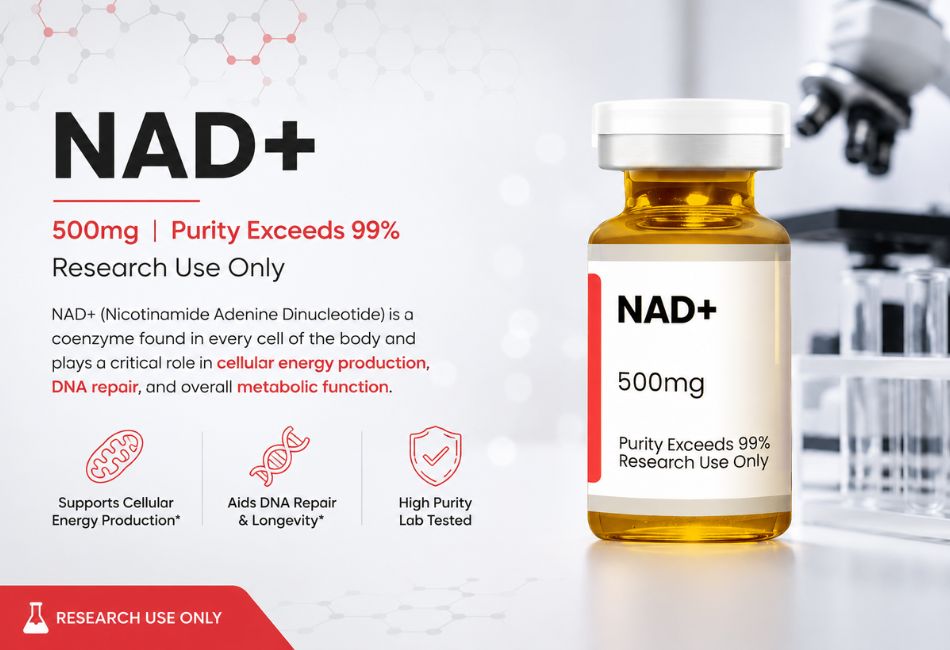
NAD+ is a redox-sensitive molecule — improper handling, moisture exposure, or contamination can degrade it or introduce confounding variables into experimental readouts before a researcher ever gets to the question they’re studying. That’s why Hotspan tests each batch independently rather than relying on manufacturer-supplied data alone, and why COA and endotoxin reports are made available per batch rather than per product line. Researchers building reproducible protocols need to know the specific lot they’re working with meets the same standard as the last one.
How This Fits Into a Broader Research Protocol
Researchers rarely study NAD+ in isolation. Because it sits upstream of both mitochondrial and DNA-repair pathways, it’s frequently paired in study design with compounds that act on adjacent systems — for example, copper-tripeptide research on extracellular matrix biology, or telomere-focused compounds studied in cellular senescence models. Understanding where NAD+ fits in that broader map helps researchers decide which additional compounds are relevant to their specific hypothesis, rather than treating NAD+ as a standalone variable.
Frequently Asked Questions
Does NAD+ actually support anti-aging research?
Yes, within preclinical and in vitro literature. NAD+ is studied for its role in mitochondrial energy production, sirtuin activation, and PARP-mediated DNA repair — all pathways linked to cellular aging.
What is NAD+ studied for specifically?
Two main areas: energy metabolism (ATP production through glycolysis and oxidative phosphorylation) and DNA repair (as a substrate for PARP enzymes).
What dosages does Hotspan’s NAD+ come in?
500mg at $69, or 1000mg at $99. Both are ≥99% pure with COA and endotoxin documentation.
Is NAD+ the same as a peptide?
No. NAD+ is a nucleotide-based coenzyme, not a peptide (a chain of amino acids). It’s grouped alongside peptides on research supplier catalogs because it’s studied through similar laboratory workflows.
How does NAD+ relate to skin-aging peptide research?
Both fields study oxidative stress and cellular signaling decline with age — NAD+ at the metabolic/DNA-repair level, and peptides like GHK-Cu at the fibroblast/collagen level. Researchers sometimes study both in parallel.
Is Hotspan’s NAD+ approved for human use?
No. It’s sold strictly for in vitro and laboratory research, not for human consumption, therapeutic use, or clinical application.
Explore Related Research Compounds
- GHK-Cu — copper tripeptide, skin and extracellular matrix research
- Epithalon — telomere biology and cellular senescence research
- Peptides For Anti-Aging Skin: The Complete Research Guide — full skin-peptide research breakdown
Get Hotspan NAD+ for Your Research
Hotspan supplies NAD+ at ≥99% verified purity, in 500mg and 1000mg options, with a COA on every batch.
Browse NAD+ Research Compounds →
Separately, Hotspan operates a physician-supervised telemedicine service for patients seeking a diagnosed, prescription-based treatment plan. This is a distinct, independently licensed service line — evaluated and prescribed by a physician for clinical use, not a consumer-facing version of the research compounds described above.
Learn About Hotspan’s Telemedicine Services →
References
1. Clement J, Wong M, Poljak A, Sachdev P, Braidy N. The Plasma NAD+ Metabolome Is Dysregulated in “Normal” Aging. Rejuvenation Research, 2019. DOI: 10.1089/rej.2018.2077
2. Open-label Study to Assess Increasing Levels of NAD+ (Nicotinamide Adenine Dinucleotide). ClinicalTrials.gov Identifier: NCT03707652
3. Massudi H, Grant R, Braidy N, Guest J, Farnsworth B, Guillemin GJ. Age-associated changes in oxidative stress and NAD+ metabolism in human tissue. PLoS One, 2012.
4. Verdin E. NAD+ in aging, metabolism, and neurodegeneration. Science, 2015.
This reference list reflects publicly available research literature. It is provided for research context only and does not constitute a claim of efficacy for any Hotspan product.
Research Use Only. All products are intended strictly for in vitro research and laboratory experimentation. Not for human consumption, therapeutic use, or clinical application. For use by qualified researchers only.