
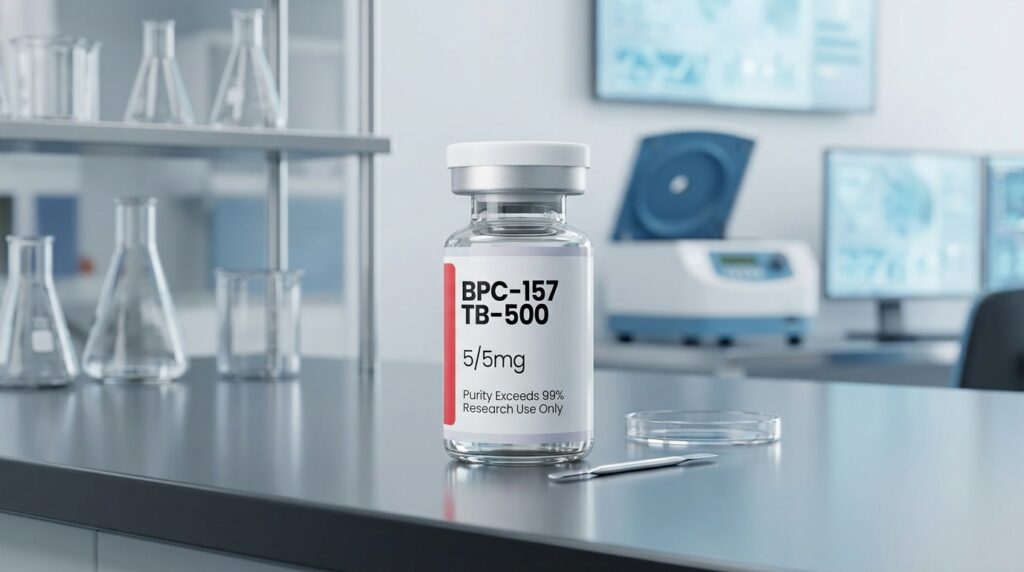
BPC-157 combination research examines how BPC-157 may be investigated alongside other experimental compounds or biological pathways.
This is a developing area of research, but it requires careful interpretation. Combining two compounds does not automatically produce a synergistic effect, and experimental observations from one model cannot be translated directly into human treatment recommendations.
For this reason, this article focuses on research concepts, experimental evidence, and scientific interpretation, rather than human dosing protocols.
For the broader BPC-157 evidence base, see our BPC-157 Research: Studies, Mechanism, Structure & Properties.
What Is BPC-157 Combination Research?
Combination research investigates whether two or more compounds produce different biological responses when studied together compared with each compound studied independently.
Researchers may investigate combinations to determine whether:
- Biological pathways overlap
- One compound changes the activity of another
- Different mechanisms produce complementary effects
- A combination changes a measured experimental endpoint
- Unexpected interactions occur
The term “combination” therefore describes a research design rather than proof of synergy.
Why Study BPC-157 in Combination?
BPC-157 has been investigated across multiple biological systems, including vascular signaling, inflammation, tissue responses, and gastrointestinal models.
Because these processes involve multiple biological pathways, researchers may investigate whether other compounds influence related pathways.
A combination study can therefore help answer mechanistic questions that cannot be addressed by studying one compound alone.
Some experimental designs may also examine BPC-157 alongside compounds or biological factors involved in cellular metabolism. NAD+ is one example of a biological molecule that could be investigated when researchers are studying relationships between cellular metabolism and other signaling pathways. Such a combination would require direct experimental testing rather than assumptions about a beneficial interaction.
Why Researchers Study Multiple Compounds
Multi-compound experiments can be used to investigate interactions between different biological pathways under controlled conditions.
For example, a study may examine whether changes in vascular signaling, cellular activity, extracellular matrix responses, or inflammatory markers differ when compounds are studied individually versus in combination.
The purpose is not simply to add more compounds to an experiment. Each additional compound introduces another variable that must be controlled and measured.
Researchers therefore need appropriate individual-compound controls, combination groups, predefined endpoints, and statistical analysis before drawing conclusions about interactions between compounds.
What Does Synergy Mean in Research?
Synergy has a specific meaning in experimental science.
Two compounds are not necessarily synergistic simply because the combined treatment produces a larger response.
Researchers need appropriate controls and quantitative methods to determine whether the combined effect is greater than what would be expected from the individual effects.
A scientifically valid combination study therefore requires:
- A control group
- Compound A alone
- Compound B alone
- Combination treatment
- Defined experimental endpoint
- Appropriate statistical analysis
Without these controls, claims of synergy are difficult to interpret.
BPC-157 and Tissue-Related Research
BPC-157 has been investigated in experimental models involving tissue responses.
These studies have examined processes associated with:
- Vascular responses
- Cellular activity
- Inflammation
- Tissue remodeling
- Repair-related signaling
When another experimental compound affects one of these same processes, researchers may investigate whether the two compounds interact.
However, overlap in biological pathways does not establish a beneficial combination.
BPC-157 and Vascular Pathways
Vascular biology is one area where combination research may be scientifically relevant.
BPC-157 research has investigated angiogenesis, endothelial activity, and nitric oxide-related signaling.
Another compound that influences vascular biology could theoretically interact with these pathways.
That interaction must be demonstrated experimentally.
Researchers cannot assume that two compounds affecting the same pathway will necessarily produce additive or synergistic effects.
BPC-157 and Inflammatory Pathways
Inflammatory signaling involves many different molecules and cellular systems.
BPC-157 research has investigated inflammatory responses in several experimental models.
Combination research could therefore examine whether another compound changes the inflammatory response associated with BPC-157.
Again, this is a research question rather than evidence of a validated treatment combination.
BPC-157 and Gastrointestinal Research
The gastrointestinal system contains interconnected epithelial, vascular, immune, and connective-tissue processes.
BPC-157 gut research has investigated intestinal tissues and barrier-related responses.
For this reason, combination studies involving gastrointestinal models may investigate interactions between BPC-157 and other experimental compounds.
Our BPC-157 Gut Research: Intestinal Barrier & Gastrointestinal Studies page covers the underlying gastrointestinal literature.
BPC-157 and TB-500 Research
BPC-157 and TB-500 are frequently discussed together online because both are associated with tissue and repair-related research.
However, online popularity does not establish that combining them produces a scientifically validated effect.
BPC-157 and thymosin beta-4-related research involve different molecular systems.
Any claim of combination benefit should therefore be supported by a study specifically evaluating the combination.
See our BPC-157 vs TB-500: Scientific Research Comparison article for the differences between these research areas.
BPC-157 and GHK-Cu Research
GHK-Cu is a copper-binding tripeptide that has been investigated in experimental research involving extracellular matrix biology, tissue signaling, and redox-related processes.
From a combination-research perspective, BPC-157 and GHK-Cu may be studied together when researchers are interested in interactions between tissue-related signaling and extracellular matrix processes.
However, overlapping biological pathways do not establish that the combination produces a synergistic effect. A controlled study comparing BPC-157 alone, GHK-Cu alone, and the combination would be required to determine whether an interaction exists.
How Researchers Study Peptide Combinations
A controlled combination experiment may follow a structure such as:
Control → Compound A → Compound B → Combination
Researchers then compare predefined outcomes across the groups.
Depending on the model, outcomes might include:
- Cell viability
- Molecular markers
- Tissue morphology
- Inflammatory mediators
- Vascular responses
- Gene expression
- Protein signaling
The appropriate endpoint depends on the scientific question.
Why Experimental Model Matters
A combination effect observed in cultured cells is not equivalent to an effect observed in an animal model.
Similarly, an animal result is not equivalent to a human clinical outcome.
Evidence can therefore be viewed across levels:
Cellular research → Animal research → Human research → Clinical trials
Each stage answers different questions.
BPC-157 combination claims should always identify where on this evidence spectrum the underlying research sits.
What Are the Risks of Assuming Synergy?
Assuming synergy without evidence can create several problems.
Two compounds can potentially:
- Interact unpredictably
- Produce opposing biological effects
- Change pharmacokinetics
- Affect the same pathway excessively
- Create unexpected toxicity
- Alter experimental outcomes
Therefore, combination research should be treated as an experimental question requiring direct investigation.
BPC-157 Combination Research and Analytical Quality
The quality of the research material also matters.
If the identity or purity of a compound is uncertain, it becomes difficult to determine whether an observed result is actually caused by the intended research compound.
Researchers should therefore consider analytical characterization, including:
- Identity
- Purity
- Batch information
- Molecular mass
- Analytical testing
Our BPC-157 COA: How to Read Purity, HPLC & LC-MS Results article explains how batch-specific analytical documentation can be evaluated.
Combination Research vs Human Protocols
An experimental combination study is not the same thing as a human treatment protocol.
A research paper may describe concentrations, administration methods, timing, or experimental conditions specific to its model.
Those conditions should not automatically be converted into instructions for human use.
This distinction is particularly important for investigational peptides where clinical evidence and standardized therapeutic protocols are limited.
What Does Current Research Tell Us?
The broader BPC-157 literature provides evidence that the peptide interacts with multiple biological processes in experimental models.
However, there is much less evidence establishing specific peptide combinations as safe and effective in humans.
This means the most useful role of combination research is currently to generate hypotheses and investigate biological interactions.
Future Directions for BPC-157 Combination Research
Future research could investigate:
- Molecular interactions between compounds
- Pharmacokinetic relationships
- Dose-response behavior in controlled models
- Long-term effects
- Mechanistic pathways
- Tissue-specific responses
- Controlled human clinical outcomes
Better-designed studies would help determine whether combination effects are reproducible and biologically meaningful.
Conclusion
BPC-157 combination research is an emerging area focused on understanding how BPC-157 interacts with other experimental compounds and biological pathways.
The existence of a proposed combination does not establish synergy, safety, or clinical effectiveness.
Strong combination research requires appropriate controls, clearly defined endpoints, validated analytical methods, and careful interpretation of the experimental model.
For the broader BPC-157 evidence base, see our BPC-157 Research.
For comparisons with another commonly discussed peptide, see BPC-157 vs TB-500.