
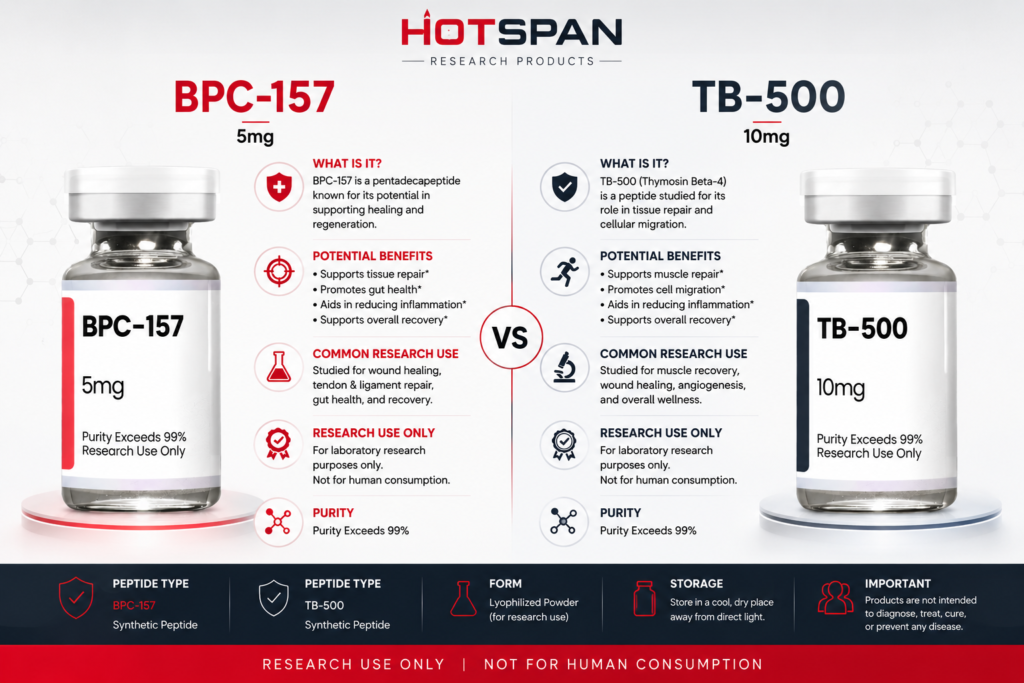
BPC-157 vs TB-500 is a common comparison in peptide research because both compounds have been investigated in connection with tissue responses, repair-related processes, inflammation, and vascular biology.
Despite these similarities, BPC-157 and TB-500 are chemically different compounds and should not be treated as interchangeable.
BPC-157 is a synthetic pentadecapeptide with a defined 15-amino-acid sequence. TB-500 is commonly discussed in relation to thymosin beta-4-derived research, although the terminology surrounding “TB-500” can vary between commercial products and research contexts.
The scientific evidence for both compounds also has important limitations, particularly the limited amount of high-quality human clinical research.
For the BPC-157 side of the comparison, see our BPC-157 Research: Studies, Mechanism, Structure & Properties.
What Is BPC-157?
BPC-157 is a synthetic peptide containing 15 amino acid residues.
Its sequence is:
GEPPPGKPADDAGLV
Researchers have investigated BPC-157 across gastrointestinal, vascular, musculoskeletal, inflammatory, and tissue-response models.
Much of the available evidence comes from animal and laboratory research.
See our BPC-157 Molecular Structure, Formula, Weight & Amino Acid Sequence article for its chemical profile.
What Is TB-500?
TB-500 is commonly associated with thymosin beta-4-related peptide research.
Thymosin beta-4 is a naturally occurring peptide involved in several cellular processes, while “TB-500” is frequently used commercially to describe a related research peptide.
This terminology should be handled carefully because the commercial label does not necessarily provide enough information to establish the exact molecular composition of a particular product.
Researchers should distinguish the naturally occurring thymosin beta-4 protein/peptide from products marketed under the TB-500 name.
BPC-157 vs TB-500: Chemical Difference
BPC-157 and TB-500 differ substantially in their molecular characteristics.
BPC-157
- Synthetic pentadecapeptide
- 15 amino acid residues
- Sequence: GEPPPGKPADDAGLV
TB-500
- Associated with thymosin beta-4-derived research
- Commercial terminology can vary
- Molecular identity should be verified through appropriate analytical documentation
These differences matter when comparing research compounds.
Chemical identity should never be assumed solely from a product name.
BPC-157 vs TB-500: Research Focus
Both compounds have attracted attention in tissue-related research, but the research literature is not identical.
BPC-157 research has investigated:
- Gastrointestinal models
- Tissue responses
- Angiogenesis
- Vascular signaling
- Inflammatory responses
- Musculoskeletal models
Thymosin beta-4-related research has investigated:
- Cell migration
- Cytoskeletal processes
- Angiogenesis
- Tissue repair
- Wound-related models
- Cellular differentiation
This means the two research areas overlap in some biological themes while remaining mechanistically distinct.
BPC-157 vs TB-500 and Angiogenesis
Angiogenesis is a major area of overlap.
BPC-157 research has investigated angiogenesis and endothelial signaling in experimental models.
Thymosin beta-4 research has also investigated angiogenic processes.
However, the fact that both compounds have been studied in angiogenesis does not mean they produce identical effects.
Different molecular pathways can influence the same biological process.
Our [BPC-157 Mechanism of Action] article explains the BPC-157-specific research in greater detail.
BPC-157 vs TB-500 for Tissue Research
Tissue repair is another area where the research topics overlap.
BPC-157 studies have examined tissue responses following experimental injury.
Thymosin beta-4-related research has also examined cell migration, vascular growth, and repair-associated processes.
But these studies use different experimental systems and endpoints.
Therefore, saying one compound is simply “better” than the other is not scientifically justified based on current evidence.
A better comparison asks:
Which biological mechanism is being studied?
What model was used?
What endpoint was measured?
Was the research performed in animals, cells, tissue, or humans?
BPC-157 vs TB-500: Human Evidence
This is one of the most important differences between online claims and scientific evidence.
Neither compound should be presented as an established, broadly approved human treatment based solely on preclinical research.
Recent reviews describe both BPC-157 and TB-500/thymosin beta-4-related compounds as investigational, with limited human evidence and substantial reliance on preclinical research.
BPC-157 has a much larger body of animal and laboratory research than human clinical research.
Human evidence remains limited.
Similarly, evidence involving thymosin beta-4 should not automatically be applied to every product marketed as TB-500.
Which Has More Research?
The answer depends on what is being measured.
BPC-157 has a substantial preclinical literature covering multiple biological systems.
Thymosin beta-4 also has a broad scientific literature because it is a naturally occurring biological peptide that has been studied independently of commercial TB-500 products.
Therefore, simply counting articles mentioning “TB-500” versus “BPC-157” can produce a misleading comparison.
The molecular identity of the compound studied matters.
BPC-157 vs TB-500: Safety Evidence
Preclinical safety studies provide useful information but cannot establish long-term human safety.
BPC-157 has been investigated in animal safety studies, while human clinical data remain limited.
For both research areas, researchers should distinguish:
Preclinical safety
from
Clinical safety.
A compound being tolerated in an animal study does not automatically establish that it is safe for human use.
BPC-157 vs TB-500: How Do They Compare?
There is no scientifically established answer that one is universally “better.”
The appropriate research compound depends on the scientific question, model, mechanism, and experimental endpoint.
A comparison based solely on online claims about recovery, muscle growth, injury healing, or other human outcomes goes beyond the strength of the available evidence.
BPC-157 vs TB-500: Research Comparison
| Research area | BPC-157 | TB-500 / thymosin beta-4 research |
|---|---|---|
| Chemical identity | Defined synthetic pentadecapeptide | Terminology varies; thymosin beta-4-related |
| Tissue research | Extensive preclinical investigation | Extensive thymosin beta-4 research |
| Angiogenesis | Studied experimentally | Studied extensively in thymosin beta-4 research |
| Gastrointestinal research | Significant research interest | Not the defining research area |
| Human evidence | Limited | Depends on the specific thymosin beta-4 research context |
| Clinical approval | Not an approved treatment | TB-500 should not be presented as an approved therapy |
How Should Researchers Compare Them?
A useful comparison should consider:
- Exact molecular identity
- Research model
- Experimental endpoint
- Mechanism being investigated
- Analytical characterization
- Published evidence
- Human vs preclinical evidence
This is more scientifically useful than comparing the compounds through anecdotal claims.
Conclusion
BPC-157 and TB-500 are different research compounds that have overlapping areas of scientific interest.
BPC-157 has been investigated extensively in preclinical gastrointestinal, vascular, tissue, inflammatory, and musculoskeletal models.
TB-500 is commonly associated with thymosin beta-4-derived research, where studies have examined processes such as cell migration, angiogenesis, and tissue remodeling.
The two should not be treated as interchangeable, and current evidence does not support declaring one universally superior for human use.
For more information, see our BPC-157 Studies and BPC-157 Mechanism of Action articles.