
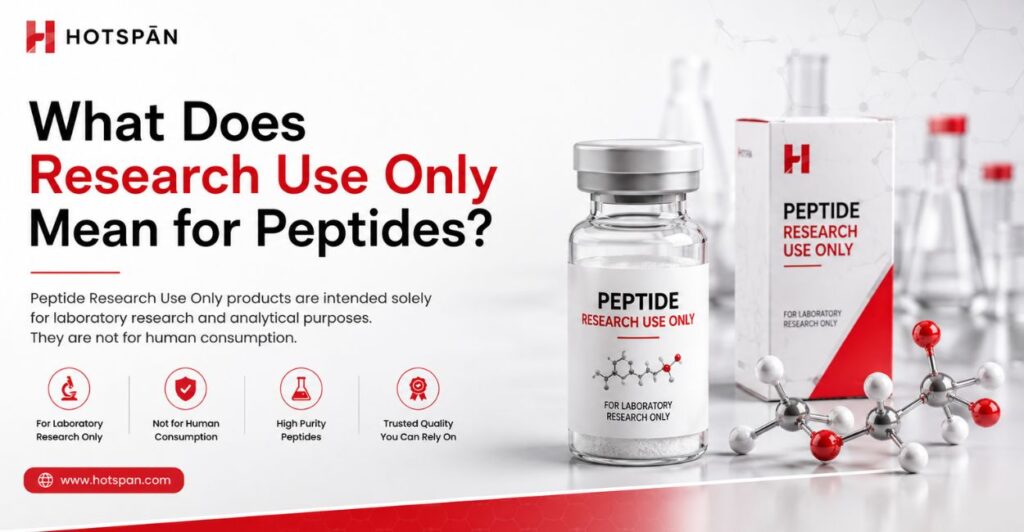
Research use only means a peptide is made and sold for laboratory work—not for use in people or animals. You may also see the shortened term “RUO” on a label or product page.
In simple terms, a research peptide belongs in a qualified laboratory. It should not be injected, swallowed, inhaled or applied to the skin. It should not be mixed into a supplement, skincare product or patient treatment.
A research label is not a technical detail that can be ignored. It tells you what the product is—and what it is not.
What are research use only peptides?
Research use only peptides are materials scientists use to study biological questions under controlled conditions. A laboratory might use one to examine how a receptor works, how cells respond to a signal or how stable a peptide remains over time.
These products do not come with approved instructions for patients. There is no approved personal dose, treatment schedule or way to administer them.
A research product can share a name with a substance used in a study or medicine. That does not make the products identical. The formula, manufacturer, quality system, testing and intended purpose may all be different.
This wording comes from official FDA labeling rules.
What can researchers use these peptides for?
Qualified researchers may use laboratory peptides for work such as:
- receptor-binding tests;
- cell-culture experiments;
- biochemical pathway studies;
- gene-expression research;
- identity and purity testing;
- stability studies; and
- development of laboratory methods.
The research question should come first. A scientist should know which compound is needed, why it fits the study and what outcome will be measured.
Good laboratory work also needs proper controls, records, storage and safety procedures. The words “research use only” do not remove those responsibilities.
What can research use only peptides not be used for?
They must not be:
- injected into a person;
- swallowed or inhaled;
- applied to human skin;
- given to an animal;
- added to food or supplements;
- mixed into a serum or cream;
- prepared as a patient treatment; or
- promoted for weight loss, muscle growth, anti-aging or healing.
Calling personal use “self-research” does not make it real laboratory research. Personal experimentation does not have the controlled setting, oversight or safety systems expected in a laboratory.
Can a doctor use a Hotspan research peptide on a patient?
No. A Hotspan research product stays a laboratory product even when a doctor or other healthcare professional is involved. A person’s qualifications do not change what the vial was made and labeled for.
Patient care should use products obtained through the right medical and pharmacy channels. Formal clinical research also follows separate ethical and regulatory processes.
Buying a research vial online is not the same as receiving an approved medicine, a lawful compounded product or an authorized clinical-trial product.
Does “not for human consumption” only mean you cannot swallow it?
No. The phrase can be confusing because some people read “consumption” as “eating or drinking.”
For Hotspan products, the meaning is broader: no human or animal use by any route. That includes injection, skin application, nasal use, inhalation and use in a homemade product.
This is why “research use only” is the clearer term. It points to the correct setting a laboratory and rules out personal use.
Can research peptides be used on animals?
Hotspan research products are not intended for animal use.
Formal animal research requires approved protocols, trained staff, suitable facilities and proper oversight. A general laboratory label does not give automatic permission for animal testing or veterinary treatment.
Researchers must make sure their study, material and source meet the requirements that apply to their institution and location.
Why are injection instructions a serious problem?
Injection places a substance inside the body and bypasses several natural defenses. Problems with sterility, bacteria, endotoxins, identity or concentration can cause serious harm.
A laboratory product has not been supplied with approved injection instructions. Giving details about needle size, injection location, dose or schedule would go against its research-only purpose.
It is reasonable to explain why injection claims are not supported. It is not appropriate to provide a step-by-step guide that helps someone inject a research chemical.
For an evidence-based example, read five peptides studied in skin-aging research.
Why can bacteriostatic water cause confusion?
Bacteriostatic water is often associated with the preparation of certain injectable medicines. When it is displayed beside peptide vials, a customer may assume the products are meant to be mixed and injected.
That impression becomes even stronger if the same website includes syringes, mixing guides, calculators, human doses or treatment claims.
The presence of bacteriostatic water does not make a research peptide suitable for personal use. It also does not prove that the peptide is sterile, approved or safe to inject.
Does 99% purity mean a peptide is safe for people?
No. A purity result tells you only part of the story. It usually shows what percentage of material was detected as the target compound under a particular test.
It does not prove:
- that the vial is sterile;
- that every impurity was detected;
- that the endotoxin level is suitable for injection;
- that the concentration is correct after mixing;
- that the peptide will remain stable;
- that a certain dose is safe; or
- that the product works in people.
A research peptide can be highly pure and still be unsuitable for human or animal use.
What does a certificate of analysis tell you?
A certificate of analysis, or COA, lists test results for a particular batch. It may show:
- the product name;
- lot or batch number;
- test method;
- expected specification;
- actual result; and
- date of testing.
A COA can help a scientist decide whether a batch meets the needs of an experiment. It is not proof that the product is an approved drug or safe personal treatment.
The batch number matters. A certificate for a different lot does not prove the quality of the vial in front of you.
For a closer look at common test results, see how to read a GHK-Cu certificate of analysis.
Does an endotoxin test prove that a peptide is sterile?
No. Endotoxin and sterility tests answer different questions.
An endotoxin test looks for certain bacterial components. A sterility test looks for living microorganisms under defined conditions. Passing one does not mean the product has passed the other.
A clear-looking solution, sealed vial or high-purity result also cannot prove sterility.
How are research peptides different from FDA-approved medicines?
An FDA-approved medicine has been reviewed for a specific use, manufacturer, formula and label. Its approval does not automatically cover every product containing a similarly named ingredient.
A research peptide does not have approved patient instructions. It has not been approved for personal goals such as weight loss, anti-aging, muscle growth or recovery.
Phrases such as “the same as” or “equivalent to” can be misleading when two products have different manufacturers, formulas, quality systems and intended uses.
How are research peptides different from compounded products?
A compounded drug is prepared under specific legal conditions for patient care. Compounded drugs are not FDA-approved in the same way as commercially approved medicines.
Not every research peptide can be compounded for a patient. The ingredient, prescription, patient need, pharmacy and state rules can all matter.
Mixing a research peptide at home does not turn it into a compounded medicine.
How are research peptides different from cosmetics?
A finished cosmetic is made for use on the skin. Its complete formula may include preservatives, stabilizers, moisturizers and other ingredients. It should also have directions for normal consumer use.
A research peptide is not a finished skincare product. A purity result does not show that it will remain stable in a cream, resist contamination or be well tolerated by human skin.
For example, Hotspan GHK-Cu is supplied for laboratory studies involving cellular and extracellular-matrix pathways. It is not a face serum or ingredient for a homemade cream.
Learn more in research-grade GHK-Cu vs. finished copper-peptide cosmetics.
What information should appear on a research peptide product page?
A helpful product page can explain:
- what the compound is;
- its molecular form or sequence;
- which pathways researchers study;
- what testing documents are available;
- how it should be stored; and
- that it is not for human or animal use.
The wording should stay focused on laboratory research. “Studied in cell models” is very different from “works in people.”
Product pages should not include personal doses, injection schedules, treatment instructions or before-and-after photos.
How should educational pages link to research products?
A product should be linked only when it directly relates to the scientific topic. There is no need to add unrelated products just to create more purchase opportunities.
One clear, relevant link is usually enough. It should appear inside a laboratory-focused section—not beside a promise about a human result.
Internal links should be spaced out so the page remains useful and easy to read. Product grids and prices can make educational information feel like a treatment sales page.
How should customer support answer personal-use questions?
Customer support should give a simple and consistent response: Hotspan products are for laboratory research only and cannot be used in humans or animals.
Staff should not answer questions about:
- personal doses;
- mixing for injection;
- injection sites;
- cycle length;
- peptide stacks;
- expected results; or
- use for a health condition.
Chat tools, saved email replies and social-media messages should follow the same rule.
What should researchers check before buying?
A qualified researcher may want to review:
- exact compound identity;
- molecular form;
- batch-specific documents;
- testing methods;
- purity specification;
- available endotoxin results;
- storage requirements;
- stability information; and
- suitability for the planned experiment.
Some studies may require independent testing. Supplier documents do not replace experimental controls or a laboratory’s responsibility for its own work.
The GHK-Cu research guide gives a practical example of how molecular form, research model and measured outcome affect a conclusion.
Frequently Asked Questions About Research Use Only Peptides
Can research use only peptides be injected?
No. Hotspan research peptides are not intended for injection or any other form of human or animal use.
Can they be applied to the skin?
No. Applying a product to the skin is still human use. A research peptide is not a skincare product.
Can a doctor use one on a patient?
No. A healthcare professional’s involvement does not turn a laboratory product into an approved medicine or lawful patient-specific preparation.
Does “not for human consumption” allow external use?
No. The restriction covers all human use, including topical application.
Does a COA make a peptide pharmaceutical grade?
No. A COA reports selected test results for a batch. It does not create FDA approval or prove that a product is safe for patients.
Is it legal to buy a research peptide?
Being available for purchase does not mean it can be used personally. Requirements can vary by location and activity, and the product remains limited to legitimate laboratory work.
Can customer reviews mention personal results?
Reviews describing injections, doses or personal outcomes conflict with a laboratory-only purpose and should not appear on research product pages.
Can published human studies be discussed?
Scientific studies can be explained accurately, but the exact study product must be separated from Hotspan’s research material. A study should not be turned into a personal-use recommendation.
What Research Use Only Means for Hotspan
Hotspan products are meant for qualified laboratory research. That message should stay clear from the product page through customer support.
High purity, a COA or an interesting scientific mechanism does not make a peptide safe for personal use. Research findings should be described as research findings—not promises about what a product will do for a person.
The simplest rule is also the most important: Hotspan research peptides belong in the laboratory and are not intended for use in humans or animals.