
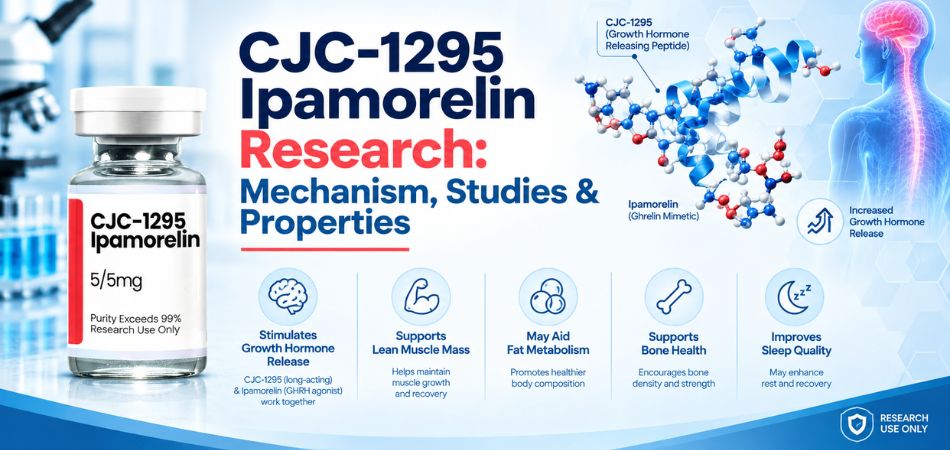
CJC-1295 and Ipamorelin are synthetic peptides that have been studied in relation to growth hormone (GH) secretion and the regulation of the GH/IGF-1 axis. Although both compounds are associated with GH research, they act through different biological pathways.
CJC-1295 is a synthetic analogue of growth hormone-releasing hormone (GHRH), while Ipamorelin is a growth hormone secretagogue that acts through the growth hormone secretagogue receptor (GHS-R). Research on these compounds has examined receptor activity, GH secretion, pharmacokinetics, molecular properties, and related physiological responses.
This research guide provides an overview of CJC-1295 and Ipamorelin, their mechanisms, available studies, molecular characteristics, and the limitations of the current evidence.
What Are CJC-1295 and Ipamorelin?
CJC-1295 is a synthetic peptide analogue related to GHRH. GHRH is one of the principal hypothalamic regulators of GH secretion. By interacting with the GHRH signaling pathway, CJC-1295 has been investigated for its ability to influence GH release.
Research on CJC-1295 has particularly focused on the long-acting form commonly referred to as CJC-1295 DAC. Human studies have examined its pharmacokinetic and pharmacodynamic properties, including changes in circulating GH and IGF-1.
Ipamorelin is a synthetic pentapeptide and growth hormone secretagogue. Early pharmacological research found that it stimulated GH release through a GHRP-like receptor while showing greater selectivity for GH release than several earlier secretagogues evaluated in the same research program.
The two compounds therefore belong to different pharmacological categories despite their shared connection to GH research.
CJC-1295 and Ipamorelin: Different Signaling Pathways
The most important distinction between CJC-1295 and Ipamorelin is their primary signaling pathway.
CJC-1295 is associated with the GHRH pathway. GHRH receptors are expressed on pituitary somatotroph cells and participate in the regulation of GH synthesis and secretion.
Ipamorelin is associated with the growth hormone secretagogue receptor (GHS-R) pathway. GHS-R1a is also known as the ghrelin receptor and plays an important role in GH secretion.
This difference provides the foundation for studying the two compounds separately before examining their combined research.
CJC-1295
Primary research pathway: GHRH receptor
Primary research focus: GH secretion, prolonged exposure, GH/IGF-1 response
Ipamorelin
Primary research pathway: GHS-R1a
Primary research focus: GH secretagogue activity, receptor selectivity, GH release
The detailed receptor mechanisms are covered separately in our CJC-1295 mechanism of action research and Ipamorelin mechanism of action research pages.
CJC-1295 Research Overview
Research on CJC-1295 has included laboratory studies, pharmacological investigations, and controlled human studies.
One of the most frequently cited human studies investigated CJC-1295 as a long-acting GHRH analogue in healthy adults. The researchers evaluated pharmacokinetics, pharmacodynamic effects, and safety. The study reported prolonged increases in GH and IGF-1 following administration of CJC-1295.
The DAC modification is particularly relevant to this research because it was developed to extend the compound’s systemic exposure. Consequently, research involving CJC-1295 DAC should not automatically be treated as evidence for every form marketed under the broader CJC-1295 name.
Current regulatory review also highlights an important evidence limitation: published literature does not always clearly identify which form of CJC-1295 is being discussed, making direct comparisons between different forms more difficult.
For a detailed review of the evidence, see CJC-1295 studies and clinical research.
Ipamorelin Research Overview
Ipamorelin was developed as a selective GH secretagogue. Its early pharmacological characterization examined its ability to stimulate GH release in laboratory and animal models.
The original research described Ipamorelin as a pentapeptide and demonstrated GH-releasing activity in rat pituitary cells, rats, and swine. The investigators also examined other pituitary hormones and reported a degree of selectivity for GH release compared with some earlier growth hormone secretagogues.
Later research into the GHS-R system has helped establish the broader biological context of compounds that act through this receptor. GHS-R1a is involved in ghrelin signaling and has effects extending beyond GH secretion, which is one reason receptor-level research should be distinguished from claims about specific clinical outcomes.
Our Ipamorelin studies and research evidence page examines the available evidence in greater detail.
CJC-1295 and the Growth Hormone Axis
The GH axis involves several interconnected signaling components.
At a simplified level, hypothalamic GHRH stimulates GH secretion from the anterior pituitary. GH then contributes to downstream signaling that includes IGF-1 production, particularly in the liver.
CJC-1295 research focuses primarily on the GHRH side of this system.
Ipamorelin research focuses primarily on the secretagogue/GHS-R side.
This distinction is important because an increase in GH concentration does not by itself establish a specific downstream physiological or clinical effect. Research findings need to be interpreted according to the experimental model, dose exposure, study duration, and measured endpoint.
The relationship between GH and IGF-1 is therefore relevant to understanding these peptides, but GH and IGF-1 measurements should remain separate from claims about outcomes such as muscle growth, fat loss, recovery, or athletic performance.
CJC-1295 and Ipamorelin Combined Research
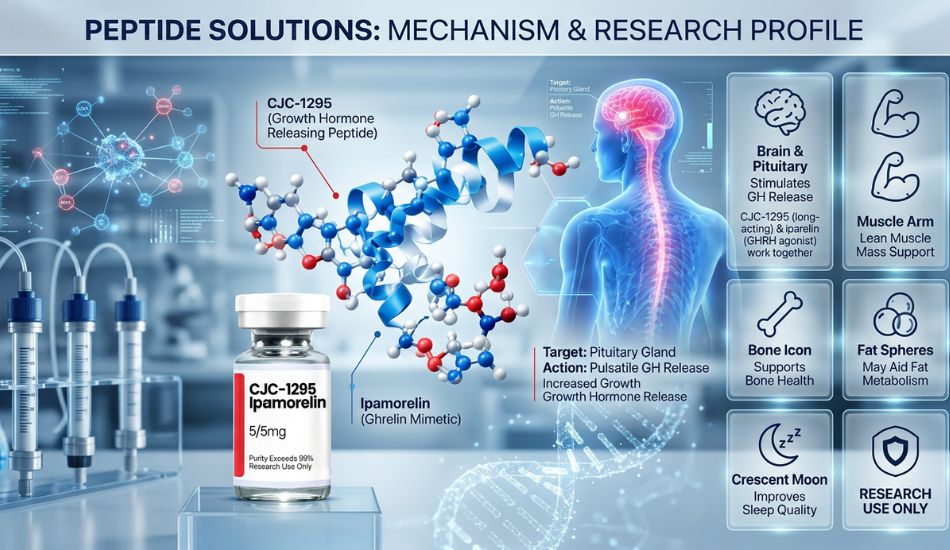
CJC-1295 and Ipamorelin are often discussed together because they influence GH secretion through different signaling systems.
From a research perspective, this creates an interesting pharmacological distinction:
CJC-1295 → GHRH-related signaling
Ipamorelin → GHS-R-related signaling
Studying the compounds together requires examining whether their effects are additive, overlapping, or otherwise dependent on experimental conditions.
However, the existence of different receptor pathways does not by itself prove that combining the compounds produces a particular biological or clinical advantage.
This is an important distinction for research content. Mechanistic plausibility and demonstrated outcomes are not the same thing.
Molecular Properties of CJC-1295 and Ipamorelin
Molecular structure provides another way to distinguish these compounds.
CJC-1295 is a synthetic peptide analogue derived from the GHRH framework. The DAC version contains an additional modification associated with albumin binding and prolonged exposure.
Ipamorelin is a much smaller pentapeptide with the sequence:
Aib-His-D-2-Nal-D-Phe-Lys-NH₂
This sequence was reported in the original pharmacological characterization of Ipamorelin.
The structural differences between the compounds correspond to their different pharmacological profiles and receptor interactions.
For detailed chemical information, see our dedicated CJC-1295 molecular structure research and Ipamorelin molecular structure research pages.
What Do CJC-1295 Studies Show?
Human research on CJC-1295 has demonstrated measurable pharmacodynamic effects on GH and IGF-1.
In a controlled study involving healthy adults, CJC-1295 produced prolonged increases in GH and IGF-1 concentrations. The study was designed to examine pharmacokinetic and pharmacodynamic characteristics rather than establish broad therapeutic effectiveness.
This distinction is important when interpreting online claims about CJC-1295. A demonstrated change in GH or IGF-1 is a pharmacological finding; it is not automatically evidence for a particular clinical outcome.
The available evidence also varies according to the specific form of CJC-1295 studied. FDA’s review notes that available literature does not consistently distinguish between different forms, while clinical data remain limited.
What Do Ipamorelin Studies Show?
Research on Ipamorelin has demonstrated GH-secretagogue activity in experimental models.
The original pharmacological study found that Ipamorelin stimulated GH release in rat pituitary cells and produced GH responses in animal models. The study also investigated several other hormones and reported a comparatively selective GH-releasing profile.
However, preclinical findings should not be presented as equivalent to established human clinical evidence.
The broader GHS-R literature also shows that this receptor participates in multiple biological processes beyond GH release. Therefore, research involving Ipamorelin needs to be interpreted within the specific experimental context rather than reduced to a single expected outcome.
CJC-1295 vs Ipamorelin
CJC-1295 and Ipamorelin have overlapping research interests but different primary mechanisms.
| Research characteristic | CJC-1295 | Ipamorelin |
|---|---|---|
| Compound type | GHRH analogue | GH secretagogue |
| Primary pathway | GHRH receptor | GHS-R1a |
| Main research focus | GH secretion and prolonged exposure | GH-secretagogue activity |
| GH/IGF-1 research | Yes | Yes |
| Molecular framework | GHRH-related peptide analogue | Pentapeptide |
| DAC form | CJC-1295 DAC is studied | Not applicable |
| Key research distinction | Long-acting GHRH-related signaling | GHS-R-mediated signaling |
The comparison is useful because it shows why the two compounds should not be treated as interchangeable simply because both appear in GH-related research.
For a dedicated comparison, see CJC-1295 vs Ipamorelin: Mechanism, Structure & Research.
Analytical Characterization and Research Quality
Research involving synthetic peptides also depends on accurate compound identification and characterization.
For a research-grade peptide, analytical evaluation can involve techniques such as high-performance liquid chromatography (HPLC) and mass spectrometry. These methods can provide information about chromatographic purity and molecular identity, respectively.
A certificate of analysis (COA) can therefore be useful when evaluating a specific research material, but a COA should be interpreted carefully. The analytical method, reported result, batch identification, testing laboratory, and scope of the analysis all matter.
Analytical purity also does not establish biological activity or clinical safety.
For this reason, research documentation should distinguish between identity, purity, stability, and biological activity rather than treating them as interchangeable measurements.
Research Limitations
The current evidence surrounding CJC-1295 and Ipamorelin has important limitations.
First, the amount and type of evidence differ between the two compounds. CJC-1295 has controlled human pharmacokinetic and pharmacodynamic research, particularly involving CJC-1295 DAC, while much of the foundational Ipamorelin literature comes from preclinical pharmacology.
Second, different formulations or structural variants should not automatically be treated as equivalent.
Third, changes in GH or IGF-1 biomarkers do not establish a specific clinical benefit.
Finally, regulatory and safety considerations must be separated from basic pharmacological research. FDA currently notes limited clinical data for CJC-1295 and identifies potential safety concerns associated with compounded CJC-1295 products, including immunogenicity concerns and reported serious adverse events.
This page therefore focuses on the scientific research surrounding these compounds rather than providing instructions for human use.
Frequently Asked Questions
What is CJC-1295?
CJC-1295 is a synthetic peptide analogue related to growth hormone-releasing hormone (GHRH). Research has examined its ability to influence GH secretion and downstream IGF-1 levels.
What is Ipamorelin?
Ipamorelin is a synthetic pentapeptide and growth hormone secretagogue. Research indicates that it stimulates GH release through a GHS-R-related pathway.
Do CJC-1295 and Ipamorelin work through the same receptor?
No. CJC-1295 is associated with the GHRH receptor pathway, whereas Ipamorelin acts through the growth hormone secretagogue receptor pathway.
Why are CJC-1295 and Ipamorelin studied together?
They are often studied together because they influence GH secretion through different signaling pathways. However, mechanistic differences alone do not establish a specific benefit from combining them.
Is CJC-1295 the same as CJC-1295 DAC?
The terms should not automatically be treated as identical. CJC-1295 DAC contains a modification associated with albumin binding and prolonged systemic exposure. Much of the human pharmacokinetic research concerns the DAC form.
Is there human research on CJC-1295?
Yes. Controlled human studies have examined the pharmacokinetics and pharmacodynamic effects of CJC-1295, including GH and IGF-1 responses.
Is Ipamorelin supported by human clinical evidence?
Ipamorelin has substantial preclinical pharmacological literature, but its evidence base should not be presented as equivalent to an established body of human clinical evidence.
What is the main difference between CJC-1295 and Ipamorelin?
The primary difference is their signaling pathway. CJC-1295 is a GHRH analogue, while Ipamorelin is a growth hormone secretagogue associated with GHS-R signaling.
Conclusion
CJC-1295 and Ipamorelin are distinct synthetic peptides that have been investigated in the context of growth hormone regulation.
CJC-1295 research centers on GHRH-related signaling, GH secretion, IGF-1 responses, and the extended pharmacokinetic characteristics associated with the DAC form. Ipamorelin research focuses on growth hormone secretagogue activity and GHS-R-mediated signaling.
Although both compounds are connected to the GH axis, their different molecular structures, receptors, and pharmacological properties make them separate research subjects.
A proper evaluation therefore requires looking beyond the shared association with GH. Mechanism, molecular structure, pharmacokinetics, study design, analytical characterization, and evidence limitations all need to be considered.
The supporting research pages below examine each area in greater depth:
- CJC-1295 Mechanism of Action
- Ipamorelin Mechanism of Action
- CJC-1295 Studies
- Ipamorelin Studies
- CJC-1295 Molecular Structure
- Ipamorelin Molecular Structure
- CJC-1295 vs Ipamorelin