
Regulatory status for peptides changes often, so we review this page regularly. Always confirm the current rules with the FDA and WADA links below.
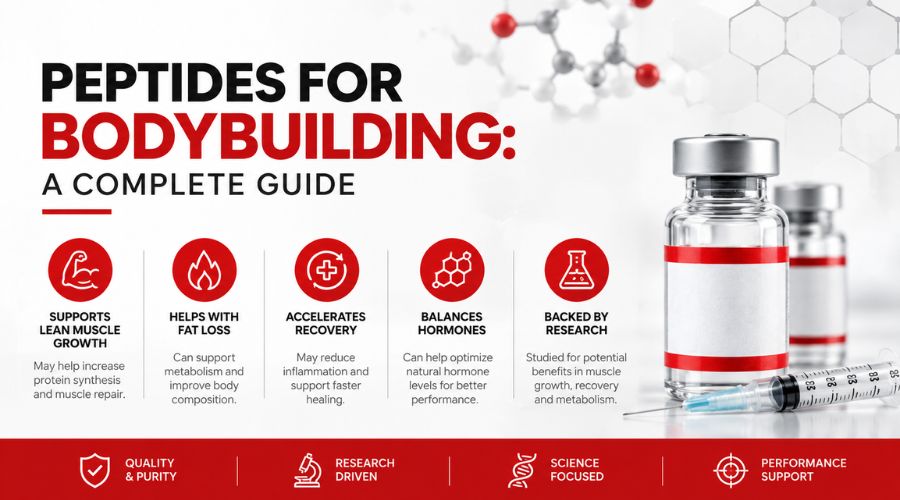
Peptides have become one of the most talked-about topics in bodybuilding. Lifters hear about ipamorelin, CJC-1295, sermorelin and BPC-157 on forums and social media, often with big promises attached.
This guide gives you the full picture. It covers what peptides are, which ones bodybuilders discuss, how they work in research models, what the evidence really says, and where the legal and anti-doping lines sit.
Research Use Only. Hotspan products are sold strictly for in vitro research and laboratory experimentation. They are not for human consumption, therapeutic use, or clinical application. This article is educational and is not medical advice.
What Are Peptides?
Peptides are short chains of amino acids, usually 2 to 50, joined by peptide bonds. Proteins are the same idea, only much longer.
Your body makes many peptides naturally. Some act as hormones or signaling molecules, such as insulin and growth hormone-releasing hormone (GHRH). Scientists can also synthesize peptides in the lab, which is where most of the compounds discussed in bodybuilding come from.
How Growth Hormone and IGF-1 Work
Most bodybuilding peptides are discussed because of their link to the growth hormone (GH) axis. Understanding that axis makes every claim easier to judge.
Step 1: The brain sets the signal. The hypothalamus releases GHRH, which tells the pituitary gland to secrete GH. A second hypothalamic hormone, somatostatin, does the opposite and suppresses GH release.
Step 2: Ghrelin adds a boost. Ghrelin, the so-called hunger hormone, also stimulates GH release. It does this partly by increasing GHRH and by acting alongside GHRH at the pituitary.
Step 3: GH is released in pulses. The body secretes GH in bursts, with the largest pulses occurring during deep sleep. GH levels decline with age.
Step 4: The liver makes IGF-1. GH signals the liver to produce insulin-like growth factor 1 (IGF-1). IGF-1 supports protein synthesis and tissue growth, and it feeds back to the brain and pituitary to limit further GH release.
Why this matters: GH on its own is not the main driver of muscle protein synthesis. Much of its anabolic effect works through IGF-1. It also has fat-mobilizing effects. This is why researchers study compounds that influence GH release. It is also why a short-term rise in GH does not guarantee a change in muscle size.
For a detailed physiology review, see Normal Physiology of Growth Hormone in Normal Adults (Endotext).
Why Bodybuilders Are Interested in Peptides
Bodybuilders want to change body composition: more lean mass, less fat, and faster recovery between sessions. GH and IGF-1 sit at the center of that conversation, so compounds that affect GH release attract attention.
Peptides in this space are often grouped by what they are thought to do:
- Growth hormone secretagogues (GHSs): compounds that prompt the pituitary to release GH.
- Tissue repair peptides: such as BPC-157 and TB-500, studied in injury and healing models.
- Metabolic peptides: studied for fat metabolism and energy balance.
Growth Hormone Secretagogues: The Main Group
GHSs are the class most linked to bodybuilding. They fall into two families.
GHRH analogs
These mimic the body’s own growth hormone-releasing hormone. Examples include sermorelin, tesamorelin and CJC-1295. Sermorelin and CJC-1295 are different compounds, even though some sources blur them together. In a 2006 study in healthy adults, CJC-1295 produced prolonged increases in GH and IGF-1 levels.
Ghrelin receptor agonists and GHRPs
These act on the GHS-R1a receptor. Examples include ipamorelin, GHRP-2, GHRP-6 and hexarelin. Ipamorelin is often highlighted in research because it releases GH with little effect on cortisol or prolactin in animal studies.
Why are they discussed together?
The two families act through different receptors. Researchers study them side by side because the combined signals may produce a stronger GH pulse than either alone. This is one reason stacks such as CJC-1295 with ipamorelin are widely discussed.
Peptide Comparison Table
| Compound | Type | Evidence level | WADA status | FDA status |
| Ipamorelin | Ghrelin receptor agonist (GHRP) | Strong animal data on GH selectivity. Limited human data. Its main completed human efficacy trial (post-operative ileus) did not meet its endpoints. | Prohibited (S2) | Not approved. Not part of any approved medicine. |
| CJC-1295 | GHRH analog | Short-term human studies in healthy adults showing GH and IGF-1 rise. No outcome trials in athletes. | Prohibited (S2) | Not approved. |
| Sermorelin | GHRH analog | Older clinical use as a diagnostic and in GH deficiency. Little data in athletes. | Prohibited (S2) | Original brand discontinued in the US. Not a general-use approved product today. |
| Tesamorelin | GHRH analog | Randomized trials in HIV patients with abdominal fat accumulation. No bodybuilding trials. | Prohibited (S2) | Approved for a narrow indication (HIV-related abdominal fat). |
| GHRP-6 / Hexarelin | GHRP | Limited human data. Hexarelin may raise cortisol and prolactin. | Prohibited (S2) | Not approved. |
| MK-677 (ibutamoren) | Oral ghrelin mimetic (small molecule, not a peptide) | A randomized trial in older adults reported increased fat-free mass, along with side effects such as raised blood sugar. | Prohibited (S2) | Not approved. |
| BPC-157 | Tissue repair peptide (not a GH peptide) | A 2025 systematic review found 35 of 36 studies were preclinical. Human safety is unknown. | Check the current list. Often treated as prohibited under S0 (non-approved substances). | Not approved. Regulatory path under active FDA review. |
| TB-500 | Thymosin beta-4 fragment | Mostly preclinical | Prohibited (thymosin beta-4 and fragments) | Not approved. Regulatory path under active FDA review. |
Table is for educational comparison only. Status can change. Verify against the WADA Prohibited List and the FDA compounding page.
What Does the Research Actually Show?
This is the most important section, because online claims run well ahead of the evidence.
A review in PubMed Central found that few long-term, rigorously controlled studies have tested GHSs. Reported effects in certain populations include improved growth in children, increased appetite, higher lean mass in wasting states, and better sleep, but long-term safety, including cancer incidence, still needs study.
Key points:
- Almost no data in trained athletes. Published studies rarely involve well-trained bodybuilders.
- GH is not a proven performance enhancer. A systematic review in the Annals of Internal Medicine found that GH increased lean body mass in young, healthy people but did not clearly improve strength or exercise capacity, and reported more side effects such as swelling and fatigue.
- GH release is not the same as muscle growth. A measured rise in GH is a short-term effect. It does not prove better body composition or performance.
- Animal data leads the way. Many claims come from rodent and cell studies.
- Training and nutrition still drive results. No peptide replaces progressive overload, enough protein, calories and sleep.
Known and Possible Side Effects
Because most compounds in this space have limited long-term human data, the safety picture is incomplete. Effects reported for GH-axis compounds include:
- Increased appetite
- Water retention
- Raised blood sugar or reduced insulin sensitivity
- Headaches and joint discomfort
Contamination and mislabeling are also real concerns with products from unverified sources. This is a major reason batch-level testing matters.
Are Peptides Legal? FDA Status
For general use, most of the peptides above are not FDA-approved drugs. Tesamorelin is approved for a narrow clinical use, but most others are not approved.
Compounding rules have also changed several times. The FDA places nominated substances into categories and has reviewed several peptides through its Pharmacy Compounding Advisory Committee. Law-firm and industry analysis in 2026 notes that these category moves do not make a peptide an approved drug. Because the rules move, check the source directly: FDA: Safety Risks Associated with Certain Bulk Drug Substances Nominated for Use in Compounding.
An FDA briefing on ipamorelin-related substances raised safety concerns based on the available clinical data, as summarized here: Ipamorelin overview, Dopinglinkki.
Are Peptides Allowed in Competition? WADA Rules
No. The World Anti-Doping Agency prohibits growth hormone, its fragments and its releasing factors, including GHRH analogs and secretagogues, under section S2 of the Prohibited List. This applies at all times for athletes under anti-doping rules. Check the current list: WADA Prohibited List.
Most natural bodybuilding federations also ban these compounds. Anyone who competes should confirm their federation’s rules first.
Peptides vs. Steroids
Peptides are not steroids. Steroids are synthetic hormones related to testosterone. Peptides are short amino acid chains that often act as signaling molecules. They work through different mechanisms, and their risk profiles are not the same. But “different from steroids” does not mean “proven safe” or “legal everywhere.”
What Matters in Peptide Research Quality
For researchers, material quality decides whether results can be trusted. Look for:
- Third-party testing from an independent, accredited lab.
- Batch-specific Certificates of Analysis that match the lot number.
- Identity and purity data, ideally HPLC-based.
- Endotoxin reporting.
- Clear labeling, including research-use status.
Hotspan publishes batch COAs with QR verification. Review them on our COA and testing page.
Explore Research Peptides at Hotspan
Qualified researchers can browse our research peptide catalog, including growth hormone peptides and tissue repair compounds, each with documented batch testing. All products are intended for laboratory research only.
Frequently Asked Questions
What are the best peptides for bodybuilding?
There is no proven “best.” The compounds most discussed are growth hormone secretagogues such as ipamorelin, CJC-1295, sermorelin and tesamorelin, plus tissue repair peptides such as BPC-157. Evidence in trained athletes is limited for all of them.
Do peptides build muscle?
Published evidence does not clearly show muscle gain in trained people. GH-axis effects are real in research, but links to body composition outcomes are not well established.
Are peptides safe?
Long-term human safety data is limited. Quality and contamination risks add to the uncertainty.
Are peptides banned in bodybuilding?
Yes in tested competition. WADA prohibits growth hormone secretagogues and releasing factors, and many federations follow it.
Are peptides steroids?
No. They are a different class of compound with different mechanisms.
Are Hotspan peptides for human use?
No. They are sold for in vitro research and laboratory experimentation only.
The Bottom Line
Peptides, especially growth hormone secretagogues, are an active area of research. But the gap between marketing claims and published evidence is large, long-term safety is unproven, and most are unapproved and banned in sport. Solid training, nutrition and recovery remain the foundation of any physique goal.
This article is for educational purposes only. It is not medical advice and does not claim that any product treats, cures or prevents any condition. Hotspan products are for laboratory research use only. Last updated October 9, 2026.