
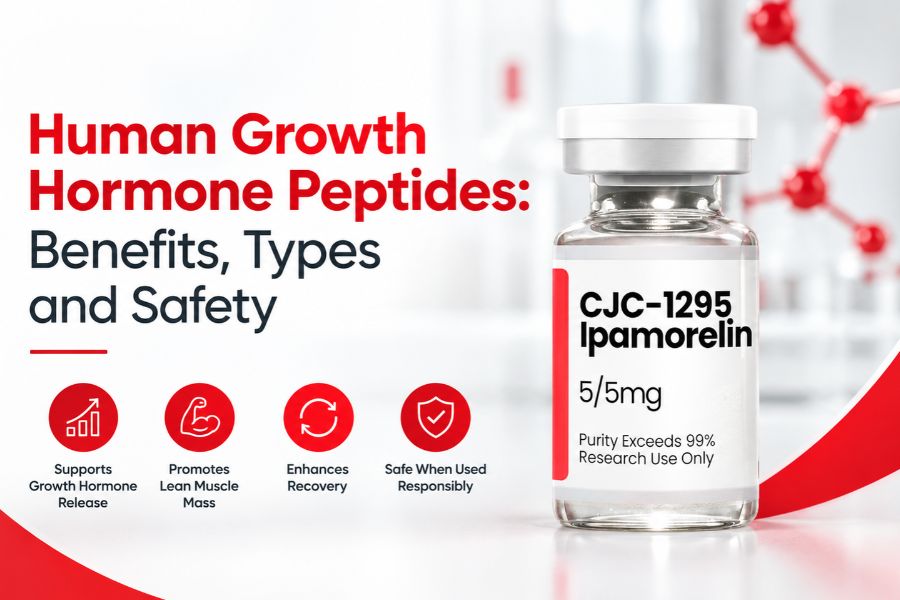
Human growth hormone peptides are among the most discussed compounds in modern peptide research. They are short chains of amino acids designed to prompt the pituitary gland to release more of the body’s own growth hormone (GH). Online, they are often described as anti-aging shortcuts. The research picture is more careful than that. This guide explains what these peptides are, the main types, what studies actually show about their potential benefits, and the safety and quality points every researcher should understand.
Research use notice: The compounds discussed here are supplied for laboratory research only. They are not intended for human or veterinary use, and nothing in this article is medical advice.
What Are Human Growth Hormone Peptides?
Growth hormone is a small protein made by the pituitary gland and released in pulses throughout the day and night. It drives growth in children and young adults, and in adults it contributes to blood sugar control, bone density and muscle growth. Levels peak around puberty and then decline with age, which is the main reason this area attracts so much interest.
Growth hormone peptides, also called growth hormone secretagogues, do not replace GH. They signal the body to produce and release its own. That is the key difference from synthetic human growth hormone (somatropin), which is a prescription injection approved only for specific medical conditions.
How Do Growth Hormone Peptides Work?
Most compounds in this category act through one of two pathways:
- GHRH analogues mimic growth hormone-releasing hormone and stimulate the pituitary to release GH in a pulsatile pattern. Sermorelin, tesamorelin and CJC-1295 belong here.
- Growth hormone-releasing peptides (GHRPs) act on the growth hormone secretagogue receptor, the same receptor targeted by ghrelin, the natural 28-amino-acid peptide first isolated in 1999. Ipamorelin, GHRP-2, GHRP-6 and hexarelin belong here.
Interestingly, synthetic GHRPs were discovered before ghrelin. Researchers used them to find the receptor first, and the natural hormone was identified afterwards.
Types of Human Growth Hormone Peptides
| Compound | Class | Research / regulatory status |
| Sermorelin | GHRH analogue | FDA-approved in 1997 for pediatric GH deficiency; discontinued in 2008 |
| Tesamorelin | GHRH analogue | FDA-approved in 2010 for HIV-associated lipodystrophy |
| CJC-1295 | GHRH analogue | Never FDA-approved; studied for GH-raising activity |
| Ipamorelin | GHRP (ghrelin mimetic) | Never FDA-approved; studied for GH-raising activity |
| GHRP-2 / GHRP-6 | GHRP (ghrelin mimetic) | Never FDA-approved; GHRP-6 was the first synthetic GHRP confirmed active (1984) |
| Hexarelin | GHRP (ghrelin mimetic) | Investigated mainly in cardiac research; data largely preclinical |
Sermorelin
Sermorelin was approved by the FDA in 1997 to treat growth hormone deficiency in children, then discontinued in 2008 and withdrawn for commercial reasons. It is known to raise GH levels, but there are no large randomized controlled trials in healthy adults testing performance, body composition or longevity.
Researchers can review the Sermorelin research peptide listing and its batch-specific COA at Hotspan.
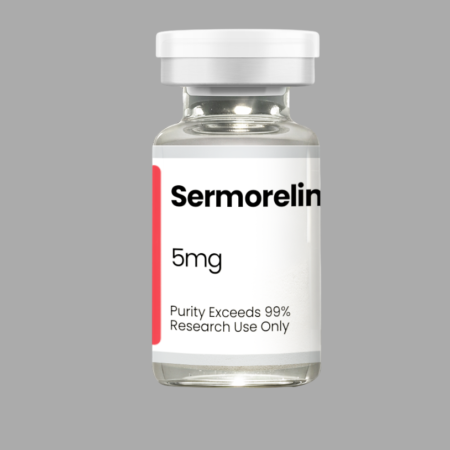
Sermorelin
Tesamorelin
Tesamorelin was approved in 2010 for HIV-associated lipodystrophy. The FDA prescribing information describes it as a prescription subcutaneous injection. In a trial of more than 400 people, visceral fat fell by about 15 percent. The drug’s goal was to reduce fat tissue rather than build muscle, and the evidence comes from a very specific patient population. See the Tesamorelin research peptide page for batch testing details.

Tesamorelin
CJC-1295 and Ipamorelin
These compounds have never been approved by the FDA. Evidence shows they raise GH levels, but there is no solid proof yet that they change muscle or fat. They are often studied together, which makes it harder to isolate what each one does.

CJC-1295 Ipamorelin
Hotspan lists Ipamorelin on its own and as the CJC-1295 Ipamorelin blend, each with a published COA.
GHRP-2, GHRP-6 and Hexarelin
These earlier-generation GHRPs remain active research tools. Hexarelin, for example, has been explored in cardiac studies, though most data come from animal and observational work rather than randomized controlled trials.
What Laboratory Research Shows
Much of the hard data on this class is physicochemical rather than clinical. A 2026 study in Chirality (Králík et al., NIH PubMed Central) analysed eight growth hormone-releasing compounds using electronic circular dichroism (ECD) spectroscopy to see how their structures behave in water, at different temperatures and next to a simple model membrane (SDS micelles).
| Compound | Molar mass (g/mol) | Key finding in the study |
| GHRP-1 | 955.1 | Partial aggregation with SDS micelles; spectrum changed, indicating interaction |
| GHRP-2 | 818.0 | Aggregated immediately with SDS micelles |
| GHRP-4 | 607.7 | Spectrum changed noticeably as temperature rose |
| GHRP-5 | 770.9 | Formed a helix-like structure with SDS micelles |
| GHRP-6 | 873.0 | First synthetic GHRP confirmed active in 1984; aggregated with SDS micelles |
| Ipamorelin | 711.9 | No significant structural change and no aggregation with SDS micelles |
| Anamorelin | 546.7 | Lacks a common peptide sequence; band intensity rose with SDS micelles |
Two takeaways matter for researchers. First, structurally similar compounds can behave very differently: GHRP-5 stayed soluble and adopted a helix-like shape in the presence of micelles, while the closely related GHRP-6 precipitated immediately. Second, this is laboratory data on structure and stability. It says nothing about effectiveness or safety in people, which is why the human evidence discussed below is a separate question.
Potential Benefits Under Investigation
Research interest in growth hormone peptides centres on a few areas. Read each one alongside the strength of the evidence behind it.
- Visceral fat: the clearest human data is for tesamorelin in HIV-associated lipodystrophy.
- Lean body mass: a review of more than 200 older adults found about a 4.6-pound increase in lean mass with growth hormone itself. Lean mass includes water, organs, and muscle, and participants did not show improved mobility.
- Athletic performance: one study in athletes found sprint capacity rose by about 4 percent, and the effect disappeared after treatment stopped.
- Sleep and recovery: often discussed, but supported mainly by early-stage and observational data.
In short, many claims about benefits are ahead of the science. Most peptides in this class lack large human trials, and the results seen with growth hormone itself do not automatically transfer to peptides that stimulate its release.
What Experts Say About the Evidence
Endocrinologists interviewed by Scientific American are cautious about the anti-aging claims around these compounds.
- Brad Anawalt (endocrinologist, University of Washington School of Medicine) explains that GH is released in pulses and that levels can fall by as much as half every seven to 10 years after puberty, which is the premise behind this whole category.
- Alexander Pastuszak (urologist and men’s health researcher, University of Utah School of Medicine) notes that sermorelin is known to raise GH, but there are no large randomized trials in healthy adults. He adds that tesamorelin’s trial goal was reducing fat, not growing muscle.
- Anne Cappola (endocrinologist, University of Pennsylvania) points out that lean body mass includes water and organs as well as muscle, and says “What you really want is function.”
The shared message is that raising GH levels and improving real-world outcomes are two different things, and only the first has been demonstrated for most of these peptides.
Safety Considerations
Excess growth hormone carries real risks
Raising GH is not risk-free just because the signal is “natural.” Too much growth hormone in adults can lead to acromegaly, where hands and feet enlarge and joints ache. It has also been linked to heart disease, stroke risk and colon cancer risk. Reported side effects of growth hormone use include swelling, joint pain, carpal tunnel syndrome and, in some cases, diabetes.
Product quality is a major concern
A recent analysis, not yet peer-reviewed, found that roughly 40 to 70 percent of thousands of gray-market peptide samples failed basic quality criteria. About 15 percent of a tested subset showed measurable endotoxin, a sign of bacterial contamination. For researchers, this is why batch-level testing and a verified supply chain matter.
Regulatory and sporting status
Growth hormone-releasing peptides are also associated with doping in professional sports. As noted in a 2026 study of growth hormone-releasing peptides published in Chirality (NIH PubMed Central), these compounds appear on the World Anti-Doping Agency’s 2025 Prohibited List under growth hormone-releasing factors.
What to Look For When Sourcing Peptides for Research
- A batch-specific certificate of analysis (COA) from an independent laboratory, such as the reports you can check through Hotspan’s batch verification page
- Clear purity data, endotoxin reports and identity confirmation for each lot, as outlined on the Quality & Testing page
- Transparent labeling that states research-use-only status
- Proper storage and handling guidance from the supplier
- Honest, evidence-based product information with no human-use claims
Frequently Asked Questions
What are human growth hormone peptides?
They are short amino acid chains that stimulate the pituitary gland to release growth hormone. They differ from synthetic HGH, which is the hormone itself.
Are growth hormone peptides FDA-approved?
Only some are, and only for specific uses. Sermorelin was approved in 1997 for pediatric GH deficiency and later discontinued. Tesamorelin was approved in 2010 for HIV-associated lipodystrophy. Others, including CJC-1295 and ipamorelin, have never been approved.
Are growth hormone peptides legal?
It depends on the compound, how it is sold and where you are. Tesamorelin is an FDA-approved prescription medicine for a specific condition. Compounds such as CJC-1295 and ipamorelin have never been FDA-approved, so reputable suppliers sell them strictly for laboratory research, not for human use. Growth hormone-releasing peptides are also on the World Anti-Doping Agency’s Prohibited List for athletes. Always check the rules that apply to you. This is general information, not legal advice.
What is the difference between peptides and HGH?
HGH (somatropin) is growth hormone itself. It is an FDA-approved prescription injection for specific conditions and is not approved for anti-aging or athletic performance. Growth hormone peptides instead prompt the pituitary to release the body’s own GH. Neither is risk-free. HGH is linked to joint pain, swelling, carpal tunnel syndrome and a higher chance of diabetes, while most peptides have limited human data and face quality concerns. Claims that peptides deliver all the benefits of HGH with none of the risks are not backed by evidence.
Do growth hormone peptides build muscle?
The evidence is limited. Growth hormone can increase lean body mass, but studies have not shown matching gains in strength or function, and peptide-specific human data is thin.
What are the main risks?
Risks include side effects linked to excess growth hormone, along with contamination and mislabeling in poorly sourced products.
Final Thoughts
Human growth hormone peptides are an active and fascinating area of research, but they are not shortcuts, and the evidence for many popular claims is still thin. Understanding the types, the real state of the science and the safety and quality issues helps researchers make better-informed decisions. If you are exploring this category for laboratory work, browse the research peptide range at Hotspan and review each product’s testing documentation.
Disclaimer: All products referenced are for in vitro laboratory research only and are not drugs, supplements or medical treatments. This content is for educational purposes and does not constitute medical advice.