
The skin aging conversation used to revolve around creams and retinols. Today, researchers are focused on something far more fundamental peptides for anti-aging skin. These short chains of amino acids communicate directly with skin biology at the cellular level, influencing pathways that conventional topicals cannot reach.
This guide breaks down the science behind skin-targeting peptides, the key compounds studied in anti-aging research, and how Hotspan’s ultra-pure, lab-grade peptides fit into that landscape.
What Are Peptides and Why Do They Matter for Skin Aging?
Peptides are short chains of amino acids, the building blocks of proteins. When arranged in specific sequences, they act as biological signals, triggering processes like collagen synthesis, cellular repair, and oxidative stress regulation.
As skin ages, several things happen at the molecular level:
- Collagen production declines — skin loses its structural scaffolding
- Fibroblast activity slows — cells that build the extracellular matrix become less responsive
- Oxidative damage accumulates — free radicals degrade skin integrity over time
- Glycosaminoglycan levels drop — the compounds that keep skin hydrated and plump diminish
This is precisely where anti-aging skin peptides become scientifically interesting. Rather than masking symptoms, peptides under laboratory investigation target the upstream biology that drives these changes.
The Key Peptides For Anti-Aging Skin — What Research Explores
1. GHK-Cu (Copper Tripeptide) — The Flagship Skin Peptide
Of all the peptides studied in the context of skin aging, GHK-Cu stands out as the most extensively researched.
GHK-Cu is a naturally occurring copper-binding tripeptide composed of glycine, histidine, and lysine complexed with copper ions (Cu²⁺). It is naturally present in human plasma and decreases measurably with age. Research literature has examined its role across multiple skin-relevant biological pathways.
What laboratory research investigates with GHK-Cu:
- Collagen and glycosaminoglycan synthesis pathways
- Fibroblast signaling and extracellular matrix regulation
- Oxidative stress marker modulation
- Angiogenesis-related mechanisms
- Immune-cell recruitment signaling
- Gene expression patterns under controlled conditions
In preclinical and in vitro models, GHK-Cu has been studied more than virtually any other peptide in dermatological research, making it a cornerstone compound for researchers investigating peptides for anti-aging skin applications.
Available at Hotspan:
| Product | Dosage Options | Purity |
|---|---|---|
| GHK-Cu | 50mg / 100mg | ≥99% Lyophilized |
Hotspan carries GHK-Cu in two research dosages 50mg for introductory research protocols and 100mg for extended study periods, both at ≥99% purity with third-party COA verification.
2. Epithalon Telomere Biology and Cellular Longevity
Epithalon (also known as Epitalon) is a synthetic tetrapeptide derived from the natural polypeptide Epithalamin. It has been studied in the context of telomere biology, specifically its interaction with telomerase, the enzyme involved in maintaining chromosomal integrity.
From an anti-aging skin research standpoint, telomere shortening is considered one of the primary drivers of cellular senescence — the process by which skin cells “age out” and lose function. Research models exploring Epithalon examine its potential interaction with these pathways.
Research areas:
- Telomere length and telomerase activity
- Cellular senescence markers
- Longevity-related gene expression
- Circadian rhythm regulation in aging models
Available at Hotspan:
| Product | Dosage | Purity |
|---|---|---|
| Epithalon | 10mg | ≥99% Lyophilized |
3. The GLOW Stack — BPC-157 + GHK-Cu + TB-500
For researchers interested in multi-peptide protocols, Hotspan’s GLOW stack combines three peptides studied across overlapping skin and tissue repair pathways:
- BPC-157 — studied for growth factor signaling and angiogenesis
- GHK-Cu — the copper tripeptide central to skin aging research
- TB-500 (Thymosin Beta-4) — investigated for actin regulation and tissue repair signaling
In the peptide research community, combining compounds that target different but complementary pathways is a growing area of interest. GLOW represents a pre-combined, precision-dosed option for researchers studying this intersection.
Available at Hotspan:
| Product | Total Dosage | Purity |
|---|---|---|
| GLOW (BPC-157 + GHK-Cu + TB-500) | 70mg | ≥99% Lyophilized |
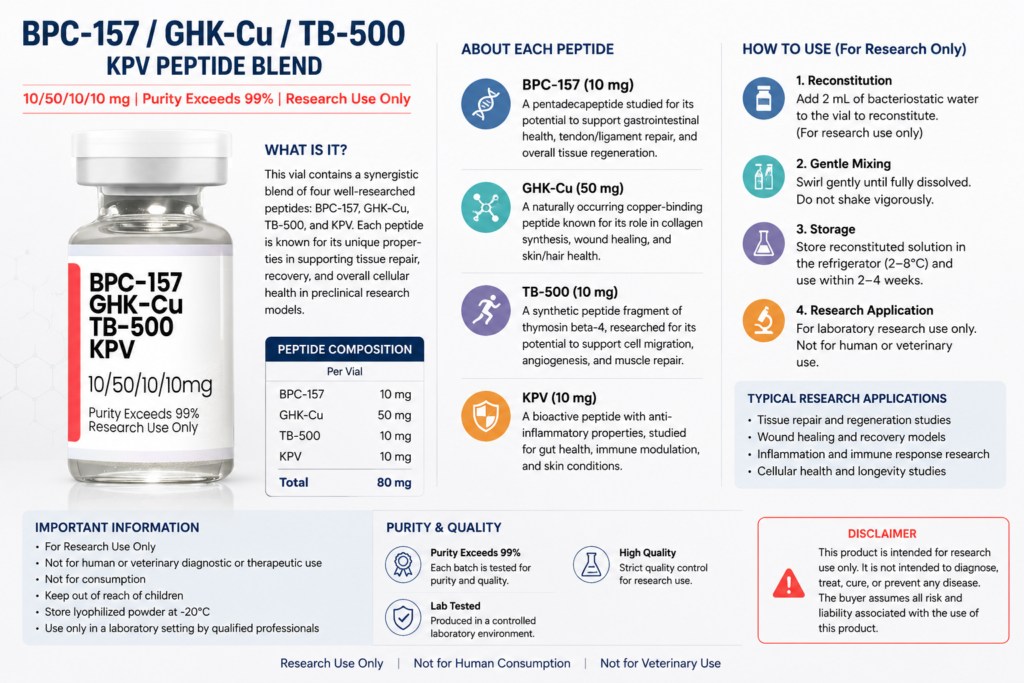
4. The KLOW Stack — BPC-157 + GHK-Cu + TB-500 + KPV
KLOW builds on the GLOW formula by adding KPV, a tripeptide derived from alpha-melanocyte-stimulating hormone (α-MSH). KPV has been studied for its anti-inflammatory signaling properties, particularly in skin-relevant models.
The addition of KPV makes KLOW of interest to researchers examining inflammatory pathways that intersect with skin aging since chronic low-grade inflammation is increasingly recognized as a driver of dermal aging (sometimes called “inflammaging”).
Available at Hotspan:
| Product | Total Dosage | Purity |
|---|---|---|
| KLOW (BPC-157 + GHK-Cu + TB-500 + KPV) | 80mg | ≥99% Lyophilized |
5. Melanotan 2 — Skin Pigmentation Research
Melanotan 2 is a synthetic analog of alpha-melanocyte-stimulating hormone (α-MSH). Its primary area of research involves melanogenesis, the biological process of melanin production in skin cells.
While distinct from the collagen/repair pathway peptides above, Melanotan 2 is studied in models examining skin pigmentation response and UV-related pathways. Researchers interested in the full spectrum of skin biology often look at pigmentation as one component of the broader skin aging picture.
Available at Hotspan:
| Product | Dosage | Purity |
|---|---|---|
| Melanotan 2 | 10mg | ≥99% Lyophilized |
The Science of Skin Aging: What Peptide Research Targets
To understand why researchers are focused on skin anti-aging peptides, it helps to map the biology they’re working with.
Collagen Degradation and the Extracellular Matrix
Collagen makes up approximately 70-80% of skin’s dry weight. It’s produced by fibroblasts and organized into the extracellular matrix (ECM), the structural scaffold of skin. As aging progresses, collagen cross-linking increases, production decreases, and the ECM loses both structural integrity and elasticity.
Peptides like GHK-Cu are studied in research models because they interact with fibroblast signaling pathways that regulate ECM components including collagen and glycosaminoglycans like hyaluronic acid.
Oxidative Stress and Free Radical Damage
Reactive oxygen species (ROS) generated by UV exposure, pollution, and metabolic processes attack lipids, proteins, and DNA in skin cells. Accumulated oxidative damage is one of the primary molecular mechanisms driving visible skin aging.
Laboratory research on peptides like GHK-Cu includes examination of antioxidant signaling pathways and markers of oxidative stress areas directly relevant to anti-aging skin peptide research.
Inflammaging — Chronic Inflammation and Skin Aging
The concept of “inflammaging” chronic, low-grade inflammation as a driver of biological aging has gained significant traction in longevity research. In skin tissue, persistent inflammatory signaling degrades collagen, disrupts the skin barrier, and accelerates cellular senescence.
Peptides with anti-inflammatory signaling properties, such as KPV (found in the KLOW stack), are studied in this context.
Telomere Biology and Cellular Senescence
Telomeres, protective caps on chromosomes, shorten with each cell division. When critically short, cells enter senescence: they stop dividing but remain metabolically active, secreting inflammatory signals that degrade surrounding tissue. This is one mechanism by which skin cells lose function over time.
Epithalon’s research profile focuses specifically on this area, making it a unique entry point in peptide anti-aging research that operates upstream of visible skin changes.
Why Purity Matters in Skin Peptide Research
When evaluating peptides for anti-aging skin research, compound purity is a non-negotiable variable. Impurities including endotoxins, residual solvents, and off-target peptide sequences can confound experimental results and introduce variables that make data interpretation unreliable.
Hotspan’s manufacturing standard addresses this directly:
- ≥99% purity on all peptide compounds
- Third-party Certificate of Analysis (COA) available for every product
- Endotoxin testing conducted and documented
- US manufactured from globally sourced APIs
- Lyophilized format for maximum stability and shelf life
- Free BAC water included with every order for proper reconstitution
For researchers building rigorous protocols around anti-aging skin peptides, the reliability of source material is foundational to the validity of results.
Research Use Disclosure
All peptides available at Hotspan.com are intended strictly for in vitro research and laboratory experimentation only. These compounds are not approved for human consumption, therapeutic use, or clinical application. They should be handled exclusively by licensed, qualified research professionals under appropriate laboratory conditions.
Nothing in this article constitutes medical advice, clinical recommendation, or health claims. Research findings cited reflect in vitro and preclinical literature and do not imply human outcomes.
Explore Hotspan’s Skin Peptide Research Catalog
Hotspan offers a focused selection of the peptides most relevant to skin anti-aging research, each manufactured to ≥99% purity with full documentation:
| Peptide | Category | Dosage Options |
|---|---|---|
| GHK-Cu | Skin & Longevity | 50mg / 100mg |
| Epithalon | Longevity & Cellular | 10mg |
| GLOW Stack | Skin & Recovery Stack | 70mg |
| KLOW Stack | Skin & Inflammation Stack | 80mg |
| Melanotan 2 | Skin Pigmentation | 10mg |
For physician-supervised protocols, Hotspan also offers a prescription pathway with personalized peptide protocols delivered in all 50 states no insurance required.
→ Explore the full Hotspan peptide catalog → Get a physician-supervised prescription
All products are for research use only. Not for human consumption. For use by qualified researchers only.