
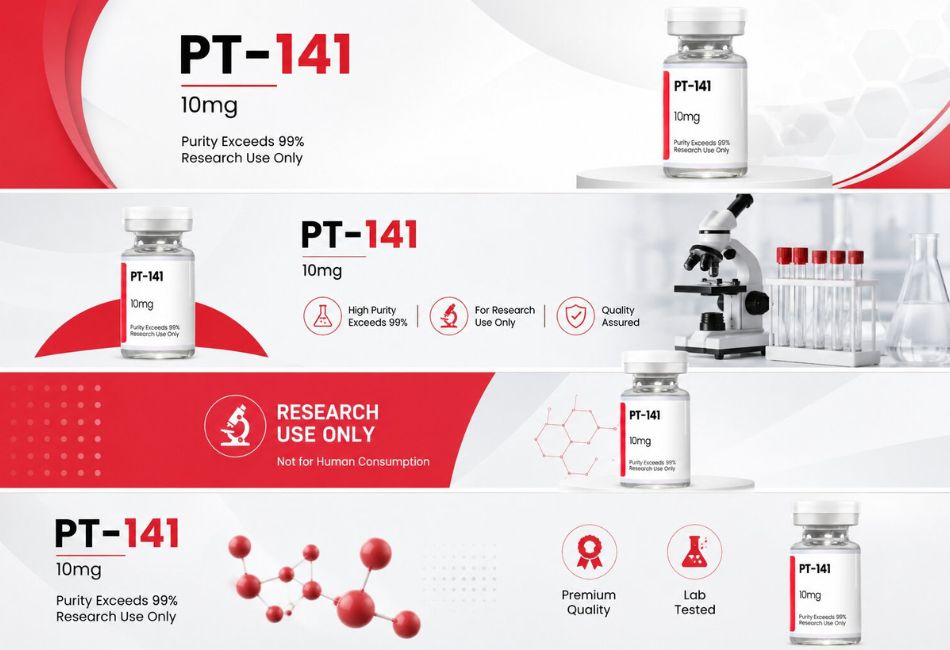
PT-141 Peptide For Wellness research centers on Bremelanotide, a synthetic melanocortin receptor agonist used in laboratory studies of MC3R and MC4R activation and its role in arousal-pathway signaling. Hotspan supplies a 99% pure, US-manufactured, COA-verified PT-141 for qualified researchers. Research Use Only, not for human or animal use outside licensed research settings.
What Is PT-141 Peptide For Wellness Research?
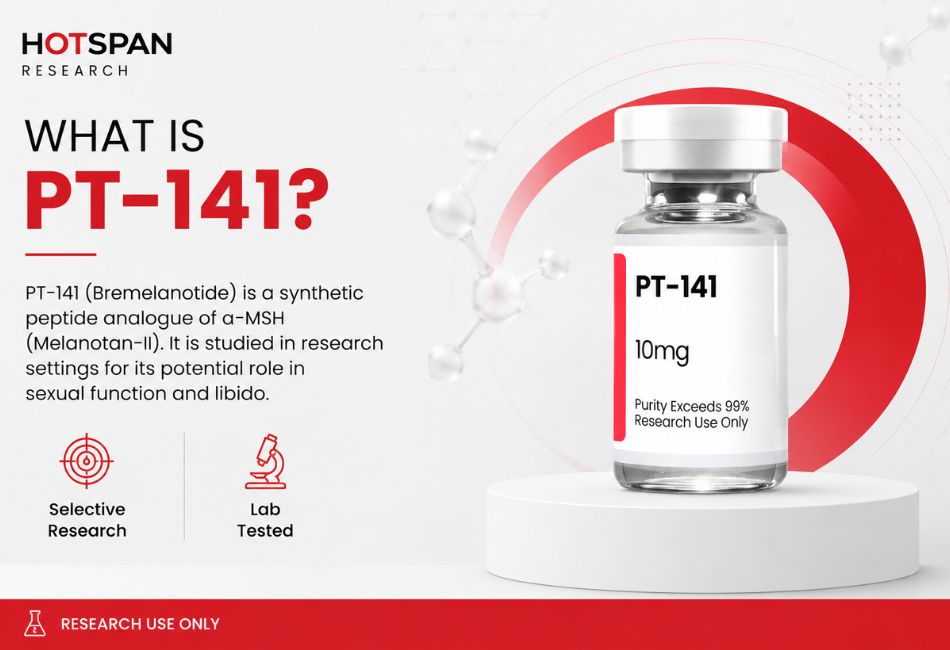
PT-141 is a synthetic peptide structurally derived from alpha-MSH and melanotan-class compounds. Unlike vasodilators that act directly on blood vessels, PT-141 works upstream on melanocortin receptors themselves, making it a distinct research tool for studying the neuroendocrine side of arousal, separate from the vascular side.
Hotspan’s PT-141 ships as a lyophilized powder, independently lab-tested, with a Certificate of Analysis on every batch.
How PT-141 Peptide For Wellness Works
Melanocortin Receptor Activation
PT-141 is studied primarily as an MC3R and MC4R agonist. In experimental models, receptor binding triggers downstream G-protein-coupled second-messenger signaling, which researchers link to arousal-related neural activity. This receptor-first mechanism separates PT-141 from PDE-5 inhibitors, which target blood flow rather than the signaling pathway believed to initiate the arousal response.
In cell-based assays, PT-141 binds MC4R with higher reported affinity than MC3R, though both subtypes appear in arousal-related models. MC4R is concentrated in hypothalamic regions tied to appetite and sexual-behavior circuits, while MC3R shows broader distribution across the central nervous system. Researchers use selective agonists and antagonists alongside PT-141 to isolate which receptor subtype drives a given downstream effect, a common approach in melanocortin pathway mapping.
Because PT-141 acts on a G-protein-coupled receptor, activation triggers a cascade: ligand binding, receptor conformational change, G-protein activation, and second-messenger release (commonly cAMP). Researchers track this cascade using radioligand binding assays, cAMP accumulation assays, and in vivo behavioral models to quantify receptor engagement and signaling strength distinct from vascular agents, where the measured endpoint is smooth-muscle relaxation rather than a neural signaling cascade.
PT-141 vs. Melanotan II
PT-141 shares a lineage with Melanotan II but has been engineered for different receptor selectivity. Comparative research focuses on how small sequence changes shift binding affinity across melanocortin receptor subtypes, data relevant to anyone mapping structure-activity relationships in this peptide family.
Hotspan PT-141 Peptide For Wellness: Product Overview
| Detail | Specification |
| Compound | PT-141 (Bremelanotide) |
| Format | Lyophilized powder |
| Dosage | 10mg per vial |
| Purity | ≥99%, independently verified |
| Price | $39 one-time, or $39/month subscription (10% savings) |
| Includes | Free BAC water or acetic acid water with every order |
| Documentation | COA and endotoxin report available per batch |
| Manufacturing | US-based, quality-controlled |
PT-141 Research Applications
- Receptor pharmacology mapping MC3R/MC4R binding and selectivity
- Neuroendocrine signaling, studying how melanocortin activation connects to arousal-linked brain activity
- Comparative peptide research benchmarking PT-141 against other melanocortin-class compounds like Melanotan 2
- Combination protocols some labs pair PT-141 with recovery-focused peptides (BPC-157, TB-500) or metabolic peptides (GLP3-R) to study cross-pathway interactions
Receptor pharmacology work typically uses radioligand competition assays to establish binding affinity (Ki) and functional assays to establish potency (EC50) at MC3R and MC4R. This data feeds structure-activity studies that compare PT-141 against other melanocortin agonists and antagonists, helping researchers understand which parts of the peptide sequence drive receptor selectivity versus binding strength.
Neuroendocrine signaling research generally sits downstream of receptor binding, looking at how MC4R activation in hypothalamic circuits connects to broader behavioral or physiological readouts in animal models. This is where PT-141 is most often positioned relative to legacy vascular-acting compounds, since it offers a way to study the upstream neural trigger rather than the downstream vascular response.
Comparative peptide research places PT-141 alongside Melanotan II and other alpha-MSH analogs to map how sequence variation shifts receptor subtype selectivity. Combination-protocol research is more exploratory, examining whether cross-pathway interactions (e.g., pairing an arousal-signaling peptide with a tissue-repair or metabolic peptide) produce additive, independent, or interacting effects at the cellular level.
None of this implies approved outcomes in humans. It reflects the direction of current preclinical and in vitro literature.
PT-141 vs. Pharmaceutical Alternatives (Research Context)
| Compound | Mechanism | Research Focus |
| PT-141 (Bremelanotide) | Melanocortin receptor agonist (brain-level) | Arousal signaling, receptor selectivity |
| Sildenafil (Viagra) | PDE-5 inhibitor | Vascular blood flow |
| Tadalafil (Cialis) | PDE-5 inhibitor, long-acting | Extended vascular effect |
The distinction matters for researchers: PDE-5 inhibitors are studied at the vascular level, while PT-141 is studied at the receptor-signaling level upstream in the melanocortin pathway. That’s a different research question, not a “better vs. worse” comparison.
PDE-5 inhibitors work by blocking the enzyme that breaks down cGMP, which prolongs smooth-muscle relaxation and increases blood flow a mechanism that depends on an intact vascular response and existing nerve signaling. PT-141 doesn’t touch that pathway at all. It’s studied for its effect further upstream, at the point where the brain’s arousal signal originates, which is why researchers sometimes study it in models where vascular-acting compounds show limited effect.
This upstream-vs-downstream distinction also shapes onset and duration in research models: melanocortin receptor activation and PDE-5 inhibition follow different time-course and dose-response patterns, which is part of why the two compound classes are typically studied as separate research questions rather than interchangeable tools.
Reconstitution & Handling (Laboratory Reference)
For lab use, PT-141 is typically reconstituted with bacteriostatic water before use in experimental protocols. Hotspan includes BAC water-free with every order specifically for this step.
Standard laboratory practice includes:
- Reconstituting under sterile technique
- Storing lyophilized powder refrigerated or frozen until use
- Storing reconstituted solution refrigerated and using within the timeframe specified in the compound’s stability literature
- Following your institution’s protocol for handling and disposal
This is a general lab-handling reference only, not a usage or self-administration guide.
Quality & Safety Standards
Quality & Testing standards for methodology and batch documentation.
Frequently Asked Questions
What is PT-141 studied for?
Researchers study PT-141 as a melanocortin receptor agonist, primarily to understand MC3R/MC4R activation and its links to arousal-pathway signaling.
How is PT-141 different from Melanotan 2?
Both derive from alpha-MSH analogs, but PT-141 is engineered for different receptor selectivity, making it a separate research subject in structure-activity studies.
What purity does Hotspan’s PT-141 carry?
Every batch is independently tested to ≥99% purity, with a COA and endotoxin report available.
Does PT-141 ship with reconstitution supplies?
Yes. Hotspan includes free BAC water or acetic acid water with every PT-141 order.
What’s the price for Hotspan’s PT-141?
PT-141 10mg is $39 as a one-time purchase, or $39/month on subscription with a 10% savings.
Is PT-141 approved for human use?
Hotspan’s PT-141 is sold strictly for in vitro and laboratory research. It is not intended for human consumption, therapeutic use, or clinical application.
Can PT-141 be studied alongside other peptides?
Yes — some research protocols combine PT-141 with recovery peptides like BPC-157 or TB-500, or metabolic peptides like GLP3-R, to study cross-pathway effects.
Explore Related Research Peptides
BPC-157 — tissue repair pathway research
TB-500 — tissue repair pathway research
GLP3-R (Retatrutide) — metabolic pathway research
Melanotan 2 — related melanocortin receptor research
Get Hotspan PT-141 for Your Research
Hotspan supplies PT-141 at 99% verified purity, US-manufactured, with a COA on every batch and free BAC water included.
Prefer physician-supervised protocols instead? Hotspan also offers a prescription pathway with personalized, physician-reviewed protocols delivered to your door.
Learn About Physician-Supervised Protocols →
Research Use Only. All products are intended strictly for in vitro research and laboratory experimentation. Not for human consumption, therapeutic use, or clinical application. For use by qualified researchers only.