
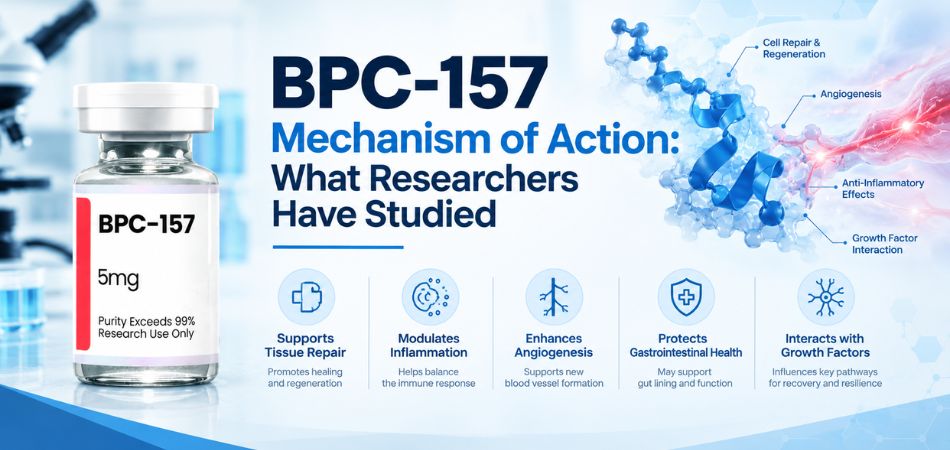
The BPC-157 mechanism of action is an active area of experimental research. Studies have investigated the peptide’s relationship with angiogenesis, nitric oxide signaling, vascular function, inflammatory pathways, and cellular processes associated with tissue repair.
However, there is no single, fully established mechanism that explains all reported experimental observations.
Instead, current research suggests that BPC-157 may interact with several biological pathways depending on the experimental model being studied.
Most importantly, these mechanisms have primarily been investigated in preclinical systems. They should not be interpreted as established mechanisms of a clinically approved human treatment.
For the broader scientific background, see our BPC-157 Research: Studies, Mechanism, Structure & Properties.
What Is the BPC-157 Mechanism of Action?
The BPC-157 mechanism of action refers to the biological pathways and molecular processes researchers have investigated to understand how the peptide produces observed experimental effects.
Research has focused on several areas:
- Angiogenesis
- Endothelial function
- Nitric oxide signaling
- Inflammatory signaling
- Fibroblast activity
- Tissue remodeling
- Vascular integrity
- Cellular signaling pathways
These areas are interconnected. Changes in vascular signaling, inflammation, and cellular activity can all influence experimental tissue responses.
BPC-157 and Angiogenesis
Angiogenesis is the process through which new blood vessels develop from existing vessels.
Researchers have investigated BPC-157 in relation to angiogenesis because vascular growth and endothelial activity are important components of tissue remodeling.
A recent experimental study reported that BPC-157 promoted angiogenesis through an FBXO22-dependent mechanism involving BACH1 stabilization.
PubMed — BPC157 drives angiogenesis through FBXO22-dependent stabilization of BACH1
The proposed pathway provides a more specific molecular explanation for some previously reported angiogenic observations.
However, this remains experimental evidence. Demonstrating a molecular pathway in cellular or animal models does not establish that the same pathway produces a clinically meaningful outcome in humans.
FBXO22 and BACH1
The FBXO22-BACH1 relationship has received attention in recent BPC-157 research.
BACH1 is a transcriptional regulator involved in cellular responses, while FBXO22 is a protein associated with regulation of protein stability.
The experimental study proposed that BPC-157 interacts with FBXO22 and affects BACH1 protein stability, contributing to changes in endothelial-cell proliferation and tube formation observed in the experimental models.
This is an example of how the BPC-157 research field is moving beyond broad descriptions of tissue effects toward investigation of specific molecular pathways.
Further research is required to determine how consistently this mechanism operates across different biological systems.
BPC-157 and Nitric Oxide Signaling
Nitric oxide, commonly abbreviated as NO, plays an important role in vascular biology.
It contributes to processes including vascular smooth-muscle relaxation and regulation of blood flow.
BPC-157 research has repeatedly investigated relationships between the peptide and nitric oxide-related pathways.
Experimental vascular studies have examined whether BPC-157 can influence endothelial responses involving NO.
Recent research using human internal mammary artery tissue reported concentration-dependent vasorelaxation and evidence of endothelial nitric oxide involvement. [PubMed study]
This distinction matters when interpreting the literature.
BPC-157 and Endothelial Function
The endothelium is the thin layer of cells lining blood vessels.
Endothelial cells regulate vascular tone, blood flow, permeability, inflammation, and other physiological processes.
Experimental BPC-157 research has examined endothelial responses in the context of vascular function and angiogenesis.
These studies are relevant because endothelial behavior can influence tissue remodeling and vascular responses.
The current evidence, however, does not establish a complete human mechanism for BPC-157.
BPC-157 and Inflammatory Signaling
Inflammation is another area investigated in BPC-157 research.
Experimental models have examined changes in inflammatory mediators and tissue responses following injury or other experimental challenges.
Researchers have proposed that BPC-157 may influence inflammatory signaling rather than acting through a single inflammatory pathway.
This distinction is important. Saying that a compound “reduces inflammation” can oversimplify complex experimental findings.
A more scientifically accurate description is that researchers have observed changes in inflammatory markers or tissue responses in specific experimental models.
BPC-157 and Fibroblast Activity
Fibroblasts are connective-tissue cells involved in extracellular-matrix production and tissue remodeling.
Because fibroblast activity is important to tissue repair, researchers have investigated whether BPC-157 influences fibroblast-related processes.
Experimental findings involving fibroblast activity have contributed to broader research into how BPC-157 may interact with tissue-repair processes.
These observations are relevant to laboratory research but should not be converted into claims that BPC-157 clinically accelerates healing in humans.
BPC-157 and Vascular Integrity
Blood-vessel integrity is another recurring theme in experimental BPC-157 research.
The vascular system does more than transport oxygen and nutrients. It also participates in inflammatory responses, tissue remodeling, and interactions between endothelial cells and surrounding tissues.
Research investigating BPC-157 has therefore examined vascular responses as part of the peptide’s broader biological profile.
The relationship between vascular signaling and tissue responses may help explain why different experimental studies have reported observations across several tissue systems.
Is There One BPC-157 Mechanism?
Not necessarily.
Current research does not support reducing BPC-157 biology to one isolated pathway.
Instead, studies have investigated a network of mechanisms involving:
Vascular signaling → endothelial activity → angiogenesis → tissue remodeling
and
Inflammatory signaling → cellular responses → tissue environment
along with specific molecular pathways such as the reported FBXO22-BACH1 axis.
This multi-pathway model is still being investigated.
BPC-157 Mechanism and Gastrointestinal Research
The gastrointestinal system represents another major research area.
Experimental studies have examined intestinal tissues, gastrointestinal injury models, and processes related to barrier function.
Potential relationships with vascular signaling, inflammation, and tissue responses have been investigated as possible contributors to the observations reported in these models.
For the evidence specific to this research area, see [BPC-157 Gut Research: Intestinal Barrier & Gastrointestinal Studies].
What About Human Mechanistic Evidence?
Human mechanistic evidence is much more limited than preclinical evidence.
For example, research involving human vascular tissue can provide useful information about biological responses, but it does not provide the same level of evidence as a controlled clinical trial in living human participants.
This distinction should remain clear throughout BPC-157 research content.
BPC-157 Mechanism: What Researchers Still Do Not Know
Several questions remain unresolved.
Researchers still need stronger evidence regarding:
- Which mechanisms are most important in humans
- Whether experimental pathways translate into clinically meaningful effects
- How different administration routes affect biological activity
- Human pharmacokinetics
- Long-term biological effects
- Dose-response relationships
- Interactions with other biological pathways
These gaps are part of the reason BPC-157 remains an investigational research subject.
BPC-157 Mechanism vs Clinical Evidence
Mechanistic evidence answers:
How might a compound produce a biological response?
Clinical evidence answers:
Does that response produce a meaningful benefit or acceptable risk in humans?
These are different questions.
BPC-157 has generated considerable mechanistic research, but that does not mean the peptide has established clinical efficacy.
This distinction should be maintained when evaluating scientific literature, product information, and online claims.
Conclusion
The current BPC-157 mechanism of action research points toward several interacting biological pathways rather than one confirmed mechanism.
Researchers have investigated angiogenesis, endothelial function, nitric oxide signaling, inflammatory responses, fibroblast activity, vascular integrity, and specific molecular pathways including FBXO22 and BACH1.
The evidence is scientifically interesting but remains largely preclinical.
For the complete scientific profile, continue to our BPC-157 Research.
For chemical information, see BPC-157 Molecular Structure, Formula, Weight & Sequence.
Frequently Asked Questions
What is the BPC-157 mechanism of action?
Research suggests that BPC-157 may influence multiple biological pathways involving vascular, endothelial, inflammatory, and cellular processes. No single complete mechanism has been established.
Does BPC-157 affect nitric oxide?
Experimental research has investigated relationships between BPC-157 and nitric oxide signaling, including vascular responses. The evidence remains primarily experimental.
Does BPC-157 promote angiogenesis?
Some experimental studies have reported angiogenic effects and investigated specific molecular pathways involved in those observations. These findings do not establish a clinical effect in humans.
What is the FBXO22-BACH1 pathway?
Recent experimental research has investigated a relationship between BPC-157, FBXO22, and BACH1 in angiogenesis-related processes.
Is the BPC-157 mechanism proven in humans?
No. Human mechanistic and clinical evidence remains limited compared with the preclinical research base.