
AOD-9604 and human growth hormone (HGH) are related in research history, but they are not the same molecule.
Human growth hormone is a 191-amino-acid protein hormone with broad biological activity. AOD-9604 is a much smaller synthetic peptide investigated primarily for lipolytic and metabolic effects.
Understanding the structural and biological differences is important when interpreting research involving either compound.
For the complete AOD-9604 evidence base, see AOD-9604 Research: Studies, Mechanism, Structure & Properties.
AOD-9604 vs HGH: Molecular Structure
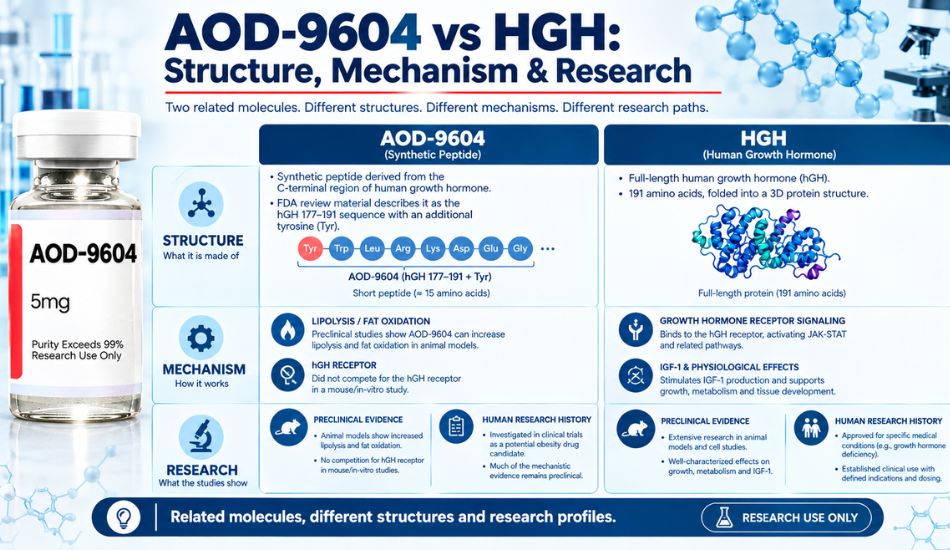
AOD-9604 and human growth hormone (HGH) differ substantially in molecular size and structure.
HGH is a 191-amino-acid protein hormone, while AOD-9604 is a 16-amino-acid synthetic peptide associated with a lipolytic region of human growth hormone.
These structural differences are important when interpreting research findings. AOD-9604 should be evaluated as a distinct peptide rather than as a smaller form of full-length HGH.
For the detailed sequence, molecular formula, molecular weight, and structural characterization of AOD-9604, see AOD-9604 Molecular Structure: Sequence, Formula, Weight & Chemical Properties.
The difference in molecular size is one of the clearest distinctions between AOD-9604 and full-length human growth hormone.
Why Is AOD-9604 Associated With HGH?
AOD-9604 was developed in relation to the lipolytic region of human growth hormone.
This relationship is important historically and scientifically, but it does not mean that AOD-9604 reproduces all of the biological activity of the complete hormone.
Research has therefore investigated AOD-9604 as a separate molecule.
AOD-9604 vs HGH: Mechanism
Human growth hormone has broad physiological effects involving growth, metabolism, and the GH/IGF-1 axis.
AOD-9604 research has focused more specifically on lipid metabolism, lipolysis, adipose tissue, and related metabolic pathways.
Research has also investigated whether AOD-9604 interacts with growth-hormone-related signaling in the same way as full-length HGH.
The available evidence indicates that AOD-9604 should not simply be treated as a smaller version of HGH.
Growth Hormone Receptor Research
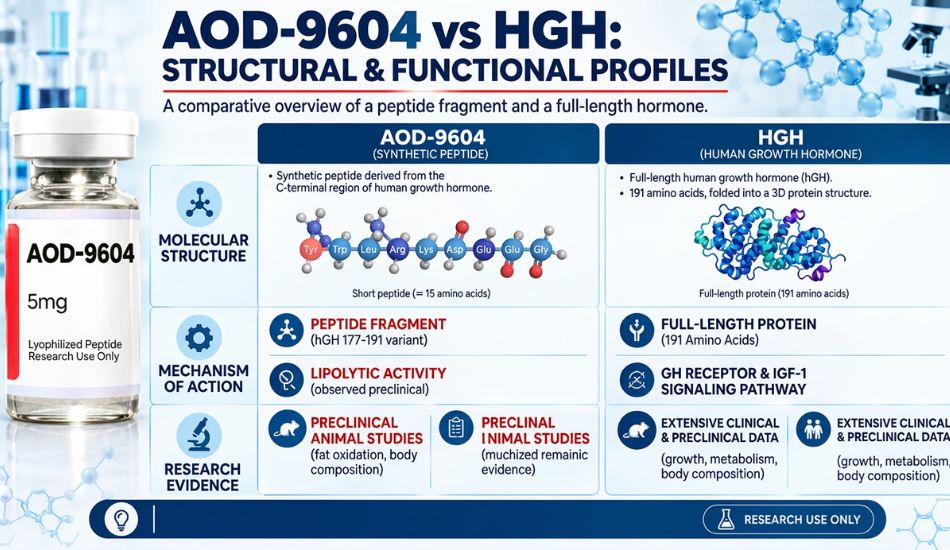
Researchers have investigated whether AOD-9604 interacts directly with the human growth hormone receptor.
Experimental findings indicate that AOD-9604 does not reproduce the receptor activity of intact human growth hormone in the same manner.
This distinction helps explain why research into AOD-9604 has focused on selected metabolic effects rather than treating it as equivalent to HGH.
AOD-9604 and IGF-1
Human growth hormone has a well-established relationship with IGF-1 signaling.
AOD-9604 has been investigated separately to determine whether its biological activity follows the same pathway.
The evidence does not justify describing AOD-9604 as equivalent to HGH in terms of the complete GH/IGF-1 system.
Instead, research has concentrated on its proposed metabolic and lipolytic activity.
AOD-9604 vs HGH: Lipolysis
Both compounds have been studied in relation to metabolism, but the research contexts differ.
AOD-9604 research has specifically investigated lipolysis and adipose-tissue metabolism.
HGH has much broader physiological activity.
Therefore, findings from HGH research should not automatically be used as evidence for AOD-9604.
AOD-9604 vs HGH: Research Evidence
AOD-9604 has been investigated through:
- Cellular research
- Animal studies
- Human clinical studies
HGH has a much broader clinical and physiological evidence base.
This difference in evidence should be considered when comparing the two compounds.
For details about AOD-9604 clinical research, see AOD-9604 Studies: Human Trials, Preclinical Research & Evidence.
Comparison Table
| Feature | AOD-9604 | Human Growth Hormone |
|---|---|---|
| Molecular size | 16 amino acids | 191 amino acids |
| Molecular type | Synthetic peptide | Protein hormone |
| Research focus | Lipolysis and metabolic activity | Broad growth and metabolic physiology |
| GH relationship | Derived from/associated with a lipolytic region | Full-length hormone |
| IGF-1 relationship | Not equivalent to full GH signaling | Established GH/IGF-1 pathway |
| Research status | Investigated experimentally | Extensive clinical literature |
Why You Should Not Treat Them as the Same
A common mistake in peptide discussions is to assume that a peptide derived from a region of a larger protein must reproduce all of that protein’s effects.
That assumption does not necessarily hold.
Molecular size, structure, receptor interactions, pharmacokinetics, and biological activity can all differ.
For AOD-9604, these differences are particularly important because its research profile is centered on selected metabolic effects.
AOD-9604 vs HGH: Key Takeaway
AOD-9604 is a small synthetic peptide associated with the lipolytic region of human growth hormone, while HGH is a full-length 191-amino-acid protein hormone.
The two compounds have different molecular structures, biological profiles, and research contexts.
AOD-9604 should therefore be evaluated using research conducted directly on AOD-9604 rather than by extrapolating from HGH studies.