
Why Multi-Peptide Research Matters
Single-peptide studies isolate one signaling pathway at a time. That approach has scientific value: clear variables, clean data, direct attribution. But biological systems rarely operate through a single pathway in isolation. Tissue repair cascades involve simultaneous activation of growth factor signaling, cytoskeletal reorganization, vascular development, extracellular matrix remodeling, and inflammatory modulation, often in parallel, often interdependent.
Multi-peptide combination protocols allow researchers to investigate how these pathways interact under controlled laboratory conditions. When BPC-157 TB-500 are studied together, the research question shifts from “what does this peptide do” to “how do these signaling cascades interact, and what happens at the intersection.” That is a fundamentally different and often more informative research question.
This guide covers the full range of BPC-157 combination protocols available through Hotspan, the mechanistic rationale for each combination, and practical implementation considerations for laboratory research settings.
BPC-157: The Foundation Peptide
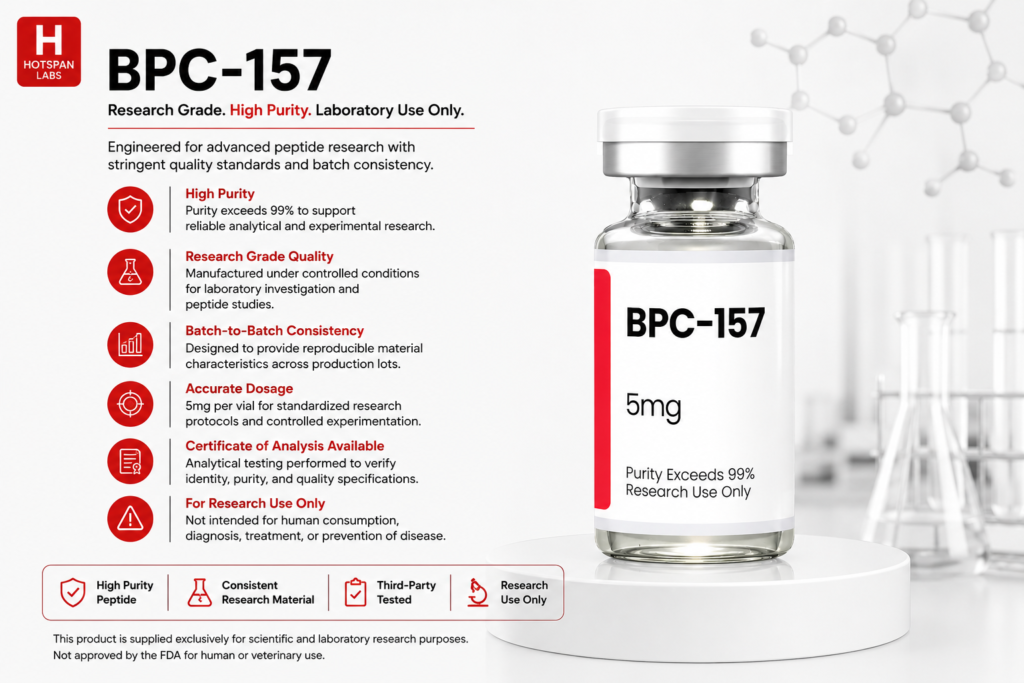
BPC-157 is a 15-amino-acid gastric peptide fragment, a partial sequence derived from a gastric-origin cytoprotective protein system. In preclinical and in vitro research, it has been extensively studied for its roles in several interconnected signaling domains.
Research on BPC-157 consistently focuses on nitric oxide-associated signaling pathways. Nitric oxide (NO) is a pleiotropic signaling molecule involved in vascular tone regulation, inflammatory cascades, and cellular protection mechanisms. BPC-157’s interaction with NO-linked pathways makes it a high-interest compound for researchers studying vascular biology and tissue-level signaling.
Beyond NO modulation, experimental models have examined BPC-157’s role in growth factor-related signaling, specifically its apparent upregulation of pathways associated with VEGF, EGF, and other repair-relevant growth factor systems. These pathways govern fibroblast activation, collagen matrix synthesis, and extracellular remodeling, making them central to any tissue repair investigation.
In the extracellular matrix domain, BPC-157 research has looked at fibroblast behavior: migration, proliferation, and collagen deposition. These are the cellular processes underlying structural tissue reconstruction in experimental models. BPC-157 appears to modulate them across multiple tissue types, a feature that makes it relevant to gut epithelial models, musculoskeletal models, and vascular endothelial models alike.
Hotspan BPC-157 is available as a standalone compound:
BPC-157 — from $39 to $79 | 5mg or 10mg · Purity ≥99% · Lyophilized · FREE BAC water included · COA and Endotoxin Report available
TB-500: The Vascular and Cytoskeletal Partner
TB-500 is a 43-amino-acid synthetic peptide corresponding to the sequence motif of Thymosin Beta-4, a naturally occurring actin-binding peptide found in eukaryotic cells. Its research profile is distinct from BPC-157 but meaningfully complementary.
The primary research focus on TB-500 centers on actin cytoskeleton dynamics. Thymosin Beta-4 sequesters G-actin monomers, influencing the polymerization-depolymerization equilibrium of the actin cytoskeleton. This has downstream effects on cell morphology, motility, and division, all relevant to wound repair and tissue remodeling investigations.
Cell migration research is a second major domain. TB-500-treated cells in experimental models demonstrate enhanced directional migration, a property relevant to wound closure studies, endothelial repair, and immune cell recruitment investigations. The mechanism likely involves cytoskeletal rearrangement enabling more efficient lamellipodia formation.
Vascular biology research on TB-500 focuses primarily on angiogenesis-related signaling: endothelial cell activation, tubulogenesis assays, and the molecular markers associated with new vessel formation. Tissue repair without adequate vascular support is incomplete; new capillary formation delivers oxygen, growth factors, and immune components to repair sites. TB-500’s role in angiogenesis signaling research makes it a natural pairing with BPC-157’s tissue-level repair signaling.
Hotspan TB-500 is available as a standalone compound:
TB-500 — $99 | 10mg · Purity ≥99% · Lyophilized · FREE BAC water · COA and Endotoxin Report available
The Core Combination: BPC-157 + TB-500 Stack
When BPC-157 and TB-500 are combined in a single research formulation, the mechanistic rationale is straightforward: BPC-157 addresses nitric oxide signaling, growth factor activation, and extracellular matrix dynamics at the tissue level, while TB-500 addresses cytoskeletal organization and angiogenesis-related vascular development. These are complementary rather than redundant pathways.
Experimental literature evaluates their complementary roles in cellular signaling pathways related to cytoskeletal organization, extracellular matrix dynamics, and vascular biology. Laboratory models investigate pathway-level interactions under controlled conditions.
For researchers, the practical value is significant. Studying both compounds simultaneously under identical experimental conditions same cell lines, same timepoints, same controls yields data on pathway interaction that sequential single-peptide studies cannot. If the combined effect in a tissue repair model exceeds the summed individual effects, that constitutes evidence of genuine synergistic interaction. If it matches, additive effects are documented. Either outcome is scientifically informative.
The combined vial format also simplifies experimental design. Rather than managing two separate reconstituted peptide stocks with independent dosing schedules, researchers work with a single preparation — reducing variability from differential stability or reconstitution timing.
Hotspan BPC-157 + TB-500 Stack:
BPC-157 + TB-500 — $99 | 10mg combined vial · Purity ≥99% · Lyophilized · FREE BAC water · COA and Endotoxin Report available
Cost comparison: purchasing BPC-157 10mg ($79) and TB-500 ($69) separately totals $148. The combined stack at $99 represents a $49 saving while also simplifying laboratory inventory management.
NAD+: Adding Cellular Energy to the Research Stack
For researchers investigating metabolic aspects of tissue repair, NAD+ (nicotinamide adenine dinucleotide) represents a meaningful addition to the BPC-157 + TB-500 protocol. NAD+ sits at the center of cellular energy metabolism — it is the primary electron carrier in mitochondrial ATP synthesis and a required cofactor for sirtuins, PARPs, and other longevity-associated enzyme systems.
In the context of repair research, the metabolic angle is underexplored but important. Active tissue repair is energetically expensive. Fibroblast proliferation, collagen synthesis, angiogenesis, and immune modulation all require sustained ATP production. Cellular NAD+ levels decline with oxidative stress, aging, and metabolic load, creating a potential bottleneck in energy-intensive repair processes.
BPC-157 + TB-500 + NAD+ as a triple-combination protocol creates a research model that covers tissue-level signaling (BPC-157), vascular development (TB-500), and mitochondrial energy substrate availability (NAD+). Each operates on a distinct mechanism; none directly duplicates the others. The research question becomes: does addressing the energy substrate dimension of repair alter the outcomes observed in the signaling dimensions?
Hotspan NAD+:
NAD+ — from $69 | 500mg or 1000mg · Purity ≥99% · Lyophilized · COA available
Triple protocol cost: BPC-157 + TB-500 Stack ($99) + NAD+ ($69) = $168 total.
GLOW: Three-Peptide Research Blend
GLOW is Hotspan’s three-peptide research formulation combining BPC-157, TB-500, and GHK-Cu in a single lyophilized blend. The addition of GHK-Cu introduces a third distinct signaling dimension to the BPC-157 + TB-500 foundation.
GHK-Cu is a copper(II)-binding tripeptide — Gly-His-Lys — identified in human plasma and other biological fluids. Research on GHK-Cu focuses on its roles in copper-mediated metalloprotein activity, extracellular matrix signaling, and redox-associated molecular markers. Its copper-chelating properties influence collagen and elastin matrix remodeling enzymes, and it has been studied in models examining oxidative stress responses and tissue matrix organization.
Experimental models assess nitric oxide–associated pathways, cytoskeletal dynamics, extracellular matrix signaling, and redox-related molecular markers. Each of the three peptides operates on a distinct but intersecting set of molecular targets: BPC-157 on NO and growth factor signaling, TB-500 on cytoskeletal organization and angiogenesis, GHK-Cu on metal-ion interactions and matrix metalloproteinase regulation.
For researchers working on multi-pathway tissue biology, skin matrix biology, or oxidative stress models, GLOW provides a single-vial solution for a three-compound study design. The 70mg format provides sufficient material for extended experimental timelines.
Hotspan GLOW:
GLOW — $169 | BPC-157 + GHK-Cu + TB-500 · 70mg · Purity ≥99% · Lyophilized · FREE BAC water · COA and Endotoxin Report available
KLOW: Four-Peptide Research Blend
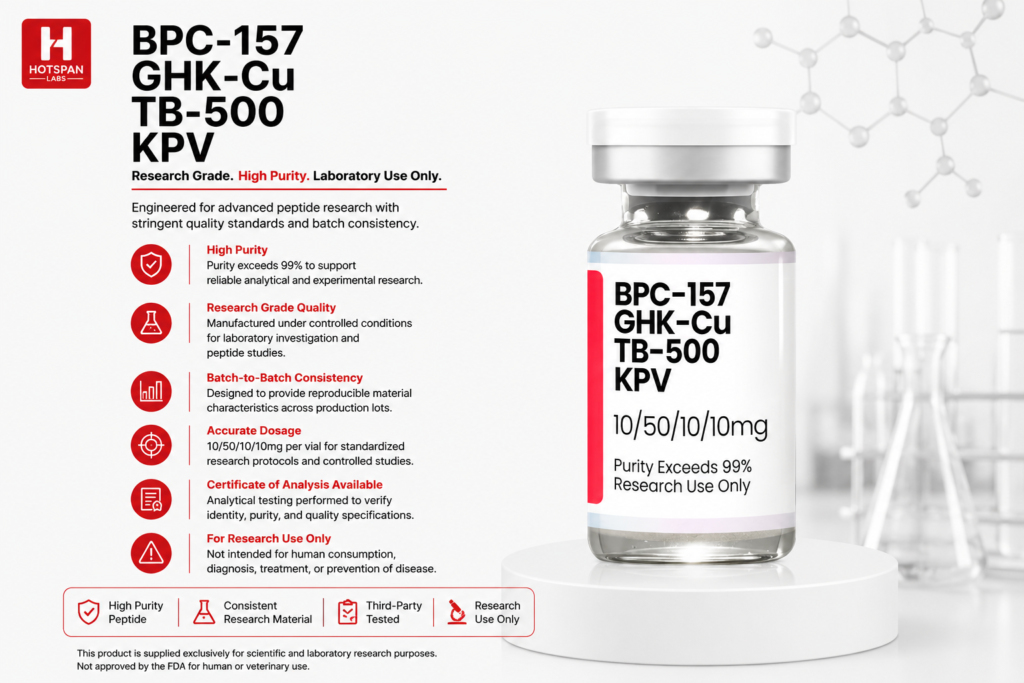
KLOW expands the combination to four peptides: BPC-157, TB-500, GHK-Cu, and KPV. The addition of KPV (Lys-Pro-Val) introduces NF-κB-related signaling into the research scope.
KPV is a tripeptide derived from the C-terminal region of alpha-melanocyte-stimulating hormone (α-MSH). It has been studied in preclinical models for its interactions with NF-κB transcriptional activity a central pathway in inflammatory signaling. NF-κB regulates expression of pro-inflammatory cytokines, cell adhesion molecules, and immune activation genes. Research models examining inflammatory modulation in tissue contexts frequently use NF-κB pathway markers as primary endpoints.
KLOW is supplied for laboratory investigation of coordinated signaling pathways involving nitric oxide modulation, cytoskeletal remodeling, NF-κB–associated transcriptional activity, and redox-related molecular markers.
The four-peptide combination creates a broad signaling coverage map:
- BPC-157 — nitric oxide signaling, growth factor pathways, fibroblast activity
- TB-500 — actin cytoskeleton dynamics, cell migration, angiogenesis-related signaling
- GHK-Cu — copper metalloprotein activity, extracellular matrix remodeling, redox responses
- KPV — NF-κB transcriptional pathway modulation, α-MSH receptor interactions
For researchers designing multi-variable studies or investigating how these pathways interact under inflammatory or oxidative stress conditions, KLOW provides the broadest single-vial research scope available in Hotspan’s product line.
Hotspan KLOW:
KLOW — $189 | BPC-157 + GHK-Cu + TB-500 + KPV · 80mg · Purity ≥99% · Lyophilized · FREE BAC water · COA and Endotoxin Report available
Selecting the Right Combination Protocol
Combination selection depends on which signaling dimensions are relevant to your research question.
Foundational two-pathway research: BPC-157 + TB-500 Stack ($99) covers NO/growth factor signaling and cytoskeletal/angiogenesis pathways. Appropriate for tissue repair models where vascular biology is a key variable.
Metabolic + repair research: Add NAD+ ($69) to the BPC-157 + TB-500 Stack for a $168 triple-protocol that adds mitochondrial energy substrate availability to the experimental variables. Relevant for aging models, metabolic stress models, or research where cellular energy status is hypothesized to modulate repair outcomes.
Matrix remodeling research: GLOW ($169) adds GHK-Cu’s copper-mediated matrix signaling to the BPC-157 + TB-500 base. Appropriate for skin biology, connective tissue, or oxidative stress experimental designs.
Broadest multi-pathway coverage: KLOW ($189) adds both GHK-Cu and KPV to create a four-variable protocol covering tissue signaling, vascular biology, matrix remodeling, NF-κB-mediated inflammatory pathways, and redox responses simultaneously.
Budget and scope comparison:
| Protocol | Components | Price | Research Scope |
|---|---|---|---|
| BPC-157 alone | 1 peptide | From $39 to $79 (5 mg or 10 mg) | NO/growth factor signaling |
| BPC-157 + TB-500 | 2 peptides | $99 (10mg combined) | + Cytoskeletal/angiogenesis |
| Stack + NAD+ | 3 compounds | from $168 (500mg or 1000mg NAD+) | + Mitochondrial energy |
| GLOW | 3 peptides | $169 (70mg) | + Copper/matrix/redox |
| KLOW | 4 peptides | $189 (80mg) | + NF-κB inflammatory pathways |
Practical Laboratory Considerations
Reconstitution
All Hotspan peptides are supplied lyophilized. Reconstitute with sterile bacteriostatic (BAC) water using aseptic technique. BAC water is included free with every order. For multi-use applications, bacteriostatic water preserves stability across multiple draws from a single reconstituted vial.
Storage of reconstituted peptides
Reconstituted peptides are stable for several days at 2–8°C. For extended storage, aliquot and freeze at -20°C or -80°C. Avoid repeated freeze-thaw cycles, which degrade peptide integrity. Lyophilized storage is stable at -20°C for 12–24 months. Stable at 2–8°C for shorter periods.
Experimental controls
For combination studies where synergy is being assessed, control group design is critical. Vehicle control, individual peptide controls, and combination groups are all necessary to distinguish additive effects from synergistic interaction. The combination vials simplify some logistics but do not eliminate the need for individual-compound comparison groups when synergy quantification is the research goal.
Endotoxin levels
Hotspan provides a Certificate of Analysis and endotoxin report on every single batch, not just spot checks. For cell-based research, endotoxin contamination is a significant confounder; lipopolysaccharide (LPS) from bacterial sources activates innate immune pathways that will interfere with inflammatory or repair signaling endpoints. Verified low-endotoxin peptides are not optional for reliable in vitro data.
Purity standards
Research applications typically require 95–99%+ purity for reliable results; lower purity introduces variables that interfere with in vitro studies and compromise data integrity. All Hotspan peptides are guaranteed at ≥99% purity, verified by HPLC with UV detection coupled with mass spectrometry at an independent CLIA-certified laboratory.
Quality Infrastructure
Research-grade peptides require more than claimed purity percentages. The verification process matters.
Every batch is tested by an independent CLIA-certified laboratory, not an in-house lab. Hotspan uses HPLC with UV detection coupled with Mass Spectrometry. Certificates of Analysis include the testing lab principal chemist’s signature and the exact methodology used.
All peptides are synthesized in USA-registered facilities following Good Manufacturing Practices. Hotspan does not source from overseas manufacturers. Full chain of custody documentation is maintained and available on request.
Hotspan Labs is also a member of the American Peptide Association, reflecting ongoing commitment to industry compliance and transparency standards.
For researchers who require documentation for institutional procurement or IRB/IBC submissions, all COA and endotoxin reports are downloadable directly from each product page.
Physician-Supervised Access
For researchers or institutions requiring physician-supervised peptide access with personalized protocols, Hotspan offers a prescription pathway. This operates independently of the research peptide catalog and provides physician-overseen protocols delivered in all 50 states without insurance requirements.
Get a Prescription → hotspan.com/prescription
Summary: Research Protocol Selection
BPC-157 combination protocols represent a research frontier precisely because they allow investigation of pathway interactions that single-peptide studies cannot address. The mechanistic diversity of the available combinations, from the two-pathway BPC-157 + TB-500 stack to the four-pathway KLOW blend, gives researchers flexibility to match experimental design to research question.
All Hotspan combination products meet the same quality standard: ≥99% purity, independent third-party verification, COA and endotoxin report per batch, USA-manufactured, lyophilized with BAC water included.