
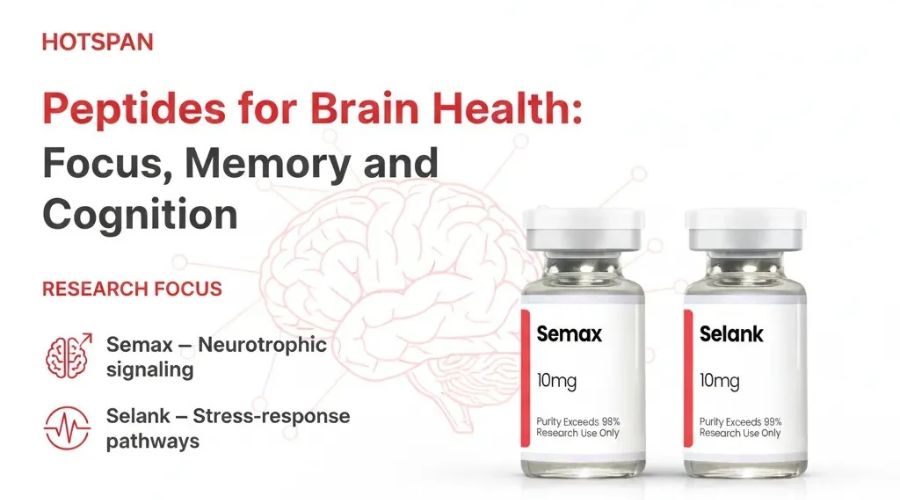
Peptides for brain health attract scientific interest because selected compounds can influence the signaling systems involved in learning, stress responses, and communication between brain cells. Semax and Selank are two examples: researchers have examined their effects through molecular experiments, brain imaging, and human clinical studies.
The appeal is understandable. Focus helps us stay with a demanding task. Memory allows us to retain and use information. Cognition brings these abilities together with reasoning, planning, and decision-making.
This guide explains why these peptides are being studied, what researchers have measured, and how to evaluate research materials. It also introduces Semax and Selank, two research products listed in Hotspan’s Cognitive & Neuropeptides range. The emphasis is on understanding the biology and comparing the research behind each compound.
Research-use notice: Hotspan’s research peptides are intended strictly for in vitro research and laboratory experimentation, not human or veterinary use. This article provides educational information, not individualized medical advice.
What Are Peptides for Brain Health?
Peptides are short chains of amino acids. Some act as biological messengers, while others are designed to interact with pathways that researchers want to investigate.
In brain-health research, the interest is often in how a compound affects neuronal signaling, responses to stress, or the processes that support learning. The term nootropic peptides is commonly used for peptides discussed in connection with cognition. It describes an area of interest, not one uniform mechanism or a regulatory approval category.
Focus, Memory and Cognition: Key Differences
- Focus: Directing attention toward a task and managing distractions.
- Memory: Encoding, retaining, and retrieving information.
- Cognition: The broader set of mental processes, including attention, memory, language, and executive function.
That distinction gives research a clearer purpose. A compound associated with changes in a stress-response pathway raises different questions from one investigated for learning-related signaling.
How Do Nootropic Peptides Work?
The brain does not have a single “focus switch.” Its activity depends on interacting networks, chemical messengers, receptors, and the ability of connections between neurons to adapt.
One research area is neuroplasticity: the nervous system’s capacity to change its connections and activity in response to experience. Researchers also examine neurotrophic factors, which help regulate neuronal development, survival, and plasticity.
Brain-derived neurotrophic factor, usually shortened to BDNF, is one example. Its interaction with the TrkB receptor makes this pathway relevant to studies of learning-related biology.
In a rat study published in Brain Research, Semax increased hippocampal BDNF protein and TrkB activation. The researchers also observed changes in a conditioned-learning task. These were measurable molecular and behavioral findings in an animal model, giving scientists a specific pathway to investigate further.
Other peptide research explores neurotransmission and stress regulation. Rather than assuming all cognitive peptides act as stimulants, it is more useful to ask which biological system each compound appears to influence.
Semax and Selank: Two Peptides for Cognitive Function
Available at Hotspan: The cognitive research range includes Semax and Selank. The overview below connects each product name with the areas explored in published research.
| Hotspan research product | Research areas discussed in this guide |
| Semax | Neurotrophic signaling, BDNF/TrkB pathways, and brain-network studies. |
| Selank | Stress-response biology and neurotransmission-related research. |
Purpose of this section: The information is educational. Hotspan’s product listings are for laboratory research, not personal treatment or cognitive enhancement.
Semax and Neurotrophic Signaling
Semax is a synthetic peptide developed from a fragment of adrenocorticotropic hormone, or ACTH. Its research profile includes neurotrophic signaling, learning-related processes, and responses to neurological injury.
For cognitive research, its connection with the BDNF/TrkB pathway is particularly interesting. This provides a biological explanation for investigating how Semax might influence the conditions that support learning and neuronal adaptation.
Researchers can approach that question at several levels: changes in gene expression, protein activity, behavior in experimental models, or patterns observed through brain imaging. Each measurement contributes a different part of the picture.
Researchers can review the Semax research listing for current specifications and lot documentation before selecting the material for an experiment.
Selank and Stress-Response Research
Selank is a synthetic peptide investigated for its relationship with anxiety-related processes and neurotransmission. Its research profile complements, rather than duplicates, the neurotrophic emphasis often associated with Semax.
One area of interest is the GABAergic system, meaning the signaling system associated with gamma-aminobutyric acid, or GABA. GABA is a major inhibitory neurotransmitter in the brain. Researchers study this system when exploring how neural activity and stress responses are regulated.

A 2016 study examined neurotransmission-related gene expression in the frontal cortex of rats after Selank administration. The investigators reported changes involving several signaling pathways and proposed GABAergic modulation as one possible component of its action. The findings give researchers a signaling pathway to examine when investigating stress-related and cognitive outcomes.
Semax and Selank should not be treated as interchangeable research materials. Evaluate each compound according to its structure, the research question, supporting evidence, and batch documentation.
What Does Published Brain-Health Research Show?
There are observable biological findings behind this field. The most useful way to interpret them is to identify the model, the measurement, and the question the study actually addressed.
For example, a 2018 study examined Semax in 24 healthy volunteers, with 14 receiving Semax and 10 receiving placebo. Researchers used resting-state functional MRI to examine the brain’s default mode network. They reported a difference in the network’s medial frontal component between the groups. This is an objective imaging finding; the experiment was not a test of everyday productivity or long-term memory improvement.
| Research example | What was measured | What the finding contributes |
| Semax in rats | Hippocampal BDNF, TrkB signaling, and a conditioned-learning task | A mechanistic link between neurotrophic signaling and learning-related behavior. |
| Semax in healthy volunteers | Resting-state brain-network patterns | Human imaging evidence of an effect on brain-network activity. |
| Selank in rats | Expression of neurotransmission-related genes | Clues about signaling pathways involved in its biological activity. |
| Selank in patients with anxiety-related disorders | Clinical symptom ratings | Human findings relevant to a defined patient population. |
A 2008 clinical study involved 62 patients with generalized anxiety disorder or neurasthenia. Thirty patients received Selank and 32 received medazepam. The authors reported similar anxiolytic effects in the two groups and also reported antiasthenic (anti-fatigue) and psychostimulant effects with Selank. These findings concern a defined patient population. They should not be interpreted as evidence of cognitive enhancement in healthy adults or as evidence of effects from Hotspan’s research material.
Together, these studies show why the field attracts interest: researchers can investigate both biological mechanisms and measurable responses. The next question is how consistently particular findings translate into specific cognitive outcomes.
Potential Benefits Under Investigation
Peptides for Focus and Attention
Research into peptides for focus asks more than whether someone feels energized. Attention includes staying with a task, selecting relevant information, and resisting distraction.
Semax’s brain-network findings and Selank’s stress-response research offer different starting points for studying those abilities. One approach examines neural signaling; another asks how changes in anxiety-related processes might relate to performance under demanding conditions.
Useful research outcomes include sustained-attention accuracy, reaction time, error rates, and resistance to distraction. These measurements make “better focus” a more precise question than a general feeling of mental stimulation.
Peptides for Memory and Learning
Interest in peptides for memory is closely connected to the biology of learning and neuroplasticity. Semax’s effects on BDNF-related signaling in animal research provide one reason to investigate that connection.
Memory itself is not a single ability. Working memory holds information briefly while it is being used. Longer-term memory involves retaining and retrieving information over time.
For that reason, a well-designed study should specify which ability it is examining and when it is measured. Immediate recall, delayed recall, and learning a new task are different outcomes.
This outcome-focused approach keeps research informative: a molecular change, a learning-task result, and a lasting memory benefit are related questions, but they are not identical findings.
Safety and Research-Use Considerations
Understanding biological activity also means understanding the context in which a material is studied. The exact compound, formulation, purity, route of exposure, and experimental conditions can all affect how results should be interpreted.
The FDA states that compounded drugs containing Semax (heptapeptide) or Selank acetate (TP-7) may pose a risk of immunogenicity for certain routes of administration because of potential aggregation and peptide-related impurities. The agency reports no or limited safety-related information for Semax for the proposed routes of administration and lacks important human safety information for Selank acetate. These concerns relate to compounded drugs and are important when separating published research from clinical-use claims.
Neither Semax nor Selank is an FDA-approved medicine for improving focus or memory in the United States. A research-use label should therefore be taken literally, not interpreted as an alternative route to personal treatment.
For laboratory work, use institutional procedures and appropriate handling documentation. For persistent or worsening problems with attention or memory, seek a qualified medical assessment rather than assuming that a research compound addresses the cause.
What to Look For When Sourcing Nootropic Peptides
Good research starts with a clearly defined question and well-characterized materials. When comparing suppliers, focus on information that helps you assess whether a product is suitable for the planned experiment.
Look for:
- A clear product identity: The compound and relevant specifications should be unambiguous.
- Lot traceability: Documentation should match the batch being evaluated.
- Appropriate analytical methods: Understand what each test measures rather than relying on a purity percentage alone.
- Testing details: Review the laboratory, testing date, and reported results.
- Handling information: Follow the supplier’s storage guidance and your institution’s procedures.
Hotspan’s Certificate of Analysis directory provides a starting point for reviewing product and lot documentation. Confirm that each report matches the exact material and batch, and request any missing information before beginning research.
For detailed guidance on interpreting purity, identity, quantity, and endotoxin results, see our guide on how to read a peptide COA. These measurements answer different analytical questions; none establishes clinical effectiveness or suitability for human use.
For researchers exploring this category, the Semax and Selank listings offer two distinct research materials. Select according to the study question, not the assumption that all cognitive peptides have the same effects.
Frequently Asked Questions
Are Semax and Selank the Same?
No. They are different synthetic peptides with different research profiles. Semax is often investigated for neurotrophic signaling and neurological processes, while Selank research includes stress responses and neurotransmission. Findings for one should not automatically be attributed to the other.
What Are Hotspan’s Cognitive Peptides Intended For?
Hotspan’s Semax and Selank products are intended strictly for in vitro research and laboratory experimentation. This article explains published findings for educational purposes; it is not a guide to personal use. Product selection should follow the laboratory’s research objectives and procedures.
Do Nootropic Peptides Work Immediately?
Some studies examine biological changes over short periods, including Semax brain-imaging measurements taken within minutes of administration. That does not establish an immediate improvement in attention or memory. There is no universal onset time for “better cognition”; the compound, outcome, and study conditions matter.
What Should a Research Peptide COA Include?
A useful COA identifies the material and batch, the testing laboratory, methods, dates, and relevant results. Check which properties were actually measured and whether the report matches the supplied lot. A high purity figure alone is not a complete assessment of a research material.
Final Thoughts
Peptides for brain health bring together several compelling areas of neuroscience: neuroplasticity, learning, stress regulation, and communication between brain networks. Semax and Selank illustrate how researchers can investigate these questions through molecular experiments and human studies.
The clearest understanding comes from connecting each compound with its specific evidence and research purpose. That approach makes the science more useful while keeping different cognitive outcomes in perspective.
For laboratory research, explore the Hotspan research catalog to review the Semax and Selank listings, compare their specifications, and confirm the documentation for the relevant batch.
This article is for educational purposes only. Hotspan research peptides are intended strictly for in vitro research and laboratory experimentation, not human or veterinary use. Consult a licensed healthcare professional for medical concerns.