
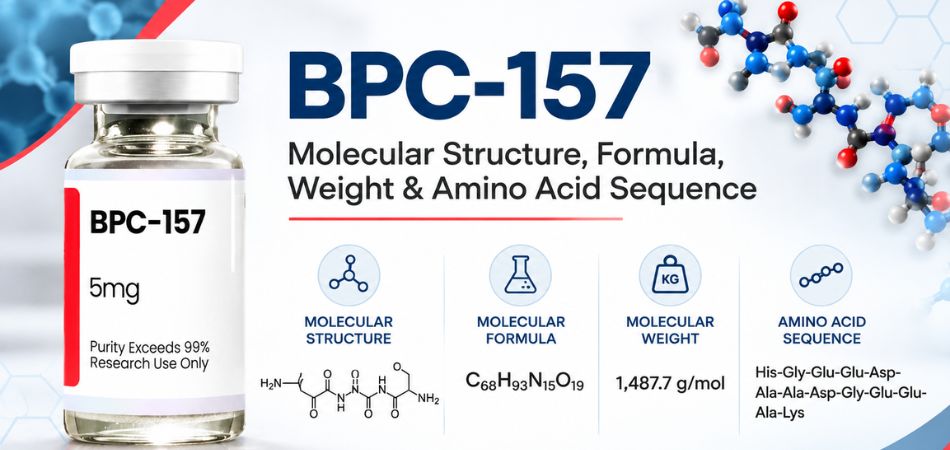
The BPC-157 molecular structure is that of a synthetic pentadecapeptide containing 15 amino acids. Its amino acid sequence is GEPPPGKPADDAGLV, and its molecular formula is C62H98N16O22.
According to PubChem, BPC-157 has a molecular weight of approximately 1419.5 g/mol and is associated with CAS number 137525-51-0. [PubChem]
Understanding the molecular structure is important when evaluating BPC-157 as a research compound because peptide sequence, molecular formula, molecular weight, identity, and analytical testing are fundamental parts of its chemical profile.
For the broader scientific context, see our BPC-157 Research: Studies, Mechanism, Structure & Properties.
What Is the BPC-157 Molecular Structure?
BPC-157 is classified as a pentadecapeptide, meaning it contains 15 amino acid residues.
Its sequence is:
GEPPPGKPADDAGLV
This sequence represents the order of amino acid residues within the peptide.
The sequence is particularly important for analytical identification because peptide identity depends on its molecular composition and sequence.
BPC-157 Amino Acid Sequence
The BPC-157 amino acid sequence is:
Gly-Glu-Pro-Pro-Pro-Gly-Lys-Pro-Ala-Asp-Asp-Ala-Gly-Leu-Val
Using the standard one-letter amino acid notation:
GEPPPGKPADDAGLV
The sequence contains:
- G — Glycine
- E — Glutamic acid
- P — Proline
- P — Proline
- P — Proline
- G — Glycine
- K — Lysine
- P — Proline
- A — Alanine
- D — Aspartic acid
- D — Aspartic acid
- A — Alanine
- G — Glycine
- L — Leucine
- V — Valine
The repeated proline residues are a notable feature of the sequence.
BPC-157 Molecular Formula
The molecular formula listed for BPC-157 is:
C62H98N16O22
This formula indicates the numbers of carbon, hydrogen, nitrogen, and oxygen atoms represented in the molecular composition.
Molecular formula is useful for analytical chemistry because it provides a chemical composition against which measured molecular mass and analytical signals can be evaluated.
PubChem lists BPC-157 under CID 9941957.
BPC-157 Molecular Weight
The molecular weight of BPC-157 is approximately:
1419.5 g/mol
Molecular weight is an important specification when working with peptides because it helps researchers interpret analytical measurements such as mass spectrometry.
The observed mass-to-charge ratio in mass spectrometry depends on the ionization state, so the molecular weight should not be confused with a single universal m/z value.
BPC-157 CAS Number
The CAS Registry Number associated with BPC-157 is:
137525-51-0
CAS numbers provide a standardized numerical identifier for chemical substances.
Researchers and laboratories may use identifiers such as CAS numbers, molecular formulas, sequences, and analytical data together when confirming the identity of a compound.
BPC-157 Chemical Profile
A basic BPC-157 chemical profile can be summarized as follows:
| Property | BPC-157 |
|---|---|
| Peptide type | Pentadecapeptide |
| Amino acid count | 15 |
| Sequence | GEPPPGKPADDAGLV |
| Molecular formula | C62H98N16O22 |
| Molecular weight | ~1419.5 g/mol |
| CAS | 137525-51-0 |
| PubChem CID | 9941957 |
These specifications provide a starting point for chemical identification.
They should be supplemented with appropriate analytical testing when evaluating a specific research batch.
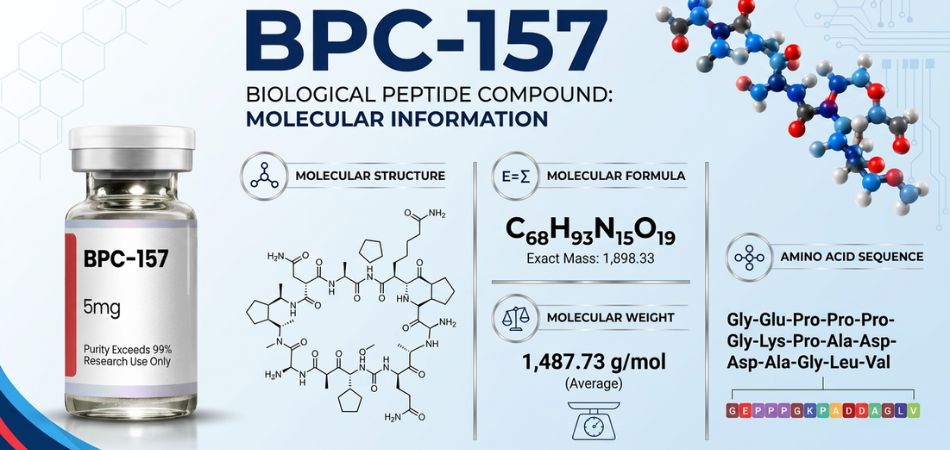
Why Molecular Structure Matters in Peptide Research
Peptide structure influences how a molecule behaves chemically and biologically.
The amino acid sequence determines the primary structure of the peptide. Researchers can then study how that structure relates to properties such as molecular interactions, stability, analytical behavior, and biological activity.
For a research compound, knowing the stated structure is therefore only one part of characterization.
Researchers may also evaluate:
- Identity
- Purity
- Molecular mass
- Degradation products
- Residual impurities
- Batch consistency
This is why analytical documentation is important alongside a peptide’s molecular specifications.
BPC-157 Structure and Analytical Testing
Molecular structure and analytical testing are closely connected.
For example, mass spectrometry can help assess whether the measured molecular mass is consistent with the expected compound.
Chromatographic techniques such as HPLC can be used to assess the presence of the target compound relative to other detectable components and estimate chromatographic purity.
A certificate of analysis may combine these and other measurements to document characteristics of a specific batch.
For more information, see How to Read a BPC-157 COA: Purity, HPLC & LC-MS Explained.
BPC-157 Molecular Structure and Stability
A peptide’s structure also matters when considering stability.
Chemical and physical conditions can affect peptide integrity, including temperature, moisture, pH, formulation, concentration, and storage conditions.
However, the molecular formula alone cannot tell you the complete stability profile of BPC-157.
Actual stability needs to be evaluated experimentally under defined conditions.
For this reason, structural information should be considered separately from storage and degradation data.
See our BPC-157 Stability: Storage, Temperature & Degradation Research page for the dedicated stability discussion.
BPC-157 Sequence and Research Identification
The amino acid sequence is particularly useful for distinguishing a peptide from unrelated compounds.
When laboratories characterize a peptide, multiple pieces of information can be considered together:
Expected sequence + expected molecular mass + analytical result + chromatographic profile
Agreement between these data points provides stronger evidence of compound identity than relying on a product name alone.
This is one reason research-grade peptide documentation should include clear analytical information.
Is BPC-157 a Protein?
No.
BPC-157 is generally classified as a peptide rather than a full protein.
The distinction is related primarily to size and molecular organization. BPC-157 consists of 15 amino acid residues, making it a relatively short peptide.
The term “protein” is commonly used for larger biological macromolecules, although the boundary between peptides and proteins can vary depending on the scientific context.
BPC-157 Pentadecapeptide
The term pentadecapeptide simply indicates a peptide containing 15 amino acid residues.
For BPC-157, those 15 residues form the sequence:
GEPPPGKPADDAGLV
This sequence is one of the defining chemical characteristics used to describe the compound.
BPC-157 Structure vs Biological Mechanism
It is important to separate two concepts.
Molecular structure describes what the compound is chemically.
Mechanism of action describes how a compound may interact with biological systems.
The sequence, molecular formula, and molecular weight describe BPC-157’s chemical identity. They do not, by themselves, prove any biological effect.
Researchers must conduct separate biochemical, cellular, animal, or human studies to investigate biological mechanisms.
Our [BPC-157 Mechanism of Action] article covers this topic separately.
BPC-157 Molecular Structure: Key Facts
The core structural information is straightforward:
- BPC-157 is a pentadecapeptide.
- It contains 15 amino acid residues.
- Its sequence is GEPPPGKPADDAGLV.
- Its molecular formula is C62H98N16O22.
- PubChem lists its molecular weight at approximately 1419.5 g/mol.
- Its CAS number is 137525-51-0.
These values are useful for research documentation and analytical characterization.
Conclusion
The BPC-157 molecular structure provides the foundation for understanding the compound’s chemical identity.
Its 15-residue sequence, molecular formula, molecular weight, and CAS identifier are important reference points for research and analytical testing.
However, structural information should not be confused with evidence of clinical effectiveness. Biological mechanisms and research findings require separate evaluation through appropriate experimental studies.
For the complete BPC-157 scientific overview, return to our BPC-157 Research.
Frequently Asked Questions
What is the BPC-157 amino acid sequence?
The BPC-157 amino acid sequence is GEPPPGKPADDAGLV.
What is the molecular weight of BPC-157?
PubChem lists the molecular weight of BPC-157 at approximately 1419.5 g/mol.
What is the molecular formula of BPC-157?
The molecular formula is C62H98N16O22.
How many amino acids are in BPC-157?
BPC-157 contains 15 amino acid residues, which is why it is classified as a pentadecapeptide.
What is the CAS number of BPC-157?
The CAS number associated with BPC-157 is 137525-51-0.
Why is the BPC-157 sequence important?
The amino acid sequence is a fundamental part of peptide identity and can be used alongside molecular-mass and analytical testing to characterize a research compound.
6 comments