
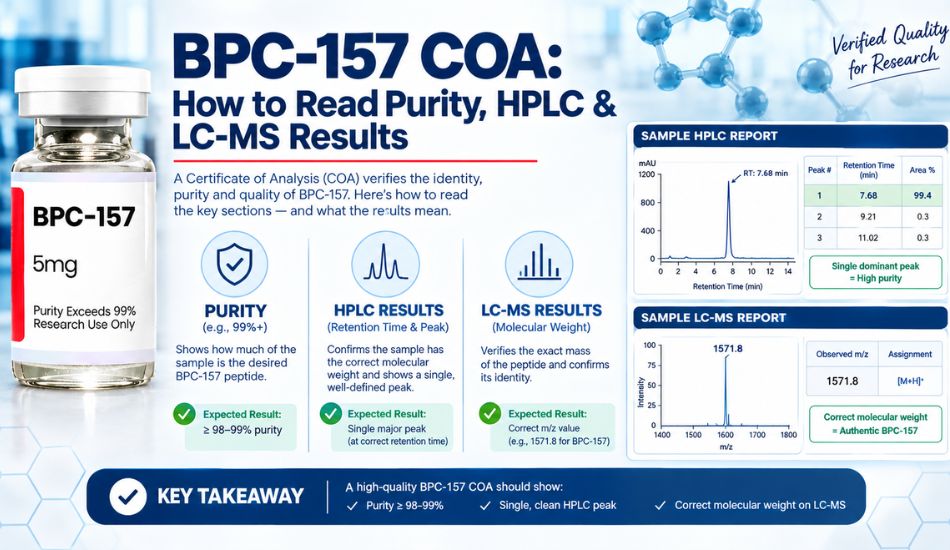
A BPC-157 COA, or Certificate of Analysis, is a laboratory document used to report analytical results associated with a particular batch of BPC-157.
A useful COA can provide information about compound identity, purity, analytical methods, batch identification, testing dates, and other specifications.
However, not every COA provides the same level of information. A document showing only a single purity percentage provides much less information than one that includes independent identity and purity testing.
When evaluating research peptides, the goal should be to determine whether the analytical documentation actually supports the stated identity and quality of the specific batch.
For the broader BPC-157 scientific profile, see our BPC-157 Research: Studies, Mechanism, Structure & Properties.
What Is a BPC-157 COA?
A Certificate of Analysis is a quality-control document associated with a specific product or batch.
The document may include:
- Product name
- Batch or lot number
- Testing date
- Test methods
- Purity result
- Identity result
- Appearance
- Quantity
- Laboratory information
- Specification limits
The exact contents vary between suppliers and laboratories.
A COA should therefore be evaluated based on the actual information it contains rather than simply the presence of the words “Certificate of Analysis.”
Why Is a BPC-157 COA Important?
A peptide’s label alone does not establish its chemical identity or purity.
Analytical testing provides evidence that can be compared against the expected characteristics of the compound.
For BPC-157, important reference information includes its molecular formula, molecular weight, and amino acid sequence.
Our BPC-157 Molecular Structure, Formula, Weight & Sequence article provides these reference specifications.
A COA can then provide batch-specific analytical results that researchers can compare with the expected profile.
BPC-157 Purity
Purity is one of the most commonly reported values on a peptide COA.
It generally represents the proportion of the detected material attributed to the target compound under the analytical method used.
A reported purity percentage should therefore be interpreted together with the testing method.
For example, a chromatographic purity result does not necessarily answer every question about:
- Peptide identity
- Residual solvents
- Heavy metals
- Endotoxins
- Microbial contamination
- Other contaminants
Purity and identity are related but different analytical questions.
What Is HPLC Testing?
HPLC stands for high-performance liquid chromatography.
It is widely used in analytical chemistry to separate components in a sample.
For peptide analysis, HPLC can help researchers evaluate the chromatographic profile of a sample and estimate the proportion associated with the target compound.
A BPC-157 COA may therefore report an HPLC purity percentage.
However, HPLC alone should not automatically be interpreted as complete proof of molecular identity.
What Is LC-MS Testing?
LC-MS combines liquid chromatography with mass spectrometry.
Liquid chromatography separates components, while mass spectrometry provides information based on mass-to-charge ratios.
This combination can provide stronger analytical characterization than relying on a single technique.
For peptide research, LC-MS can help assess whether an observed molecular mass is consistent with the expected compound.
The exact interpretation depends on the analytical method, instrument settings, sample preparation, and reported results.
HPLC vs LC-MS for BPC-157
HPLC and LC-MS answer different analytical questions.
HPLC:
- Separates components
- Provides chromatographic information
- Can be used to estimate purity
LC-MS:
- Combines chromatographic separation with mass analysis
- Helps investigate molecular mass
- Can provide additional identity information
Using complementary analytical methods can provide a more informative characterization of a research peptide.
What Should a BPC-157 COA Include?
A useful BPC-157 COA should ideally provide enough information to identify the material being tested.
Look for:
Batch or Lot Number
The batch number should correspond to the specific material being sold.
Testing Date
The date indicates when the analytical testing was performed.
Product Identification
The document should clearly identify the compound being tested.
Analytical Method
The COA should indicate which analytical method was used.
Purity Result
A reported purity value should be accompanied by information about the analytical method.
Identity Testing
The document should provide evidence that the tested material corresponds to the stated compound.
Laboratory Information
The testing organization should be identifiable.
How to Read a BPC-157 COA
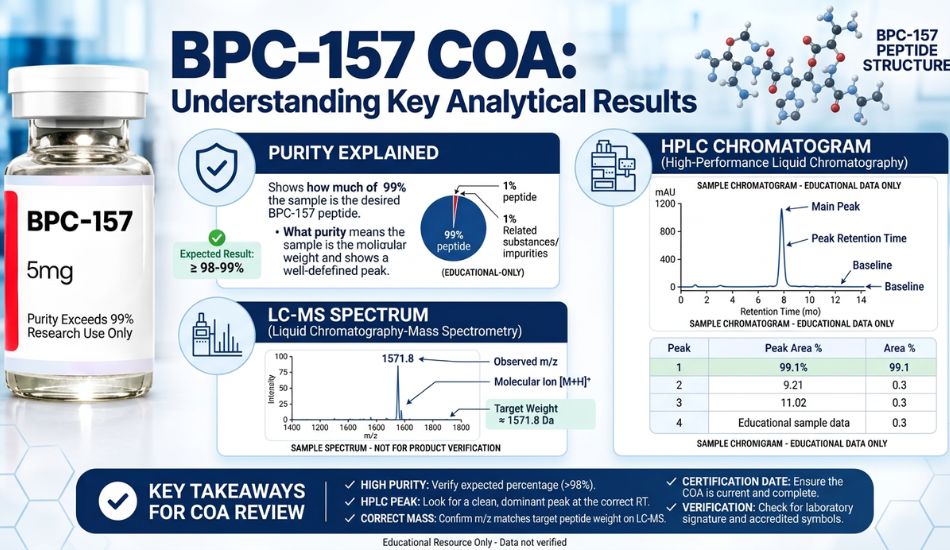
When reviewing a BPC-157 Certificate of Analysis, start with the batch or lot number and confirm that it corresponds to the material being evaluated. Then check the testing date, laboratory name, analytical methods, reported purity, and identity results.
A useful COA should make it possible to determine:
- What compound was tested
- Which batch was tested
- When the testing was performed
- Which laboratory performed the analysis
- Which analytical methods were used
- What purity result was reported
- What evidence supports compound identity
A high purity percentage should not be viewed by itself. The testing method, laboratory information, batch identification, and identity data provide important context for interpreting the result.
Does a BPC-157 COA Prove Identity?
Not necessarily.
The strength of the identity evidence depends on the analytical methods used.
A document that only reports “99% purity” without explaining the method provides limited information.
Identity confirmation can be stronger when complementary analytical information is provided, such as molecular-mass analysis alongside chromatographic data.
Researchers should evaluate the actual analytical evidence rather than relying on a headline percentage.
Does 99% Purity Mean the Peptide Is 99% Safe?
No.
This is an important distinction.
A purity percentage is an analytical measurement. It does not establish:
- Clinical safety
- Human efficacy
- Sterility
- Absence of every possible contaminant
- Long-term stability
- Regulatory approval
A research compound can have a high analytical purity result while still requiring separate evaluation for other quality or safety characteristics.
BPC-157 COA and Third-Party Testing
Third-party testing means analytical testing is performed by an external laboratory rather than solely by the manufacturer or supplier.
Independent testing can provide an additional layer of verification.
However, “third-party tested” should still be evaluated carefully.
Look for:
- Laboratory identification
- Batch number
- Testing date
- Actual analytical results
- Test methods
- Compound identity
- Purity data
A generic statement that a product is “third-party tested” is less informative than an accessible, batch-specific laboratory report.
For more information, see our Why Third-Party Testing Matters for Research Peptides guide.
How to Check a BPC-157 COA
A practical review process is:
Step 1: Check the compound name
Confirm that the COA identifies BPC-157 rather than another peptide.
Step 2: Check the batch number
Make sure the batch number matches the material being evaluated.
Step 3: Check the testing date
Determine when the analysis was performed.
Step 4: Identify the analytical methods
Look for HPLC, LC-MS, mass spectrometry, or other relevant analytical techniques.
Step 5: Review the purity result
Determine what the reported percentage actually represents.
Step 6: Review identity information
Look for analytical evidence supporting compound identity.
Step 7: Check laboratory information
Determine whether the testing organization is identifiable.
Step 8: Look for additional testing
Depending on the research requirement, additional testing may be relevant.
BPC-157 COA and Other Quality Tests
Purity and identity are only part of analytical characterization.
Depending on the intended research application, laboratories may also evaluate characteristics such as:
- Residual solvents
- Heavy metals
- Microbial contamination
- Endotoxins
- Sterility
- Water content
- Other impurities
The relevance of each test depends on the intended use and formulation.
Therefore, a COA should be evaluated according to the specific research requirements rather than by a single purity number.
COA vs Product Page Claims
A product page may make statements about purity, testing, or research quality.
A batch-specific COA provides more useful evidence because it connects analytical results to a particular lot.
This is why research buyers and laboratories should distinguish between:
Marketing claims
and
Batch-specific analytical documentation.
The latter is generally more useful for technical evaluation.
Can a COA Guarantee BPC-157 Quality?
No.
A COA provides evidence from specified tests. It does not automatically guarantee every possible quality characteristic.
The value of the document depends on:
- Test method
- Laboratory competence
- Sample integrity
- Batch traceability
- Testing scope
- Reporting quality
A strong quality system uses multiple controls rather than relying on a single document.
BPC-157 COA and Research Use
BPC-157 is an investigational research compound, and its scientific and regulatory status should be kept separate from analytical purity.
A high-purity research material does not become an FDA-approved medicine simply because it has a COA.
The COA answers a quality-control question:
What did the laboratory find in this particular batch using these analytical methods?
It does not answer:
Is BPC-157 an approved or clinically proven treatment?
These are fundamentally different questions.
Conclusion
A BPC-157 COA is most useful when it provides clear, batch-specific analytical information.
Researchers should look beyond a headline purity percentage and examine the testing method, identity evidence, batch number, laboratory information, testing date, and additional quality-control data.
HPLC can provide chromatographic purity information, while LC-MS or mass spectrometry can provide additional molecular characterization.
Frequently Asked Questions
What is a BPC-157 COA?
A BPC-157 COA is a Certificate of Analysis that reports laboratory test results for a specific BPC-157 batch.
What does BPC-157 purity mean?
Purity is an analytical measurement indicating the proportion of material identified as the target compound under a particular testing method.
Is HPLC enough to verify BPC-157?
HPLC can provide useful chromatographic information, but additional analytical testing may provide stronger evidence of molecular identity.
What does LC-MS show?
LC-MS combines liquid chromatography with mass spectrometry and can provide information about molecular mass and chromatographic characteristics.
Does a 99% BPC-157 purity result prove safety?
No. Purity does not establish clinical safety, efficacy, sterility, or regulatory approval.
What should I check first on a BPC-157 COA?
Check the compound name, batch number, testing date, laboratory information, analytical methods, purity result, and identity data.
5 comments