
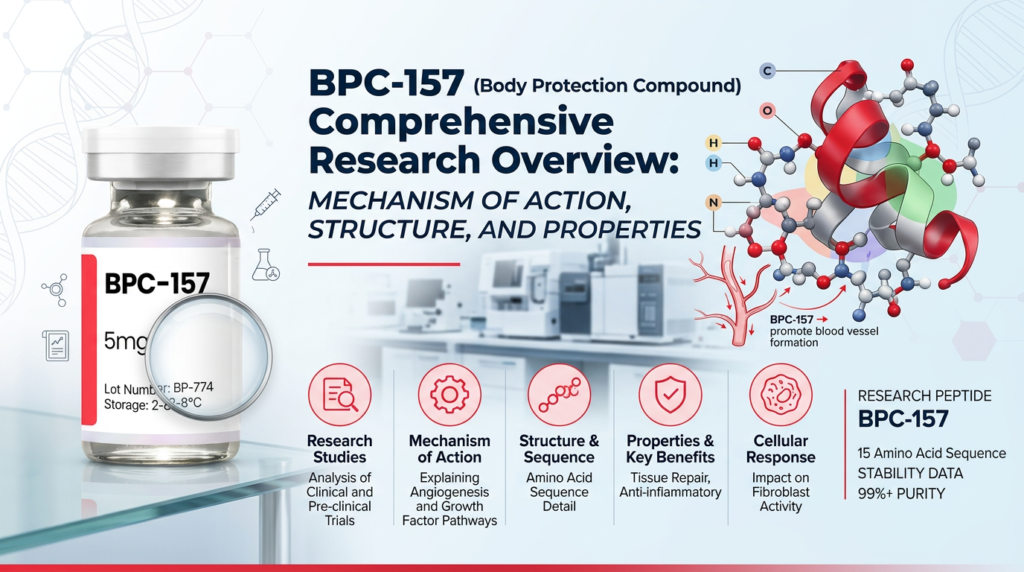
BPC-157 is a synthetic 15-amino-acid peptide that has been investigated primarily in preclinical research. Scientific studies have examined its biological activity across gastrointestinal, vascular, musculoskeletal, nervous-system, and other experimental models.
This guide provides a research-focused overview of BPC-157, including its molecular structure, properties, mechanisms investigated in laboratory studies, major research areas, stability, analytical testing, and current research limitations.
Research-use note: BPC-157 should not be presented as an established treatment for human disease. Much of the published evidence comes from animal and laboratory models, and preclinical findings cannot automatically be translated into proven human benefits.
What Is BPC-157?
BPC-157, commonly referred to as Body Protection Compound-157, is a synthetic pentadecapeptide that has attracted scientific interest because of its activity across several experimental biological models.
The compound consists of 15 amino acids with the sequence GEPPPGKPADDAGLV. PubChem lists BPC-157 under CID 9941957 and reports a molecular formula of C62H98N16O22 and a molecular weight of approximately 1419.5 g/mol.
For a more detailed explanation of the compound’s molecular characteristics, read our BPC-157 Molecular Structure guide for detailed information about its sequence, molecular formula, molecular weight, and chemical properties.
Researchers have investigated BPC-157 across several areas, including vascular function, gastrointestinal models, tissue injury, inflammation, and cellular signaling.
Explore BPC-157 Research
BPC-157 Gut & Intestinal Research
Human Research vs. Preclinical Research
Most published BPC-157 research has been conducted in preclinical models, including animal and laboratory studies. Human clinical evidence remains limited. Findings from animal or laboratory research should therefore not automatically be interpreted as demonstrating the same effects in humans.
BPC-157 Molecular Structure and Properties
BPC-157 is a pentadecapeptide, meaning it contains 15 amino acid residues.
| Property | BPC-157 |
|---|---|
| Peptide length | 15 amino acids |
| Amino acid sequence | GEPPPGKPADDAGLV |
| Molecular formula | C62H98N16O22 |
| Molecular weight | Approximately 1419.5 g/mol |
| PubChem CID | 9941957 |
| CAS number | 137525-51-0 |
The molecular information should be verified against authoritative chemical databases before being used for laboratory purposes.
The sequence and molecular composition are important for analytical characterization. Techniques such as high-performance liquid chromatography and mass spectrometry can be used to evaluate peptide material.
For a deeper explanation of peptide testing, see How to Read a Peptide COA: Purity, HPLC & LC-MS Explained.
BPC-157 Research: What Do Scientific Studies Show?
Research on BPC-157 spans several decades, with a large proportion of the available literature consisting of animal and laboratory studies.
Researchers have investigated BPC-157 in models involving:
- Gastrointestinal injury
- Tissue injury
- Blood vessel formation
- Ischemia and vascular function
- Inflammatory responses
- Musculoskeletal models
- Nervous-system models
- Organ injury
- Nitric oxide signaling
- Oxidative stress
For a deeper review of the available evidence, see BPC-157 Research: What Do Scientific Studies Show?.
This distinction between preclinical findings and established clinical evidence is important. Experimental observations can identify biological effects and potential mechanisms, but they do not automatically establish clinical efficacy or safety in humans.
BPC-157 Mechanism of Action
There is no single universally established mechanism that explains all reported BPC-157 activity.
Researchers have investigated several biological pathways and processes, including angiogenesis, nitric oxide signaling, endothelial activity, inflammatory responses, and cellular signaling.
For a detailed explanation, see BPC-157 Mechanism of Action: What Researchers Have Studied.
Angiogenesis and Vascular Research
Angiogenesis is the formation of new blood vessels from existing vascular structures.
BPC-157 has been investigated for its effects on angiogenesis and vascular repair in experimental models. Research has examined relationships involving vascular endothelial growth factor receptor 2 (VEGFR2) and endothelial-cell activity.
More recent research has investigated additional molecular pathways that may contribute to these observations.
These findings remain experimental and should not be interpreted as proof of a clinically established vascular or tissue-repair treatment.
Nitric Oxide Signaling
The nitric oxide system has also been investigated in BPC-157 research.
Experimental studies have examined relationships between BPC-157 and nitric oxide signaling in vascular and organ-injury models.
Research involving human-derived tissue has also investigated vascular responses associated with endothelial nitric oxide signaling.
These findings provide useful mechanistic information but do not establish a therapeutic effect in humans.
BPC-157 and Tissue Research
One of the major areas of BPC-157 research involves experimental tissue-injury models.
Researchers have investigated BPC-157 in models involving:
- Muscle
- Tendon
- Ligament
- Bone
- Gastrointestinal tissue
- Blood vessels
- Nervous tissue
Research has examined processes involving angiogenesis, fibroblast activity, collagen-related processes, inflammatory signaling, and microvascular function.
For a focused discussion of gastrointestinal research, see our BPC-157 Gut Healing & Intestinal Barrier Research guide.
It is important to distinguish experimental tissue-repair findings from proven human clinical outcomes. Research in animals or laboratory systems does not establish that the same effects occur in humans.
BPC-157 and Gastrointestinal Research
BPC-157 has a long history of investigation in gastrointestinal models.
Experimental studies have examined models involving the:
- Stomach
- Esophagus
- Intestinal tract
- Duodenum
- Mesenteric circulation
Researchers have investigated changes involving tissue injury, vascular responses, and inflammatory processes.
Our BPC-157 Gut Healing & Intestinal Barrier Research article provides a more detailed look at this research area and the evidence limitations surrounding it.
BPC-157 and Vascular Research
Vascular research is another important area of investigation.
Experimental studies have examined BPC-157 in models involving:
- Blood vessel formation
- Ischemia
- Vascular injury
- Blood-flow changes
- Endothelial function
- Nitric oxide signaling
Research involving human-derived vascular tissue has also provided additional experimental information about possible endothelial responses.
However, these findings should still be interpreted within the broader context of limited human clinical evidence.
BPC-157 and Inflammation Research
Inflammatory signaling has also been investigated in BPC-157 research.
Preclinical studies have reported changes in inflammatory markers and biological pathways in experimental injury models.
These observations are scientifically relevant, but they should not be interpreted as evidence that BPC-157 is an established anti-inflammatory treatment.
BPC-157 Stability and Formulation
Peptide stability is an important consideration in laboratory research.
Researchers must distinguish between:
- Chemical stability
- Physical stability
- Stability in solution
- Stability in biological environments
- Stability during storage
- Stability after formulation or reconstitution
For a broader explanation of lyophilized peptides, see What Does Lyophilized Mean? Peptide Stability Explained.
For a detailed discussion of these factors, see our BPC-157 Stability: Storage, Temperature & Degradation Research guide for more information about the specific stability questions researchers may encounter.
Avoid making unsupported claims about exact shelf life or storage duration unless those claims are supported by appropriate analytical stability data.
How Is BPC-157 Tested?
Analytical testing is important when evaluating the identity and quality of research peptide material.
Common analytical approaches include HPLC and LC-MS.
HPLC
High-performance liquid chromatography can be used to evaluate chromatographic purity and identify additional peaks.
A reported purity percentage should therefore be understood in the context of the analytical method and accompanying documentation.
LC-MS
Liquid chromatography-mass spectrometry can provide molecular-mass information and support compound identification.
Using complementary analytical methods can provide a more informative characterization profile than relying on a single reported purity number.
Certificate of Analysis
A BPC-157 Certificate of Analysis may include information such as:
- Product or compound name
- Batch or lot number
- Test date
- Purity result
- Analytical method
- Molecular-mass information
- Testing laboratory
- Additional quality-control results
For a detailed explanation, see How to Read a Peptide COA: Purity, HPLC & LC-MS Explained.
You can also link this section to your existing Why Third-Party Testing Matters for Research Peptides article to explain why independent analytical testing can be relevant when evaluating research materials.
BPC-157 vs TB-500
BPC-157 and TB-500 are frequently discussed together because both have been investigated in research involving tissue and vascular processes.
However, they are different peptide entities with different molecular structures and research histories.
| Research factor | BPC-157 | TB-500 |
|---|---|---|
| Peptide type | Synthetic pentadecapeptide | Peptide associated with thymosin-beta-4 research |
| Research areas | Gastrointestinal, vascular, tissue and other experimental models | Tissue, cellular and vascular research |
| Evidence base | Predominantly preclinical | Predominantly preclinical |
| Molecular structure | Distinct 15-amino-acid sequence | Different peptide sequence/structure |
| Human evidence | Limited | Limited |
| Clinical status | Not an established approved therapy | Not an established approved therapy |
For the complete comparison, see BPC-157 vs TB-500: Scientific Research Comparison.
BPC-157 Combination Research
BPC-157 is also frequently discussed alongside other research peptides.
Your existing BPC-157 Combination Protocols for Laboratory Research article can cover this subject separately.
Keep this topic separate from the main pillar because combination research has a different search intent from basic BPC-157 structure, mechanism, and evidence.
The pillar should provide the overview, while the combination article should provide the deeper discussion.
BPC-157 Safety and Research Limitations
The existence of extensive preclinical research does not mean that BPC-157 has an established human safety or efficacy profile.
Important limitations include:
- Limited human clinical evidence
- Incomplete human pharmacokinetic data
- Limited long-term human safety data
- Differences between animal models and human biology
- Limited pharmaceutical formulation data
- Uncertainty surrounding therapeutic applications
Therefore, BPC-157 content should clearly distinguish between:
What researchers have observed
and
What has been demonstrated clinically.
This distinction should be maintained across all Hotspan BPC-157 content.
Is BPC-157 FDA Approved?
BPC-157 should not be described as an FDA-approved treatment.
The available evidence does not support presenting BPC-157 as an approved therapy for treating human medical conditions.
For broader information about research-use-only products, see Research Use Only Peptides: Meaning, Regulations & Laboratory Use.
For regulatory information specifically related to research peptides in the United States, you can also reference Are Research Peptides Legal in the USA? 2026 Guide.
BPC-157 Research: Key Takeaways
BPC-157 is a synthetic 15-amino-acid peptide that has generated substantial scientific interest across multiple preclinical research models.
The key points are:
- BPC-157 contains 15 amino acids.
- Its reported sequence is GEPPPGKPADDAGLV.
- PubChem lists its molecular formula as C62H98N16O22.
- Its reported molecular weight is approximately 1419.5 g/mol.
- Research has examined gastrointestinal, vascular, musculoskeletal, nervous-system, and other experimental models.
- Researchers have investigated mechanisms involving angiogenesis, nitric oxide signaling, endothelial activity, and other cellular pathways.
- Much of the available evidence remains preclinical.
- Human pharmacokinetic, safety, and efficacy data remain limited.
- HPLC and LC-MS can be used as analytical tools for peptide characterization.
- BPC-157 should not be presented as an established FDA-approved medical treatment.
The most useful way to evaluate BPC-157 is to separate experimental findings from clinically established evidence.
Frequently Asked Questions About BPC-157
What is BPC-157?
BPC-157 is a synthetic 15-amino-acid peptide that has been investigated primarily in preclinical research involving gastrointestinal, vascular, tissue, and other biological models.
What is the amino acid sequence of BPC-157?
The reported BPC-157 sequence is GEPPPGKPADDAGLV.
For detailed molecular information, see BPC-157 Molecular Structure, Formula, Weight & Amino Acid Sequence.
What is the molecular weight of BPC-157?
The reported molecular weight is approximately 1419.5 g/mol.
What has BPC-157 been studied for?
Researchers have investigated BPC-157 in experimental models involving gastrointestinal injury, vascular function, angiogenesis, tissue injury, inflammation, and other biological processes.
See BPC-157 Research: What Do Scientific Studies Show? for a deeper review.
How is BPC-157 analyzed?
Analytical methods such as HPLC and LC-MS can be used to evaluate peptide purity and support compound identification.
See How to Read a Peptide COA: Purity, HPLC & LC-MS Explained for more information.
What does research-use-only mean?
Research-use-only generally indicates that a product is intended for laboratory or scientific research and should not be represented as a product for diagnosing, treating, curing, or preventing disease.
See Research Use Only Peptides: Meaning, Regulations & Laboratory Use.
What is the difference between BPC-157 and TB-500?
They are different peptide entities with different structures and research histories. Both have been investigated in preclinical research, but they should not be treated as interchangeable compounds.
Scientific References
Use primary scientific literature and authoritative databases when supporting claims about BPC-157.
Recommended source types include:
- PubMed
- PubChem
- Peer-reviewed scientific journals
- ClinicalTrials.gov where relevant
- Regulatory sources
Scientific references should be added directly to the relevant claims rather than relying on unsupported statements or secondary peptide websites.
For product-specific information, testing documentation, and research-use details, see our BPC-157 product guide
7 comments